

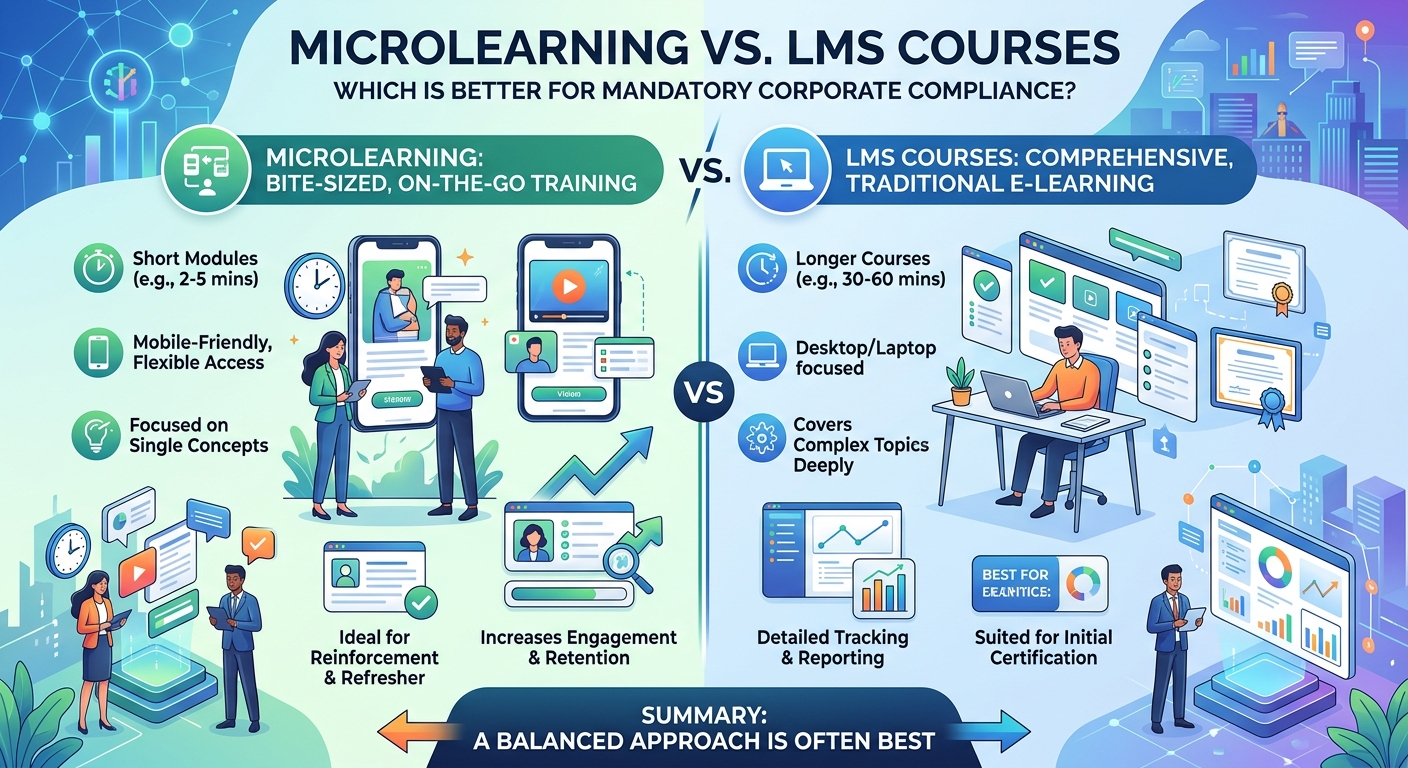
Microlearning vs. Comprehensive Learning Platforms: Optimizing Mandatory Corporate Compliance Training
In today's rapidly evolving corporate landscape, mandatory compliance training is not just a formality; it's a critical safeguard against legal repercussions, reputational damage, and operational inefficiencies. For Vice Presidents, Directors, and Senior Managers in Learning & Development, the challenge lies in delivering this essential training effectively, engagingly, and efficiently across diverse industries—from Banking and Finance to Pharma and Oil & Gas. The perpetual debate in eLearning circles often boils down to two prominent methodologies: the focused power of microlearning versus the comprehensive structure of traditional learning platforms.
Which approach truly serves your organization better for mandatory compliance? Let's delve into a detailed comparison to help you make an informed decision.
Understanding the Imperative of Corporate Compliance Training
Mandatory compliance training covers a vast array of topics: anti-money laundering (AML), data privacy (GDPR, CCPA), anti-harassment, ethics, health and safety (OSHA), and industry-specific regulations. The goal is to ensure every employee understands and adheres to the rules that govern their role and the organization as a whole. Failure to comply can result in hefty fines, legal battles, and a significant blow to employee morale and public trust.
However, simply delivering training isn't enough. It must be absorbed, understood, and applied. This is where the delivery method becomes paramount.
Traditional Comprehensive Learning Platforms for Compliance
For decades, organizations have relied on robust, centralized systems to manage, deliver, and track their extensive training programs. These platforms are designed to host large courses, often structured with multiple modules, assessments, and certifications, providing a single source of truth for all learning activities.
Key Attributes and Benefits:
- Centralized Management: Offers a consolidated repository for all training materials and comprehensive administrative controls.
- In-depth Coverage: Capable of delivering extensive content necessary for complex regulatory topics, ensuring no detail is overlooked.
- Robust Tracking & Reporting: Provides detailed audit trails, completion rates, and assessment scores, crucial for regulatory compliance and internal accountability.
- Structured Learning Paths: Facilitates sequential learning, guiding employees through a predefined curriculum.
Challenges and Considerations for L&D Leaders:
Many L&D leaders often ponder: What are the primary obstacles in maintaining learner engagement with extensive, mandatory courses? Key issues include:
- Learner Fatigue: Long courses can lead to decreased attention spans, lower retention rates, and a perception of training as a chore.
- Time Commitment: Requiring employees to dedicate hours away from their core tasks can be costly and disruptive, especially in fast-paced industries like Retail or Hospitality.
- Update Latency: Updating large courses with new regulations can be time-consuming and cumbersome, potentially delaying critical information dissemination.
- Accessibility: While often web-based, extensive content might not be easily digestible on mobile devices, impacting access for a mobile workforce.
Another crucial question for organizations with a global footprint: When considering a global workforce, what challenges arise in ensuring consistent regulatory adherence across different regions using traditional platforms?
The Rise of Microlearning for Compliance
Microlearning breaks down complex information into small, digestible, focused chunks—typically 3-10 minutes in length. These bite-sized modules can take various forms: short videos, interactive quizzes, infographics, or brief articles, each addressing a single learning objective.
Key Attributes and Benefits:
- Enhanced Engagement: Short, focused content is less intimidating and more likely to hold learner attention, increasing completion rates.
- Improved Retention: Studies suggest that spaced repetition of micro-content significantly boosts information recall and long-term retention.
- Flexibility & Accessibility: Ideal for "just-in-time" learning, employees can access modules whenever and wherever they need, often on mobile devices. This is particularly valuable in dynamic sectors like Sales and Health Care.
- Agility in Updates: New regulations or policy changes can be quickly integrated and deployed as standalone micro-modules, ensuring timely compliance.
- Cost-Effective Production: Developing shorter modules can often be less expensive and faster than creating lengthy courses.
Challenges and Considerations for L&D Leaders:
While powerful, microlearning isn't without its questions: Can micro-segments truly cover the depth required for intricate legal and ethical guidelines? Potential challenges include:
- Potential for Fragmentation: Without a well-designed curriculum, micro-modules might appear disconnected, hindering a holistic understanding of complex topics.
- Scope Limitation: Extremely complex topics might require a more extensive initial explanation that microlearning alone might struggle to provide without a broader context.
- Design Intensity: Creating highly effective, self-contained micro-content often requires expert instructional design to ensure clarity and impact.
Another common query: How can dynamic, short-form content be deployed effectively across geographically diverse teams?
Microlearning vs. Comprehensive Platforms: A Head-to-Head Comparison
Let's weigh these two approaches against critical L&D metrics:
Engagement & Retention
- Comprehensive Platforms: Risk of disengagement due to length, leading to "click-through" compliance without true understanding.
- Microlearning: Higher engagement, better retention due to focus and brevity. An Microlearning LMS can further enhance this with personalized pathways.
Time & Cost Efficiency
- Comprehensive Platforms: Significant upfront time and cost for development and deployment; ongoing time commitment from learners.
- Microlearning: Faster to develop and deploy; less time required from learners, leading to higher productivity. Which training methodology offers faster deployment for urgent regulatory updates? Microlearning often wins here.
Adaptability & Updates
- Comprehensive Platforms: Updates can be slow and resource-intensive, potentially creating compliance gaps.
- Microlearning: Highly agile; individual modules can be updated or replaced quickly to reflect regulatory changes, crucial in sectors like Finance and Pharma.
Tracking & Reporting
- Comprehensive Platforms: Excellent for detailed, auditable records of extensive course completion.
- Microlearning: Modern platforms for micro-content also offer sophisticated tracking and reporting, sometimes even more granular (e.g., specific module completion, quiz scores).
Leveraging AI for Enhanced Compliance Training
Regardless of whether you lean towards microlearning or traditional courses, artificial intelligence is revolutionizing how we deliver and consume compliance training. For instance, an AI Powered Authoring Tool can dramatically speed up content creation and personalization.
Consider the question: How can artificial intelligence personalize compliance education for individual roles?
- Personalized Learning Paths: AI can analyze an employee's role, past performance, and specific compliance risks to deliver tailored content, ensuring relevance. This is a core tenet of Adaptive Learning.
- Intelligent Content Curation: AI can suggest relevant micro-modules or sections of larger courses based on an employee's interactions and knowledge gaps.
- Predictive Analytics: AI can identify employees or departments at higher risk of non-compliance based on engagement data, allowing for proactive intervention. This directly supports Risk-focused Training strategies.
- Gamification: AI can drive dynamic and engaging experiences. What role does gamification play in boosting compliance training effectiveness across different demographics? A Gamified LMS, powered by AI, can offer personalized challenges and rewards, making mandatory training more enjoyable and impactful.
Making the Right Decision for Your Organization
The "better" approach isn't a one-size-fits-all answer. It depends heavily on your organization's specific needs, culture, and the nature of the compliance topics:
- For foundational, highly complex topics requiring deep dives (e.g., initial certifications in Banking or Pharma), a comprehensive course might be necessary, potentially augmented by microlearning for reinforcement.
- For ongoing reinforcement, policy updates, specific incident training, or just-in-time refreshers, microlearning is exceptionally effective. It's ideal for keeping employees aware of dynamic regulations in industries like Oil & Gas or responding to new privacy laws in Health Care.
- The Blended Approach: Many organizations find the optimal solution in a blended learning strategy. This combines the structured depth of comprehensive courses for initial learning with the agility and engagement of microlearning for reinforcement, knowledge checks, and updates.
When implementing, consider your audience's learning preferences and the technical capabilities of your existing platforms. The seamless integration of microlearning capabilities into your overall learning ecosystem is key.
Conclusion
For L&D leaders navigating the complexities of corporate compliance, the choice between microlearning and comprehensive learning platforms is a strategic one. While traditional systems provide a robust framework for extensive content and audit trails, microlearning excels in engagement, retention, and adaptability—qualities increasingly vital in our fast-paced world. By understanding the strengths and weaknesses of each and exploring how AI can elevate both, you can design a compliance training strategy that not only meets regulatory requirements but also fosters a truly compliant, knowledgeable, and engaged workforce.
Ultimately, the most effective strategy often involves leveraging the best of both worlds, creating a dynamic, adaptive learning environment that protects your organization and empowers your employees.
.jpg)


