

Mastering Knowledge Retention: Essential Strategies for L&D Leaders
In the dynamic landscape of corporate learning and development, the true measure of training success extends far beyond mere delivery. For Vice Presidents, Directors, and Senior Managers of L&D, the critical question isn't just "Was the training delivered?" but "Was the knowledge retained, and is it being applied effectively?" Across industries like Compliance, Sales, Banking, Finance, Insurance, Retail, Pharma, Healthcare, Hospitality, Oil and Gas, and Mining, ensuring employees not only learn but also remember and utilize crucial information is paramount for operational excellence, risk mitigation, and competitive advantage. This article delves into robust strategies and technological solutions that empower trainers to accurately measure knowledge retention after training delivery, transforming learning from an event into a continuous, impactful process.
Why Measuring Knowledge Retention is Indispensable for Your Organization
Effective training represents a significant investment of time, resources, and capital. Without concrete methods to gauge knowledge retention, organizations risk squandering these investments on initiatives that yield little long-term behavioral change or performance improvement. For L&D leaders, understanding retention rates offers invaluable insights:
- Validating Training ROI: Demonstrating the tangible return on investment by linking retained knowledge to improved performance metrics.
- Identifying Gaps: Pinpointing areas where content, delivery methods, or learner engagement might be falling short.
- Optimizing Future Training: Using data-driven insights to refine curricula, adapt learning modalities, and enhance overall training effectiveness.
- Ensuring Compliance: In highly regulated sectors like Finance, Pharma, and Healthcare, verifiable knowledge retention is critical for meeting regulatory requirements and avoiding costly penalties.
As L&D professionals, how can we move beyond anecdotal evidence to concrete data when assessing what our teams truly remember and apply?
Key Strategies for Measuring Knowledge Retention
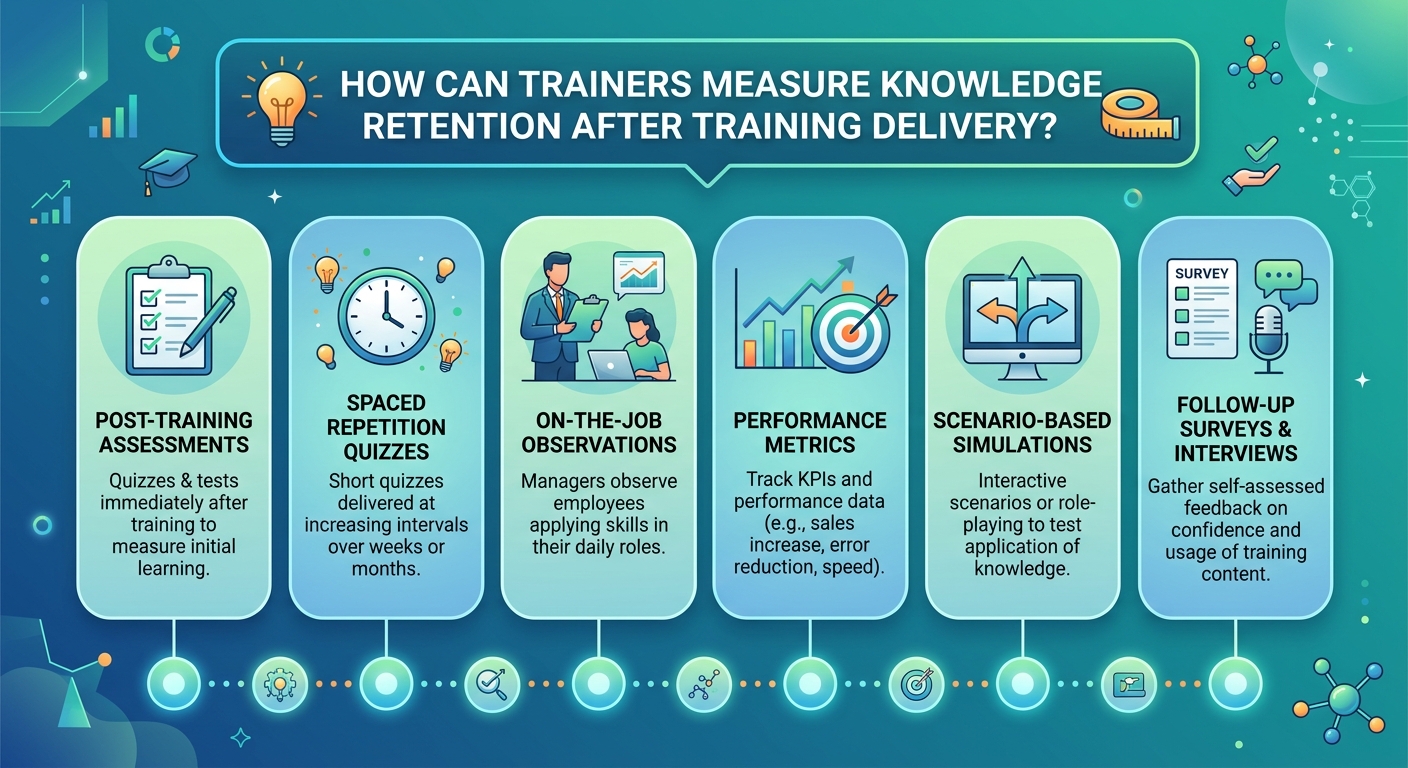
1. Pre- and Post-Assessments with Strategic Intervals
While basic pre- and post-assessments are standard, their effectiveness in measuring retention is amplified when coupled with strategic timing. Administering an assessment immediately after training, and then again weeks or even months later, provides a clearer picture of long-term recall. The delta between the immediate post-test and the delayed test reveals the 'forgetting curve' for your specific content and audience.
- Utilize diverse question types: multiple-choice, true/false, short answer, and scenario-based questions to test different levels of understanding.
- Focus on application-oriented questions that require learners to think critically, not just recall facts.
2. Spaced Repetition and Micro-Quizzing
The science of learning strongly supports spaced repetition for bolstering long-term memory. Instead of a single, large assessment, integrate frequent, short quizzes or challenges distributed over time. These can be delivered via a Microlearning LMS, allowing learners to revisit key concepts in digestible chunks.
Can advanced analytical tools predict which learners might struggle with retaining crucial information? Yes, modern learning management software can track performance on these micro-quizzes, flagging individuals or topics that require further attention. This proactive approach helps stem knowledge decay before it becomes a significant issue.
3. Performance Metrics and On-the-Job Application
The ultimate test of knowledge retention lies in its application. For Sales teams, this might mean tracking conversion rates post-product training. In Banking, it could involve fewer errors in transaction processing. For Healthcare, it’s about adherence to new protocols. Collaborate with operational managers to identify key performance indicators (KPIs) directly impacted by the training content.
- Behavioral Checklists: For skills-based training, supervisors can use checklists to observe if new behaviors are being consistently applied.
- Peer Reviews: Encourage colleagues to provide feedback on the application of learned skills, especially in collaborative environments.
What is the most effective way to track employee learning progress and link it directly to job performance? A comprehensive learning management system that integrates with HR and performance management systems can provide a holistic view.
4. Surveys and Qualitative Feedback
While quantitative data is crucial, don't underestimate the power of qualitative insights. Post-training surveys (immediate and delayed) can gather valuable perspectives on perceived retention, confidence in applying new knowledge, and practical challenges faced.
- Ask learners to rate their confidence in applying specific skills or knowledge areas.
- Inquire about real-world scenarios where they've had to use the learned material.
- Conduct focus groups or one-on-one interviews to delve deeper into retention challenges and successes.
5. Observational Assessments and Simulations
For training that involves practical skills—common in Hospitality, Manufacturing, or Oil and Gas—direct observation is indispensable. Supervisors or designated assessors can evaluate learners performing tasks in a controlled or real-world environment.
Simulations and scenario-based learning offer a safe space to test knowledge application under pressure. A Gamified LMS can provide engaging simulations that mimic real-world challenges, such as handling customer complaints or responding to a safety incident, providing immediate feedback and data on decision-making.
Leveraging Technology for Enhanced Retention Measurement
Modern eLearning solutions and intelligent platforms have revolutionized how L&D leaders can approach knowledge retention. A robust enterprise learning management system is no longer just a content repository; it's a strategic tool for measurement and analysis.
The Power of a Modern LMS
A sophisticated MaxLearn LMS provides analytics dashboards that track learner progress, assessment scores over time, and engagement levels. This data helps identify patterns of retention and areas for improvement. A cloud based learning management system ensures accessibility for global teams, crucial for industries like Mining or Pharma with distributed workforces.
Adaptive Learning Paths
How can intelligent systems personalize the learning journey and optimize knowledge recall? Adaptive Learning tailors content delivery based on a learner's performance and knowledge gaps. If a learner struggles with a concept during a quiz, the system can automatically assign additional resources or remedial modules. This personalized reinforcement significantly boosts retention by addressing individual needs proactively.
AI-Powered Content and Assessment Creation
The advent of an AI Powered Authoring Tool is transforming content development. These tools can not only help create engaging learning content management system materials but also generate intelligent assessments that adapt difficulty based on learner responses, further refining retention measurement. For Risk-focused Training in sectors like Finance or Insurance, this ensures critical compliance knowledge is not just learned but ingrained.
Analytics from a Learning Content Management System (LCMS)
Beyond the LMS, a dedicated LCMS offers deeper insights into content effectiveness. By analyzing which modules or topics lead to higher retention rates, L&D teams can continuously optimize their training materials. This is vital for maintaining a relevant and impactful learning management system experience.
Conclusion
For L&D Vice Presidents, Directors, and Managers, measuring knowledge retention is not merely an administrative task; it is a strategic imperative that directly impacts organizational performance, compliance, and competitive edge. By moving beyond traditional methods and embracing a holistic approach that combines structured assessments, ongoing reinforcement, performance linkage, and advanced technology, trainers can gain invaluable insights into the true impact of their programs.
Investing in a sophisticated learning management software that supports Microlearning LMS, Gamified LMS features, and Adaptive Learning capabilities is no longer a luxury but a necessity. These tools, coupled with smart measurement strategies, empower L&D leaders to demonstrate tangible ROI, foster a culture of continuous learning, and ensure that crucial knowledge isn't just delivered, but truly retained and applied throughout the enterprise.
How can global teams ensure consistent compliance training retention across different regions? A powerful, cloud based learning management system like MaxLearn LMS provides the centralized platform and analytical capabilities needed to standardize training delivery and track retention effectively across diverse geographical and operational landscapes.
.jpg)


