

How Fast Do Employees Forget Training? The Science of Knowledge Decay Explained
In the dynamic landscape of modern business, continuous learning is not just an advantage—it's a necessity. Yet, for many Vice Presidents, Directors, and Senior Managers in Learning & Development, a pervasive and costly challenge persists: the rapid erosion of newly acquired knowledge. Employees sit through extensive training sessions, absorb critical information, and then, within weeks or even days, much of it fades into the ether. This phenomenon, known as knowledge decay, represents a significant drain on resources and a barrier to achieving organizational goals, whether in critical areas like Compliance, Sales, Banking, Finance, Insurance, or Health care.
Understanding the science behind how fast employees forget training is the first step towards building more effective, enduring learning programs. This article delves into the cognitive mechanisms of knowledge decay and offers strategic, technology-driven solutions to ensure your training investments yield lasting results.
The Science Behind Knowledge Decay: Ebbinghaus's Forgetting Curve
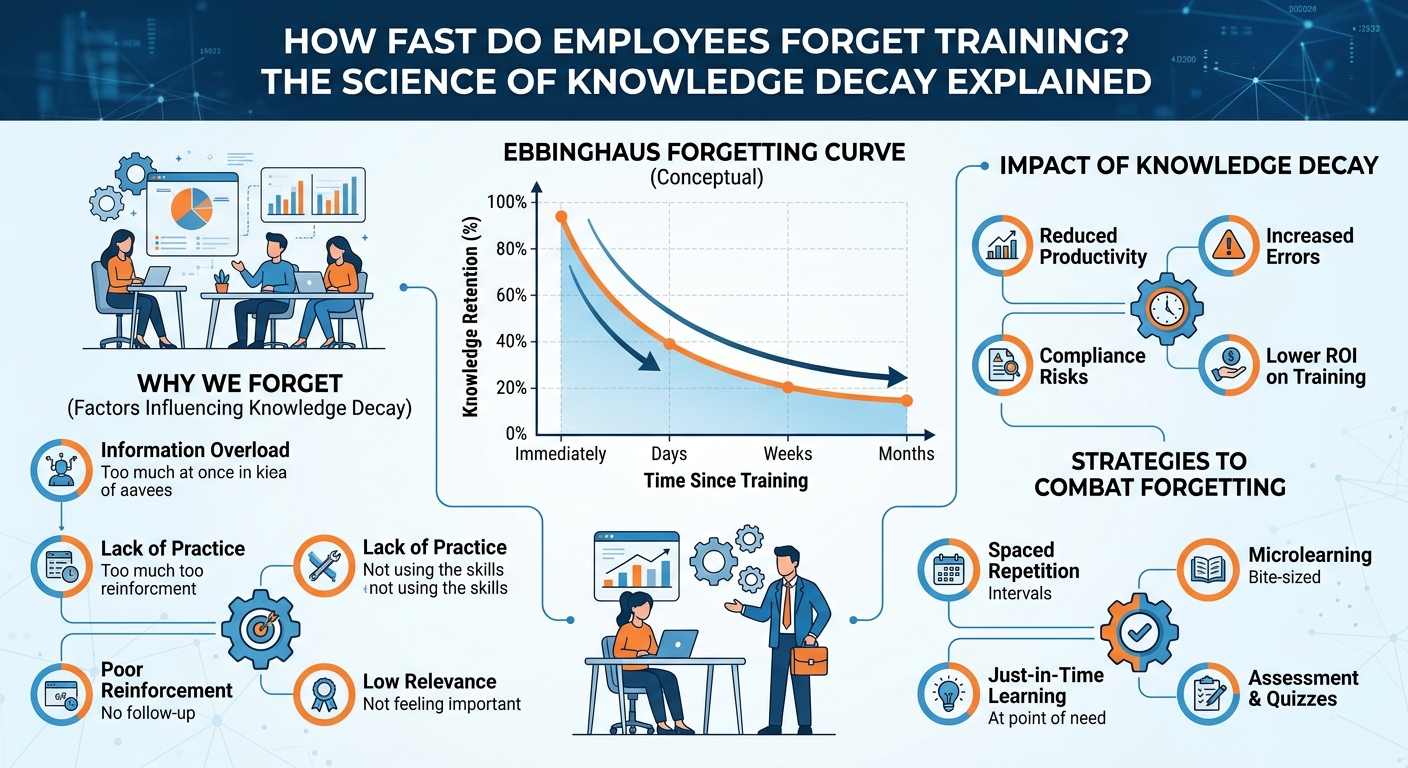
The concept of knowledge decay is most famously illustrated by Hermann Ebbinghaus's Forgetting Curve. In the late 19th century, Ebbinghaus conducted groundbreaking research demonstrating that the human brain rapidly loses much of what it learns if that knowledge isn't reinforced. His findings revealed that within just one hour, people forget approximately 50% of new information. Within 24 hours, that figure can climb to 70%, and after a week, it can be as high as 90%.
This isn't a sign of poor intelligence; it's a natural function of how our brains manage information. Our minds prioritize what to retain based on relevance, emotional impact, and most importantly, repeated exposure and application. Without regular recall and application, new information struggles to move from short-term to long-term memory, eventually becoming inaccessible.
This rapid decline has profound implications for corporate training. A week-long onboarding program, a crucial Compliance certification course, or a new product training for Sales teams could see much of its impact vanish almost as quickly as it was delivered, unless strategic interventions are put in place.
Question: Can advanced analytics predict which employees are most likely to forget specific training content?
Answer: Yes, modern learning platforms can leverage data analytics and machine learning to identify patterns in learner engagement, performance, and interaction with content. By analyzing these factors, such systems can predict at-risk learners or topics where knowledge decay is more probable, allowing L&D teams to intervene with targeted reinforcement.
Why Traditional Training Fails to Stick
Traditional training methodologies often inadvertently exacerbate the forgetting curve. Here are some common pitfalls:
- Information Overload: Cramming too much information into lengthy sessions overwhelms learners, making retention difficult.
- Lack of Relevance: Generic content that doesn't directly apply to an employee's daily tasks or roles (e.g., in Pharma, Oil and Gas, or Mining) is quickly deemed irrelevant and forgotten.
- Passive Learning: Lectures and read-only materials without active engagement or opportunities for practice lead to superficial understanding.
- Absence of Reinforcement: Once a training session ends, there's often no follow-up, leaving learned material to decay unchecked.
- Infrequent Updates: In fast-evolving industries like Finance or Health care, outdated content quickly loses its value and impact.
Strategies to Combat the Forgetting Curve
To overcome knowledge decay, L&D professionals must shift from one-off events to continuous learning ecosystems. Here's how:
Embrace Microlearning
Microlearning breaks down complex topics into bite-sized, easily digestible modules. Instead of a two-hour webinar, employees receive short, focused bursts of information—perhaps a 5-minute video, an interactive quiz, or a quick infographic. This approach aligns perfectly with modern attention spans and busy work schedules, making it ideal for industries like Retail or Hospitality where time is always a constraint. Implementing a robust Microlearning LMS allows for efficient delivery and tracking of these targeted learning units.
Leverage Gamification
Introducing game-like elements such as points, badges, leaderboards, and challenges transforms training into an engaging and motivating experience. Gamification taps into intrinsic human desires for achievement and competition, making learning more enjoyable and memorable. This is particularly effective for driving engagement in routine but critical tasks in Compliance or customer service in Banking. A Gamified LMS can significantly boost participation and knowledge retention.
Implement Adaptive Learning Paths
Not all employees start from the same knowledge base or learn at the same pace. Adaptive Learning tailors the learning experience to each individual, assessing their current knowledge and skills, then dynamically adjusting the content and pace to meet their specific needs. This personalized approach ensures learners receive the right content at the right time, preventing both boredom for advanced learners and frustration for those needing more support, optimizing the learning journey for maximum retention.
Utilize AI for Content Creation and Delivery
Artificial intelligence is revolutionizing how training content is developed and distributed. An AI Powered Authoring Tool can streamline content creation, suggest relevant topics, and even personalize learning paths based on an individual's performance and job role. AI can also facilitate intelligent content delivery, pushing timely reminders, adaptive quizzes, or contextual learning snippets directly to employees when they need them most, reinforcing knowledge at critical junctures, especially in fast-paced Sales environments.
Question: How can machine learning enhance the personalization of employee training beyond basic adaptive paths?
Answer: Machine learning algorithms can analyze vast datasets of user behavior, performance data, and even sentiment analysis to create hyper-personalized learning experiences. This includes dynamically generating new content variations, suggesting peer learning opportunities, optimizing the timing of content delivery based on individual peak performance times, and even proactively identifying skill gaps before they impact job performance.
Focus on Risk-focused Training
For industries like Compliance, Pharma, Finance, and Banking, certain knowledge areas carry higher risks if forgotten. Risk-focused Training prioritizes critical information, ensuring that content related to regulations, safety protocols, or sensitive customer interactions receives consistent and rigorous reinforcement. By identifying high-risk areas, L&D teams can allocate resources more effectively, applying techniques like spaced repetition and regular assessments to bolster retention where it matters most for business growth and regulatory adherence.
The Role of a Robust Learning Management System
Implementing these strategies effectively requires a sophisticated learning platform. A modern LMS (Learning Management System) is the backbone of any successful continuous learning program. It’s more than just a repository for courses; it’s an integrated ecosystem that supports content delivery, learner engagement, and performance tracking. An enterprise learning management solution provides the tools needed to combat knowledge decay across diverse industries.
A cutting-edge learning management software or learning content management system (LCMS) enables L&D professionals to:
- Deliver microlearning modules on demand.
- Host engaging gamified experiences.
- Manage and personalize adaptive learning paths.
- Integrate AI-powered tools for content authoring and analytics.
- Track individual and team progress, identifying knowledge gaps before they become critical.
Choosing the right cloud based learning management system, such as a MaxLearn LMS, means investing in a comprehensive learning management solutions that supports all these functions. An effective lms learning management system should offer robust analytics to monitor engagement and retention, providing insights that allow L&D leaders to continually refine and optimize their programs. The analytics capabilities of a powerful learning management system can highlight areas where employees struggle, helping to pinpoint exactly what content needs more reinforcement or revision.
Question: How does the integration of advanced analytics within an LMS help L&D leaders make data-driven decisions about training effectiveness?
Answer: An LMS with advanced analytics provides L&D leaders with actionable insights into learner behavior, content effectiveness, and knowledge retention. It can track completion rates, performance on assessments, time spent on modules, and even correlate training outcomes with business KPIs. This data empowers leaders to identify which training methods are most effective, optimize content for better engagement, demonstrate ROI, and strategically allocate resources to maximize learning impact and combat knowledge decay.
Conclusion
The reality is that employees forget training, and they forget it fast. But this doesn't have to be a detriment to your organization's growth or a continuous drain on your L&D budget. By understanding the science of knowledge decay and proactively implementing modern, technology-driven strategies, L&D leaders can transform their training programs from fleeting events into powerful, enduring engines of skill development and business performance.
Embracing innovative approaches like microlearning, gamification, adaptive learning, and AI-powered tools within a comprehensive learning management solutions is not just about keeping up with trends; it's about building a future-ready workforce that retains critical knowledge, performs optimally, and drives sustained success across all segments and industries, from Compliance to Hospitality. It's time to make your training stick.
.jpg)


