

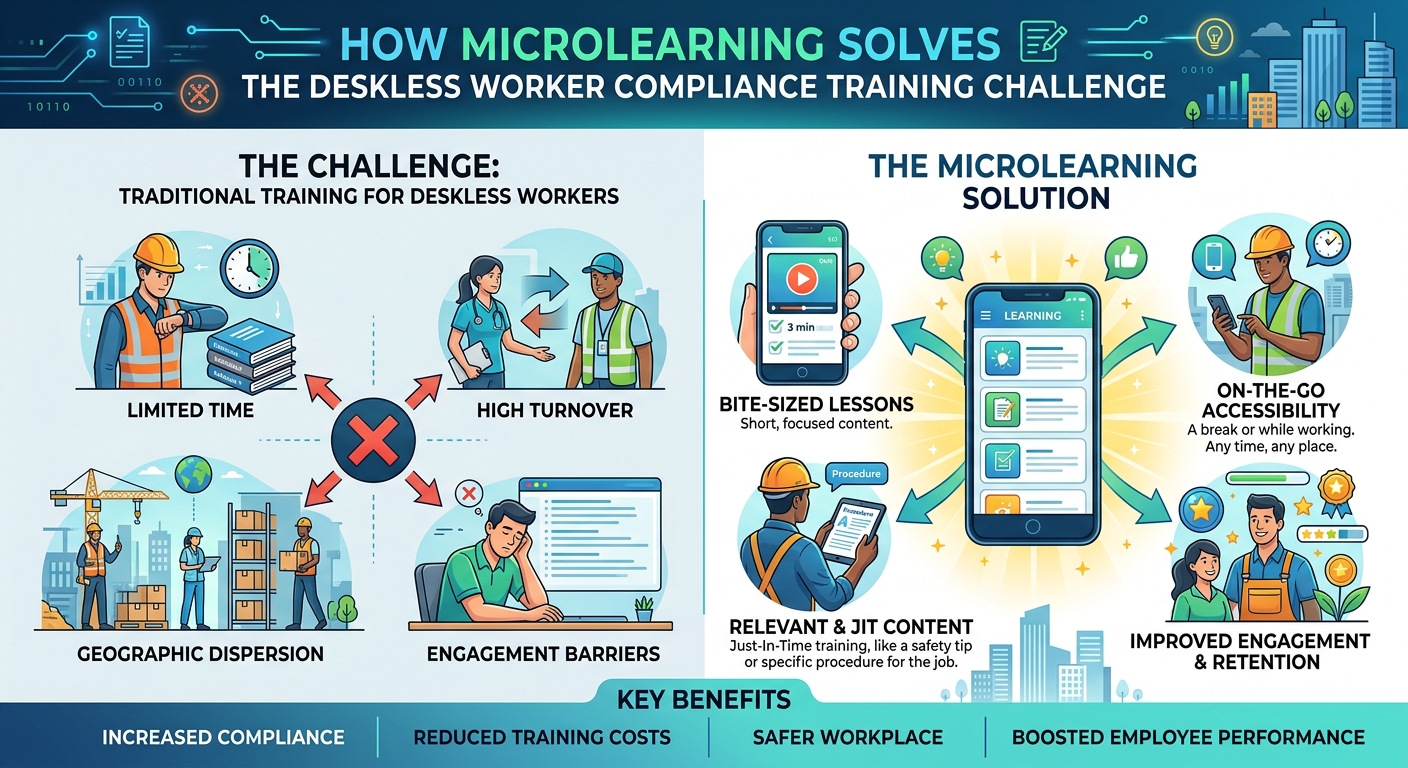
How Microlearning Solves the Deskless Worker Compliance Training Challenge
For Vice Presidents, Directors, Senior Managers, and Managers in Learning & Development, the challenge of ensuring comprehensive and effective compliance training for deskless workers is a persistent and often complex one. Whether in retail, healthcare, manufacturing, or transportation, these frontline employees are the backbone of operations, yet they often face unique barriers to traditional learning. Time constraints, limited access to technology, diverse work environments, and the sheer volume of information can make compliance a moving target, leading to potential risks for the organization.
The imperative for robust compliance is undeniable. Regulatory bodies across industries like banking, finance, insurance, retail, pharma, and oil and gas impose strict guidelines, with non-compliance carrying hefty fines, reputational damage, and even legal repercussions. For deskless workers, who are often the face of the company and directly interact with customers, products, and processes, understanding and adhering to these rules is paramount. This is where microlearning emerges as not just a viable solution, but a strategic necessity, transforming the way organizations approach critical training.
The Unique Challenges of Deskless Workers in Compliance Training
Traditional, long-form compliance modules often fail to resonate with deskless teams for several reasons:
- Time Scarcity: Field staff, nurses, sales associates, and logistics personnel rarely have dedicated blocks of time for training. Their schedules are dynamic, often dictated by immediate operational needs, customer demands, or production cycles.
- Access Limitations: Many deskless workers do not have consistent access to desktop computers. Mobile devices are their primary tools, but not all traditional learning platforms are optimized for them.
- Engagement and Retention: Lengthy, text-heavy courses can be monotonous, leading to disengagement and poor retention of vital information, especially when it comes to complex regulatory content.
- Diverse Environments: Compliance needs can vary significantly across different roles, locations, and operational contexts within the same organization, making a one-size-fits-all approach ineffective.
Microlearning: The Strategic Advantage for Compliance
Microlearning, characterized by short, focused bursts of learning content, directly addresses these challenges. It breaks down complex compliance topics into digestible, bite-sized modules – typically 3-7 minutes long – that can be consumed quickly and efficiently. This approach is intrinsically suited for the demanding schedules and diverse learning environments of deskless employees.
- Optimized for Mobile: Microlearning content is inherently designed for mobile consumption, allowing workers to train on their smartphones or tablets during brief downtimes, commutes, or breaks.
- Enhanced Engagement: Short, interactive modules, often incorporating video, quizzes, and gamification, prevent cognitive overload and maintain learner interest far more effectively than lengthy presentations.
- Improved Retention: The spaced repetition inherent in a microlearning strategy, where key concepts are revisited over time in new formats, significantly boosts knowledge retention and application.
- Agility and Relevance: Regulatory landscapes are constantly shifting. Microlearning allows for rapid content updates and delivery, ensuring that compliance training always reflects the latest requirements.
How Microlearning Directly Addresses Compliance Hurdles
Overcoming Time Scarcity
By delivering information in brief, targeted segments, microlearning fits seamlessly into the "nooks and crannies" of a deskless worker's day. A 5-minute module on a specific safety protocol or data privacy regulation is far more likely to be completed than a 60-minute course. This flexibility empowers employees to take ownership of their learning without disrupting operational flow.
Ensuring Accessibility & Convenience
A modern Microlearning LMS is designed with mobile-first principles, ensuring that content is available anytime, anywhere, on any device. This means a retail associate can review a new POS compliance guideline on their tablet, or a healthcare worker can brush up on infection control procedures via their smartphone between patient visits. The accessibility of the cloud based learning management system removes geographical barriers and promotes continuous learning.
Boosting Engagement and Retention
Microlearning thrives on interactivity. Whether through quick polls, scenario-based questions, or short video demonstrations, these elements make learning active rather than passive. Furthermore, incorporating a Gamified LMS can transform mandatory compliance into an engaging experience, motivating completion and fostering friendly competition, which further solidifies learning outcomes.
Promoting Consistency Across Diverse Teams
Despite varied work contexts, microlearning ensures that core compliance messages are delivered consistently across the entire deskless workforce. Each module, regardless of its specific application, can reinforce fundamental principles. With an advanced LMS or LCMS, L&D can manage and distribute a centralized library of content, ensuring everyone receives accurate, up-to-date information.
Leveraging Advanced eLearning Technologies for Compliance
Smart Learning Management Solutions
Implementing a robust learning management system is foundational. An enterprise learning management solution specifically built for microlearning can track progress, completion rates, and comprehension across vast, dispersed teams. MaxLearn LMS, for example, offers the sophisticated functionality needed to manage and deploy microlearning at scale. As a comprehensive learning content management system and learning management software, it provides the infrastructure for effective compliance training. For organizations seeking powerful learning management solutions, a modern lms learning management system like this is indispensable.
Engaging Learning Experiences
Beyond simple completion, genuine understanding and behavioral change are critical for compliance. A Gamified LMS can integrate points, badges, leaderboards, and challenges into compliance training, making it less of a chore and more of an achievement. This intrinsic motivation significantly improves engagement and recall.
Personalized Learning Paths
Not all deskless workers have the same compliance knowledge gaps. Adaptive Learning tailors the learning path based on an individual's prior knowledge, performance in assessments, and role-specific requirements. This ensures that employees spend their limited training time focusing on areas where they genuinely need development, making the learning process highly efficient and relevant.
Streamlined Content Creation
Developing effective microlearning content, especially for complex compliance topics, can be resource-intensive. An AI Powered Authoring Tool significantly speeds up this process. It can help L&D teams rapidly convert existing documentation into engaging micro-modules, suggest relevant content, and even personalize learning experiences based on audience profiles, keeping pace with regulatory changes.
Targeted Compliance Focus
For industries like finance, pharma, and oil and gas, identifying and mitigating specific risks is paramount. Risk-focused Training uses data to pinpoint common compliance violations or high-risk areas. Microlearning can then be deployed to specifically target these vulnerabilities, providing precise, timely interventions that significantly reduce organizational exposure.
Addressing Key Questions for L&D Leaders
For L&D executives exploring this transformation, several key considerations arise:
- How can L&D pinpoint the most critical compliance areas for diverse deskless roles? Leveraging data analytics from incidents, audits, and existing performance metrics can identify high-risk areas. An advanced learning management system can then deliver targeted micro-modules to address these specific vulnerabilities for different roles within the organization.
- What strategies ensure learning content remains fresh and relevant given evolving regulations and operational changes? Adopting an agile content development cycle supported by an AI-powered authoring tool allows L&D to quickly update or create new microlearning modules. This ensures that compliance training is always aligned with the latest regulatory mandates and operational best practices.
- How do organizations measure the real-world impact and effectiveness of compliance training on deskless teams? Beyond completion rates, impact can be measured through performance improvements, reduction in incidents, and employee feedback. Learning management solutions with robust analytics, combined with adaptive learning features, provide deeper insights into comprehension and application, demonstrating ROI.
- How can technology aid in delivering consistent compliance messages across geographically dispersed teams? A cloud-based learning management system is essential. It provides a centralized platform for all compliance content, accessible via mobile devices for deskless workers anywhere. This ensures that everyone receives the same consistent, high-quality messaging, regardless of their physical location.
- What are the best practices for personalizing compliance training to individual deskless worker needs and prior knowledge? Implementing adaptive learning pathways within a microlearning framework allows the system to assess a learner's existing knowledge and tailor the content accordingly. This ensures that each worker receives training that is challenging yet achievable, focusing on their specific learning gaps.
Conclusion
The deskless worker compliance training challenge is substantial, but it is not insurmountable. By embracing the power of microlearning, supported by cutting-edge eLearning technologies like a Microlearning LMS, Gamified LMS, and an AI Powered Authoring Tool, L&D leaders can transform compliance from a burdensome obligation into an engaging, effective, and continuous learning journey. This strategic shift not only mitigates organizational risk but also empowers deskless workers with the knowledge they need to excel, contributing directly to a more compliant, productive, and secure enterprise.
.jpg)


