

Beyond Compliance Checkboxes: 5 Essential Metrics CCOs and HR Leaders Must Track in Modern Compliance Training
In today's complex regulatory landscape, compliance training is no longer just a legal formality; it's a strategic imperative for safeguarding an organization's reputation, financial stability, and ethical integrity. For Chief Compliance Officers (CCOs) and HR leaders across industries like Sales, Banking, Finance, Insurance, Retail, Pharma, Health care, Hospitality, Oil and Gas, and Mining, ensuring employees understand and adhere to policies is paramount. However, simply delivering training isn't enough. The true challenge lies in measuring its impact and effectiveness. This article delves into the five critical metrics CCOs and HR leaders must track to transform compliance training from a mandatory exercise into a powerful tool for risk mitigation and organizational growth.
The Evolving Landscape of Compliance Training
Gone are the days of tedious, one-size-fits-all training modules. Modern compliance training demands engagement, relevance, and measurable outcomes. With new regulations constantly emerging and employee demographics shifting, a proactive and data-driven approach is essential. An effective LMS, particularly a robust learning content management system, plays a pivotal role in delivering and tracking this evolving content. Organizations need more than just a delivery platform; they require sophisticated learning management software to truly understand performance and impact.
Why Metrics Matter in Compliance
Without quantifiable data, compliance training remains a black box. Are employees truly absorbing the material? Is the training preventing incidents? Is it a worthwhile investment? Tracking key metrics provides objective answers, enabling CCOs and HR leaders to:
- Identify areas of weakness in training content or delivery.
- Demonstrate due diligence to regulators and stakeholders.
- Optimize resources and improve ROI.
- Foster a culture of compliance rather than just enforcing rules.
- Proactively address potential risks before they escalate.
Deploying powerful learning management solutions is the first step towards achieving this level of insight.
The 5 Key Metrics CCOs and HR Leaders Must Track
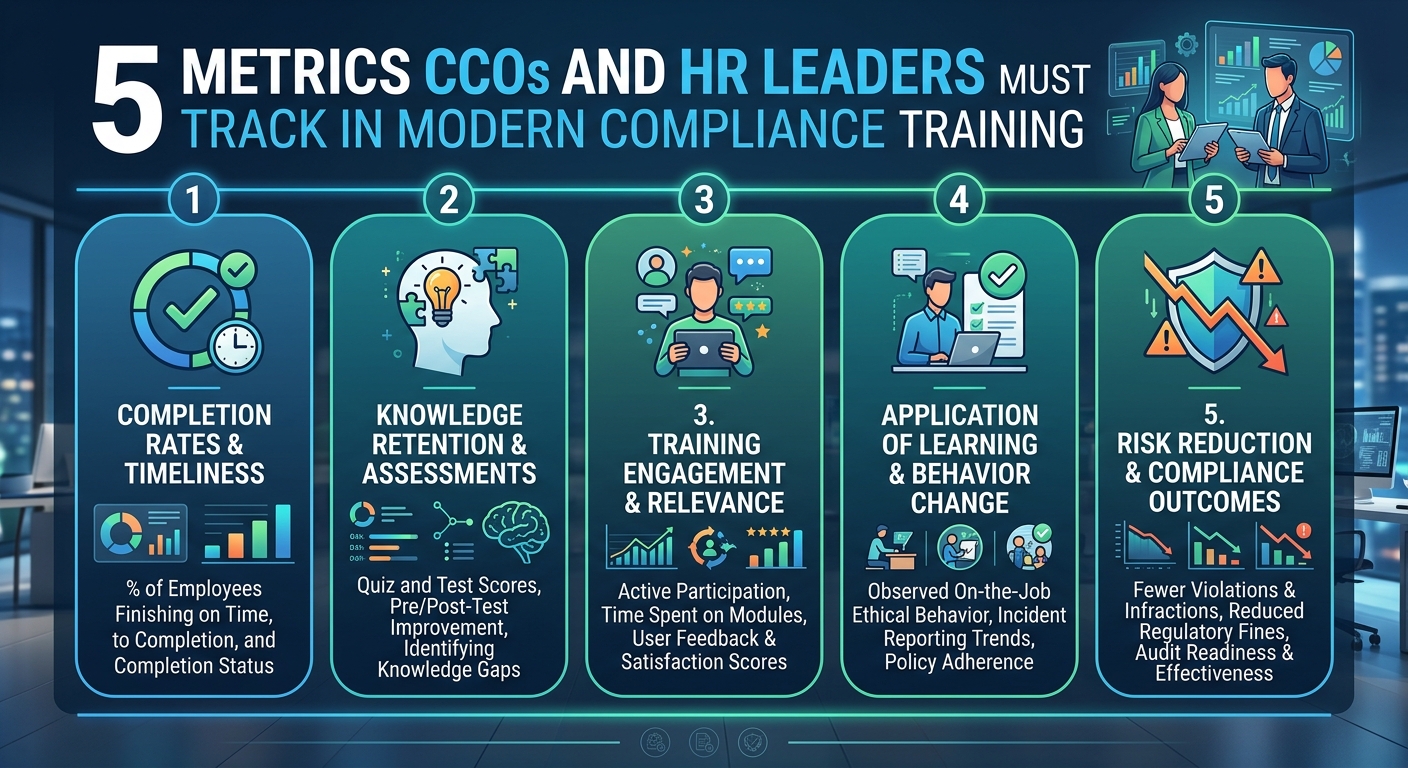
1. Completion Rates and Engagement Levels
While seemingly basic, a high completion rate signifies that employees are at least exposed to the material. However, modern tracking goes deeper, examining engagement. Are learners actively participating, interacting with the content, and spending adequate time on key sections? Low engagement often correlates with poor knowledge retention and higher risk.
- Tracking Completion: Percentage of employees who successfully finish all required modules.
- Measuring Engagement: Time spent on modules, interaction rates (clicks, responses to interactive elements), participation in discussions, and frequency of log-ins. A Gamified LMS can significantly boost these metrics by introducing points, badges, and leaderboards.
- Why it Matters: Indicates accessibility, relevance, and the intrinsic motivation of your workforce. Poor engagement is a red flag for potential compliance gaps.
2. Assessment Scores and Knowledge Retention
Did employees understand the material, and more importantly, do they remember it over time? High assessment scores immediately post-training are good, but true success lies in long-term knowledge retention. This is where the effectiveness of the training content itself is truly tested.
- Initial Assessment Scores: Average scores on quizzes and tests immediately following training modules.
- Retention Quizzes: Performance on follow-up assessments conducted weeks or months after initial training.
- Error Rates on Practical Scenarios: Performance on simulated real-world scenarios designed to test application of knowledge.
- Why it Matters: Directly measures the transfer of information and the sustainability of learning. Consistent low scores indicate training gaps or a need for different delivery methods, such as a Microlearning LMS that delivers information in digestible chunks.
3. Behavioral Change and Application
This is the ultimate goal of compliance training: influencing actual employee behavior to align with policies and regulations. Measuring behavioral change requires more than just online tracking; it involves observation, feedback, and sometimes, incident analysis. It moves beyond theoretical knowledge to practical application.
- Manager and Peer Feedback: Qualitative observations from supervisors and colleagues on adherence to compliance protocols in daily work.
- Audits and Internal Reviews: Performance on compliance checklists and adherence during internal audits.
- Observation of Best Practices: Documenting instances where employees proactively demonstrate compliant behavior or identify potential issues.
- Why it Matters: Directly correlates training with real-world impact and a reduction in non-compliant actions. This metric shows whether employees are not just knowing, but doing.
4. Incident Reduction and Risk Mitigation
The most tangible measure of compliance training's success is its direct impact on reducing incidents, violations, and associated risks. This metric ties training directly to business outcomes and financial implications, showcasing its true value.
- Number of Compliance Incidents: Tracking the decrease in reported violations, regulatory fines, or breaches post-training.
- Audit Findings: Improvement in compliance audit results over time.
- Legal/Reputational Costs Avoided: Estimating the financial and reputational savings due to proactive compliance.
- Why it Matters: Provides a clear ROI for compliance training efforts and validates the investment. Risk-focused Training is specifically designed to target areas with the highest potential for impact on these metrics.
5. Cost-Effectiveness and Return on Investment (ROI)
Even the most effective training has a cost. CCOs and HR leaders must evaluate if the investment in compliance training (including content development, platform costs like an lms learning management system, and employee time) provides a measurable return in terms of risk reduction, operational efficiency, and avoided penalties.
- Training Development and Delivery Costs: Total expenditure on content creation, software licenses, administrative overhead, and instructor fees.
- Employee Time Investment: Cost associated with employee time spent in training.
- Cost of Non-Compliance: Fines, legal fees, reputational damage, and operational disruptions due to violations.
- ROI Calculation: Comparing the total cost of training against the financial benefits derived from incident reduction and improved compliance.
- Why it Matters: Justifies budget allocation for training programs and ensures resources are being utilized efficiently.
Insights from Intelligent Learning Systems
Modern learning platforms, including robust enterprise learning management solutions, offer advanced analytics to track these metrics. Let's explore some common inquiries regarding smart learning approaches.
How can learning analytics help tailor compliance training to specific job functions and roles?
By analyzing performance data, completion rates, and assessment scores across different employee groups, analytics can pinpoint areas where certain roles struggle more than others. This allows L&D teams to create highly targeted learning paths, ensuring that a financial analyst receives compliance training relevant to their specific market regulations, while a manufacturing floor supervisor gets content focused on safety and environmental policies. Intelligent systems can even suggest personalized content, creating a truly Adaptive Learning experience that caters to individual needs and knowledge gaps.
What considerations are vital when developing compliance training for a global workforce operating under diverse legal frameworks?
Developing global compliance training requires meticulous attention to localization and cultural nuance. Smart learning platforms can help segment audiences by region, delivering country-specific modules that address local laws, cultural sensitivities, and industry-specific regulations. This might involve different language versions, case studies relevant to local contexts, and varying emphasis on certain topics based on regional risk profiles. Centralized reporting then allows CCOs to monitor adherence to local requirements while maintaining a global overview.
What are the cutting-edge technological advancements transforming how compliance content is created and maintained?
The latest advancements include the use of sophisticated algorithms to automate content updates, personalize learning paths, and even generate interactive scenarios. An AI Powered Authoring Tool can dramatically reduce the time and resources required to create engaging, relevant, and compliant content. These tools can identify regulatory changes, suggest content modifications, and even help in translating and localizing modules, making compliance content creation faster, more accurate, and highly scalable.
Leveraging Technology for Superior Tracking
To effectively track these metrics, organizations need a powerful learning management system. A modern MaxLearn LMS offers comprehensive reporting dashboards, real-time analytics, and integration capabilities that provide CCOs and HR leaders with the insights they need. Whether it's a cloud based learning management system or an on-premise solution, the chosen platform should simplify data collection and analysis, turning raw data into actionable intelligence. Such a system is not just a tool for delivery but a strategic asset for understanding and improving compliance effectiveness.
Conclusion
In the dynamic world of modern business, effective compliance training is a non-negotiable. By meticulously tracking these five key metrics—Completion & Engagement, Knowledge Retention, Behavioral Change, Incident Reduction, and Cost-Effectiveness—CCOs and HR leaders can move beyond simply checking boxes. They can build robust, data-driven compliance programs that actively protect their organizations, foster an ethical culture, and drive sustainable growth. Investing in the right technology, like a comprehensive learning management system, is fundamental to this success, transforming compliance from a burden into a competitive advantage.
.jpg)


