

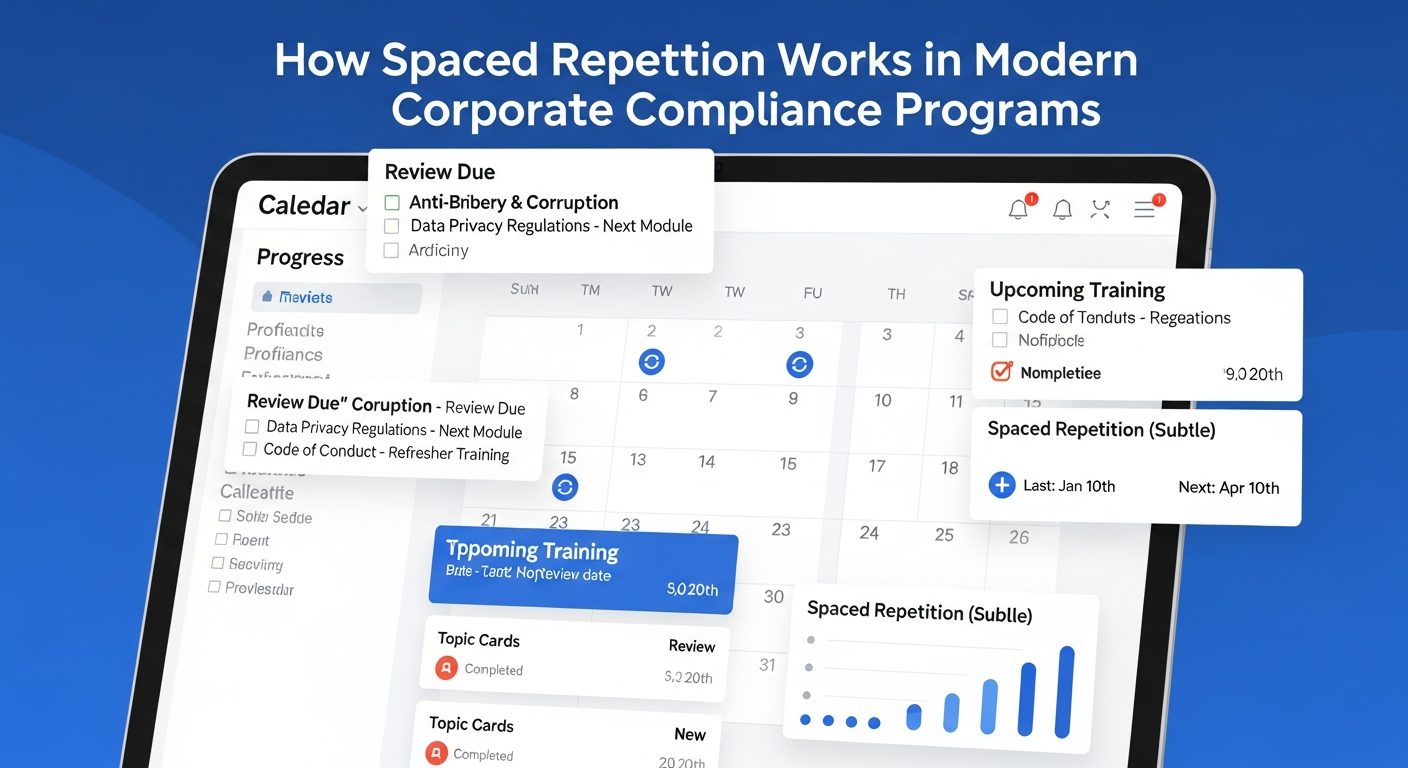
How Does Spaced Repetition Work in Modern Corporate Compliance Programs?
In the intricate world of corporate compliance, the stakes are perpetually high. Organizations across every sector—from banking and finance to healthcare, oil and gas, and retail—navigate a labyrinth of regulations, policies, and ethical standards. For Vice Presidents, Directors, and Senior Managers in Learning & Development, the challenge isn't just delivering compliance training; it's ensuring that critical knowledge is not only absorbed but retained long-term, effectively changing employee behavior and mitigating risk.
Traditional "check-the-box" annual training often falls short, leading to the dreaded "forgetting curve." Employees might pass a quiz today, but crucial details can fade within weeks, leaving organizations vulnerable. This is where Spaced Repetition emerges as a powerful, scientifically-backed strategy, transforming how modern corporate compliance programs are designed and executed. Far from a niche academic concept, Spaced Repetition, integrated with advanced eLearning technologies, is becoming an indispensable tool for robust and sustainable compliance.
The Science of Memory: Understanding Spaced Repetition
At its core, Spaced Repetition is an evidence-based learning technique rooted in cognitive psychology, specifically countering the Ebbinghaus Forgetting Curve. Herman Ebbinghaus’s research in the late 19th century demonstrated that humans forget information rapidly after initial learning, with the steepest drop-off occurring shortly after exposure. To combat this, he proposed that reviewing information at increasing intervals significantly boosts long-term retention.
How does it work? Instead of cramming or reviewing content immediately, Spaced Repetition systems strategically re-introduce information to learners just as they are about to forget it. This "active recall" process, timed at optimal intervals, forces the brain to retrieve the information, strengthening neural pathways and solidifying memory. For compliance training, where accuracy and recall are paramount, this neurological advantage is invaluable. It shifts the focus from merely exposing employees to content to genuinely embedding critical rules and procedures into their long-term memory.
Integrating Spaced Repetition into Modern Compliance Training
The practical application of Spaced Repetition in corporate settings relies heavily on sophisticated LMS platforms and intelligent content delivery. Here's how it's integrated:
1. Microlearning Modules and Bite-Sized Content
- Spaced Repetition thrives on digestible content. Compliance topics are broken down into Microlearning LMS modules—short videos, interactive quizzes, infographics, or brief scenarios—each focusing on a single concept or rule.
- These bite-sized pieces are ideal for quick, repeated reviews without overwhelming the learner.
2. Personalized Learning Paths and Adaptive Learning
- Modern learning management system solutions don't treat all learners uniformly. Instead, they leverage Adaptive Learning algorithms.
- Based on an individual's performance (e.g., correct answers, time taken), the system adjusts the repetition schedule. Topics a learner struggles with are reviewed more frequently, while mastered subjects are spaced out further.
3. Automated Reinforcement and Notifications
- The power of Spaced Repetition comes from automation. An advanced cloud based learning management system automatically schedules "recall moments" through notifications, emails, or in-platform prompts.
- These prompts might trigger a short quiz, a scenario-based question, or a brief recap, ensuring consistent engagement without manual intervention from L&D teams.
4. Gamification and Engaging Interactions
- To make repeated reviews less monotonous, leading platforms incorporate Gamified LMS elements. Points, badges, leaderboards, and progress tracking motivate learners to engage with the spaced content.
- This transforms compliance training from a chore into an engaging, continuous learning journey.
The Role of Advanced eLearning Platforms
Implementing effective Spaced Repetition for enterprise compliance requires a robust learning management software. A comprehensive learning management system (LMS) or LCMS like MaxLearn LMS is not just a content repository; it's an intelligent engine driving the learning process. Key features include:
- Intelligent Scheduling Algorithms: Automatically calculates optimal review intervals based on learner performance and learning science principles.
- Comprehensive Analytics: Provides L&D managers with insights into individual and organizational knowledge gaps, areas of strength, and overall compliance readiness.
- Diverse Content Support: Handles various formats, from interactive simulations to video and text, often supported by an AI Powered Authoring Tool for rapid content creation.
- Seamless Integration: Fits within the existing IT infrastructure, ensuring accessibility and ease of use for all employees, making it a true enterprise learning management solution.
AI's Transformative Impact on Spaced Repetition and Compliance Training
Artificial intelligence is catapulting Spaced Repetition from a powerful technique to a truly dynamic and highly effective compliance solution. AI-driven learning management solutions continuously refine the learning experience.
How does artificial intelligence amplify learner engagement and ensure critical compliance knowledge sticks long-term?
AI plays a pivotal role in optimizing how learners interact with compliance content. By analyzing engagement patterns, completion rates, and performance data, AI can personalize not just the spacing of repetitions but also the format and type of content delivered. If a learner disengages from text-heavy modules, AI might prompt them with an interactive scenario or a short video. It also enhances Gamified LMS features by tailoring challenges and rewards, keeping motivation high. This hyper-personalization ensures that each learner receives the most effective and engaging pathway to mastery, boosting overall recall and ensuring that vital compliance information becomes second nature.
In what ways can intelligent systems help organizations achieve consistent compliance effectiveness across a globally diverse workforce with varying regulatory landscapes?
For multinational corporations, compliance is incredibly complex due to diverse local regulations, cultural nuances, and linguistic differences. AI-powered Spaced Repetition systems can segment training content and repetition schedules based on geographical location, role, and specific regulatory requirements. They can dynamically adapt content language, legal examples, and even the context of scenarios to resonate with local teams. Furthermore, AI helps identify common compliance gaps across regions, allowing L&D to create targeted training interventions that address universal challenges while respecting local specifics, making MaxLearn LMS a truly global solution.
How can intelligent algorithms continuously optimize learning pathways, proactively identify knowledge gaps, and even predict future compliance training needs?
The true genius of AI in this context lies in its predictive capabilities. By continuously analyzing learner performance data, AI algorithms can identify subtle patterns that indicate a potential knowledge gap before it becomes a problem. For example, if several employees in a specific department consistently struggle with a particular regulatory concept, AI can flag this and recommend a targeted, spaced review for that group. Moreover, by integrating with external data sources (e.g., regulatory updates, industry news), AI can even anticipate future training needs, suggesting new compliance modules or revisions to existing ones before a new regulation takes effect. This proactive approach transforms compliance training from reactive to preventative, bolstering Risk-focused Training strategies.
Benefits of Spaced Repetition in Compliance Programs
Adopting Spaced Repetition through a modern learning content management system offers tangible benefits for organizations:
- Enhanced Knowledge Retention: Significantly improves long-term recall of complex compliance information, leading to better decision-making.
- Reduced Training Time: While it involves more frequent touchpoints, each session is short and targeted, leading to more efficient learning overall compared to lengthy annual courses.
- Improved Employee Confidence and Behavior: Employees feel more confident in their understanding of policies, leading to fewer errors and better adherence to regulations.
- Mitigation of Compliance Risks: A well-informed workforce is less likely to commit violations, reducing potential fines, legal costs, and reputational damage.
- Better Audit Readiness: Continuous reinforcement ensures employees are always up-to-date and ready to demonstrate compliance knowledge during audits.
- Optimized L&D Resources: Automated systems free up L&D teams to focus on strategy and content creation rather than scheduling and tracking.
Conclusion
For L&D leaders striving to build resilient, compliant organizations, Spaced Repetition is not merely a learning technique; it's a strategic imperative. By leveraging the power of cognitive science and integrating it with advanced eLearning platforms, organizations can move beyond surface-level understanding to cultivate deep, lasting compliance knowledge. The synergy between Spaced Repetition, Microlearning LMS, Adaptive Learning, and AI-driven insights offers an unparalleled advantage in an increasingly regulated world. Embrace this innovative approach, and empower your workforce with the unwavering compliance understanding essential for success.
.jpg)


