

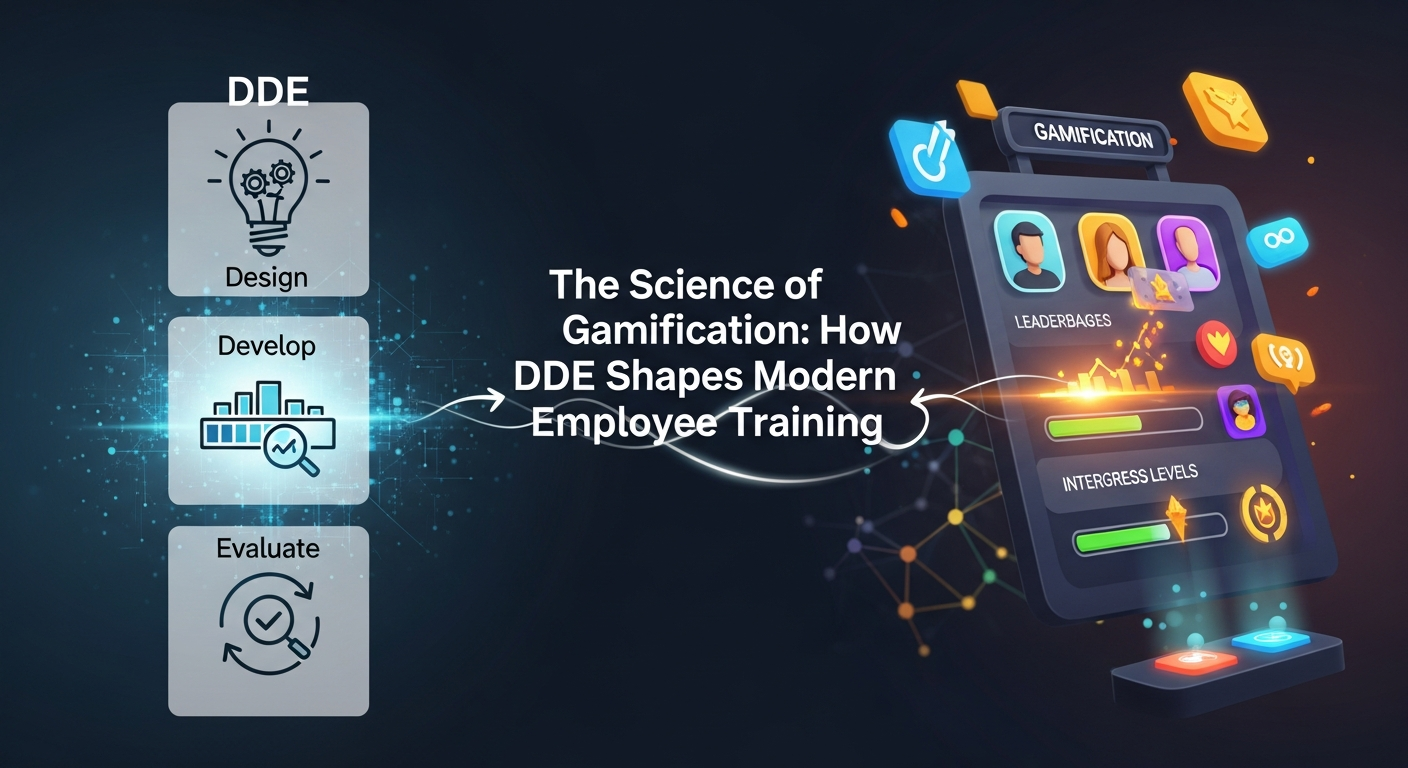
The Science of Gamification: How DDE Shapes Modern Employee Training
In today's rapidly evolving corporate landscape, traditional employee training methods often fall short. Learning and Development (L&D) leaders, from Vice Presidents to Managers, are constantly seeking innovative approaches to boost engagement, improve retention, and demonstrate a clear return on investment. Enter gamification – a powerful methodology that leverages game design elements and game principles in non-game contexts. But at its heart lies a sophisticated scientific framework: DDE – Dynamic Difficulty Adjustment, Engagement, and Experience. Understanding how DDE operates is crucial for truly transforming modern employee training.
DDE isn't just about adding points and badges; it's a meticulously designed psychological approach to learning that tailors the challenge, sustains learner interest, and optimizes the overall educational journey. For industries ranging from Microlearning LMS-driven compliance to high-stakes healthcare and complex financial services, DDE-powered gamification offers a strategic advantage in developing a highly skilled and motivated workforce.
Deconstructing DDE: Dynamic Difficulty, Engagement, and Experience
Dynamic Difficulty Adjustment (DDA): The Personalization Engine
At the core of effective gamification lies Dynamic Difficulty Adjustment. DDA ensures that the learning content and challenges presented to an employee are constantly adapted based on their real-time performance, knowledge gaps, and learning pace. This isn't a one-size-fits-all approach; it's a truly Adaptive Learning system. If a learner masters a concept quickly, DDA automatically presents more complex scenarios or advanced topics. Conversely, if they struggle, the system offers additional support, simpler tasks, or alternative explanations without making them feel inadequate.
The scientific benefit of DDA is profound. It keeps learners in the "flow state" – a psychological concept where a person is fully immersed in an activity, experiencing energized focus, full involvement, and enjoyment. This prevents both boredom (from tasks too easy) and frustration (from tasks too difficult), leading to optimal cognitive load and enhanced information processing. For any enterprise learning management system, integrating DDA means creating a more efficient and effective learning path for every individual.
Engagement: Igniting Intrinsic Motivation
Beyond difficulty, gamification thrives on engagement. DDE ensures that the gamified elements are not mere window dressing but serve to intrinsically motivate the learner. This involves a carefully curated blend of mechanics:
- Immediate Feedback: Learners receive instant validation or correction, reinforcing correct behaviors and guiding improvement.
- Progression & Achievement: Points, levels, badges, and virtual rewards provide tangible evidence of progress, appealing to our innate desire for mastery and accomplishment.
- Social Interaction & Competition: Leaderboards, team challenges, and peer recognition foster healthy competition and collaboration, leveraging our social instincts.
- Narrative & Immersion: Story-driven learning experiences transform mundane topics into compelling quests, making the content more memorable and relatable.
A well-designed Gamified LMS leverages these elements to transform passive learning into an active, enjoyable pursuit. The psychological reward system, often tied to dopamine release, reinforces learning behaviors, making employees eager to participate and excel. This is a critical component for any learning content management system looking to boost participation rates.
Experience: Crafting the Holistic Learning Journey
The final pillar of DDE is the overall Experience. This encompasses not just the individual interactions but the entire journey an employee undertakes within the gamified training environment. A superior learning experience is seamless, intuitive, and highly relevant to the learner's professional goals. It ensures that the skills acquired through gamified modules are directly transferable to real-world scenarios, leading to measurable performance improvements.
For L&D professionals in retail, hospitality, or sales, an engaging experience means employees can practice customer interactions, product knowledge, or service protocols in a safe, simulated environment. For banking, finance, and insurance, it could involve navigating complex regulatory landscapes or product features. The goal is to make learning an integral, positive part of the employee's daily experience, fostering a culture of continuous development. A comprehensive learning management system should prioritize this holistic experience.
DDE in Action Across Diverse Industries
The versatility of DDE makes it applicable across a wide spectrum of industries:
- Compliance & Risk-focused Training: Gamified scenarios can transform dry regulatory mandates into interactive challenges, ensuring employees understand and apply critical rules to mitigate risks. This is especially vital in sectors like banking, finance, pharma, and healthcare.
- Sales Training: DDE can adapt challenges based on sales performance, product knowledge, or customer interaction skills, driving healthy competition and continuous improvement among sales teams. An AI Powered Authoring Tool can dynamically generate relevant sales scenarios.
- Healthcare & Pharma: Complex medical procedures, drug information, and patient care protocols can be simulated with adaptive difficulty, allowing professionals to practice and refine skills in a safe environment.
- Manufacturing & Oil & Gas/Mining: Safety procedures, equipment operation, and emergency response training benefit immensely from DDE's adaptive and immersive nature, reducing human error in high-stakes environments.
- Retail & Hospitality: Customer service training, product knowledge, and operational efficiency can be enhanced through gamified challenges that simulate real-world scenarios, adapting to individual learning needs.
Implementing an effective learning management software with DDE capabilities allows organizations to deploy consistent, high-quality training across global teams, regardless of their location or prior knowledge.
AI's Transformative Role in DDE-Powered Gamification
Artificial Intelligence significantly amplifies the power of DDE in modern employee training. By processing vast amounts of learner data, AI refines and personalizes the learning experience to an unprecedented degree. For L&D leaders, understanding these capabilities is key.
How can intelligent systems personalize the learning journey to maximize individual skill acquisition?
Intelligent algorithms analyze learner interactions, performance data, and even emotional responses within the gamified environment. This allows the system to precisely calibrate the dynamic difficulty, recommend specific resources, and present challenges tailored to an individual's unique learning style and pace. This advanced personalization ensures that each employee is always engaging with content that is optimally challenging, preventing disengagement and accelerating skill development. Imagine a learning management system that understands you better than you understand your own learning gaps.
What advanced analytics are available to refine training efficacy and content impact?
AI-driven analytics move beyond simple completion rates. They can track intricate behavioral patterns, identify common stumbling blocks, and predict future performance trends. By continuously analyzing engagement metrics, time spent on tasks, problem-solving approaches, and the effectiveness of different game mechanics, these systems provide L&D teams with actionable insights. This enables continuous optimization of both the content and the gamification strategies, ensuring that every training module within the lms learning management system is performing at its peak potential and delivering maximum impact.
Can digital platforms offer relevant learning experiences based on a user's operational context or location?
Absolutely. AI can leverage contextual information, such as an employee's role, department, previous training history, or even their physical location, to deliver highly relevant and scenario-specific learning. For example, a retail employee in a specific store could receive gamified challenges directly related to new product displays in their location, or a field technician could access diagnostic simulations relevant to equipment found at their current site. This contextualization makes the learning experience more immediate, practical, and directly applicable, bridging the gap between theoretical knowledge and real-world application, especially valuable for a cloud based learning management system.
The Future of Employee Training with DDE
As organizations continue to embrace digital transformation, DDE-powered gamification, enhanced by AI, will become a cornerstone of future-proof L&D strategies. It transcends the limitations of traditional methods, offering a scalable, engaging, and highly effective way to upskill and reskill workforces across all industries. A modern learning management system that integrates these principles is no longer a luxury but a necessity for competitive advantage.
For Vice Presidents, Directors, and Managers of L&D, investing in a robust MaxLearn LMS that harnesses the science of DDE and the power of AI represents a strategic decision to cultivate a culture of continuous learning, foster high performance, and ultimately drive business growth. It's about more than just training; it's about shaping a highly competent, engaged, and adaptable workforce ready for tomorrow's challenges. The future of enterprise learning management is dynamic, engaging, and truly experiential.
.jpg)


