

Shaping Success: Applying Operant Conditioning in Modern eLearning for L&D Leaders
As leaders in Learning & Development, your ultimate goal is to foster desired behaviors and knowledge acquisition that directly contribute to organizational success. In an increasingly dynamic business landscape, understanding the science behind how people learn and respond to their environment is paramount. Enter the "Theory of Operant Conditioning," a psychological framework developed by B.F. Skinner, which offers profound insights into behavior modification and, crucially, how we can engineer more effective and engaging eLearning experiences.
For Vice Presidents, Directors, and Managers overseeing L&D initiatives across diverse industries—from Compliance and Sales to Banking, Healthcare, and Oil and Gas—the principles of operant conditioning are not just academic theories. They are actionable strategies for designing training that sticks, drives performance, and delivers tangible ROI. This article explores how these foundational concepts can be strategically integrated into your modern Microlearning LMS, transforming passive learning into active, reinforced behavior change.
The Core Tenets of Operant Conditioning in L&D
Operant conditioning posits that behaviors are learned and maintained based on their consequences. In a corporate learning context, this means that the feedback, rewards, or even lack thereof that employees receive after engaging with training content or exhibiting specific work behaviors will dictate whether those behaviors are repeated or extinguished.
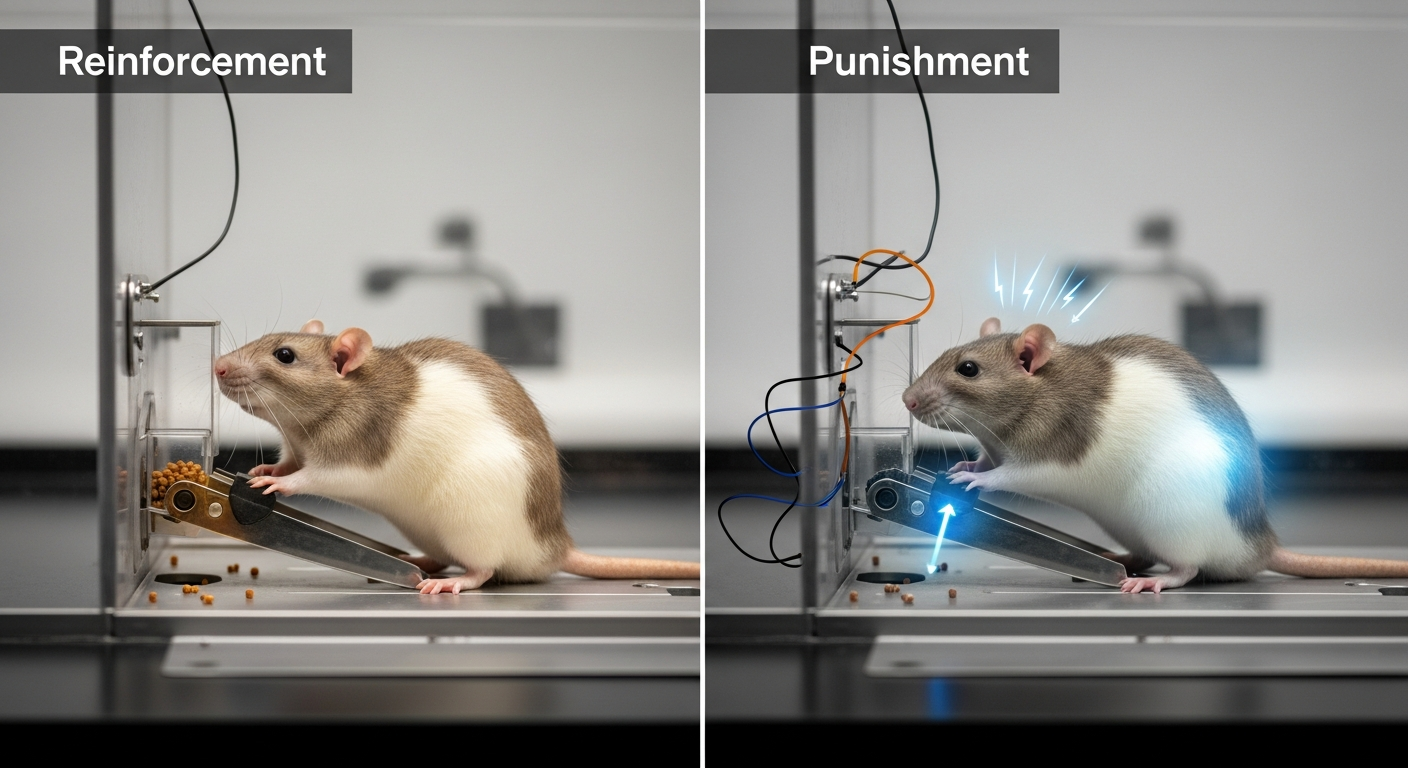
Reinforcement: Encouraging Desired Behaviors
- Positive Reinforcement: This involves adding a desirable stimulus after a behavior to increase the likelihood of that behavior recurring. In eLearning, this could be immediate positive feedback, points, badges, leaderboards, or recognition for completing modules or mastering skills. A Gamified LMS excels at implementing positive reinforcement, turning learning into a rewarding experience.
- Negative Reinforcement: This involves removing an undesirable stimulus after a behavior to increase its likelihood. For instance, successfully completing a mandatory compliance module (desired behavior) removes the constant reminder emails (undesirable stimulus), encouraging prompt completion in the future. It's about removing an impediment, not administering something unpleasant.
Punishment: Discouraging Undesired Behaviors
- Positive Punishment: Presenting an undesirable stimulus after a behavior to decrease its likelihood. In L&D, direct "punishment" is rarely, if ever, used. Instead, consequences like failing a module (requiring re-study) or negative performance reviews might serve a similar, albeit less direct, function by indicating that current behavior is unacceptable.
- Negative Punishment: Removing a desirable stimulus after a behavior to decrease its likelihood. An example might be losing access to certain privileges or opportunities due to consistent non-compliance with training requirements. Again, L&D typically avoids harsh "punishment," focusing more on reinforcement and corrective feedback.
Extinction: When Behaviors Fade
Extinction occurs when reinforcement for a previously learned behavior ceases, causing the behavior to gradually disappear. If employees stop receiving recognition for applying new sales techniques learned through a Microlearning LMS, they might revert to old habits. This highlights the importance of sustained reinforcement and practical application post-training.
Schedules of Reinforcement: Timing is Everything
The frequency and predictability of reinforcement significantly impact how quickly behaviors are learned and how resistant they are to extinction. Continuous reinforcement (every correct response is rewarded) leads to rapid learning but also rapid extinction if reinforcement stops. Intermittent reinforcement (rewards are occasional) leads to slower learning but greater resistance to extinction. For Adaptive Learning platforms, varying reinforcement schedules can be incredibly powerful in maintaining learner engagement and long-term retention.
Applying Operant Conditioning in Modern eLearning
Translating these principles into a practical learning content management system strategy means designing an ecosystem where desired learning behaviors are consistently reinforced. Here's how L&D leaders can leverage a robust learning management software:
- Immediate and Specific Feedback: A core principle of operant conditioning is immediate feedback. eLearning platforms, especially those offering Microlearning LMS modules, can provide instant scores, explanations, and tailored remedial content, reinforcing correct answers and correcting misconceptions on the spot.
- Gamification for Engagement: Points, badges, leaderboards, and progress bars—hallmarks of a Gamified LMS—are direct applications of positive reinforcement. They create an intrinsically motivating environment, encouraging learners to complete modules, achieve mastery, and compete positively.
- Personalized Learning Paths: Adaptive Learning tailors content and challenges based on a learner's performance. This ensures that learners are consistently reinforced for their progress, receiving more difficult content when ready (positive reinforcement) and extra support when struggling (negative reinforcement, removing the obstacle to learning). This personalized approach is a hallmark of an effective lms learning management system.
- Skill-Based Badges and Certifications: Awarding digital badges or certificates upon the completion of specific skill sets provides tangible recognition and positive reinforcement, motivating employees to acquire new competencies relevant to their roles, be it in Banking compliance or Pharma sales.
- Structured Remediation and Practice: If an employee fails to demonstrate mastery, the system can automatically provide additional practice or alternative explanations (corrective feedback) until mastery is achieved. This functions as a subtle form of negative reinforcement, removing the "undesirable" state of not knowing. For Risk-focused Training, this is critical for ensuring compliance and mitigating potential hazards.
Leveraging Technology: The Power of an Enterprise Learning Management System
Implementing these principles at scale requires a sophisticated LMS. An enterprise learning management solution acts as the central hub for delivering, managing, and tracking learning experiences that effectively leverage operant conditioning. A cloud based learning management system offers the scalability and accessibility needed to apply these principles across a global workforce.
For example, an AI Powered Authoring Tool within a learning management system allows L&D teams to rapidly create engaging, interactive content specifically designed to provide immediate feedback and reinforcement. This is crucial for industries like Retail and Hospitality, where rapid onboarding and continuous skill updates are vital.
Furthermore, an advanced LCMS (Learning Content Management System) enables easy updates and personalization of content, ensuring that reinforcement strategies remain fresh and relevant. Whether it's enhancing negotiation skills for Sales teams or ensuring stringent regulatory adherence in Finance and Insurance, the right learning management solutions empower L&D to proactively shape employee behavior.
AI's Role in Optimizing Behavioral Learning
Artificial Intelligence is revolutionizing how we apply psychological principles in training, offering unprecedented capabilities to enhance and personalize the learning experience.
How can artificial intelligence personalize learning paths to enhance employee skill acquisition?
AI analyzes vast amounts of learner data, including interaction patterns, performance metrics, and knowledge gaps, to dynamically adapt content and difficulty. This ensures that each employee receives precisely the right amount of challenge and support, providing optimal positive reinforcement for progress and subtle negative reinforcement by removing unnecessary hurdles. AI can identify when a learner is struggling with a concept, offering immediate, targeted interventions that reinforce correct understanding. This tailored approach effectively shapes desired behaviors by optimizing the learning journey for maximum impact.
What strategies can AI employ to ensure consistent and effective training delivery across diverse global teams?
AI-driven platforms can automatically localize content, including language translation and cultural nuances, ensuring that reinforcement mechanisms resonate equally across different regions. By analyzing performance data from various geographic segments, AI can identify universal motivators and localized barriers to learning, allowing L&D leaders to fine-tune strategies for global consistency. This also includes ensuring adherence to global compliance standards, making Risk-focused Training universally effective, and providing consistent behavioral shaping for all employees, regardless of location.
How do advanced analytics driven by AI provide insights into future training needs and impact?
AI uses predictive analytics to forecast skill requirements based on industry trends, organizational goals, and individual performance trajectories. By correlating training engagement and outcomes with business metrics, AI can demonstrate the long-term impact of specific reinforcement strategies on employee behavior and business performance. This allows L&D teams to proactively design future learning interventions, ensuring sustained behavioral change and optimizing the entire learning ecosystem. It helps in anticipating the effects of training programs before they are fully deployed, ensuring resources are allocated effectively for maximum behavioral return.
Conclusion
The Theory of Operant Conditioning provides L&D leaders with a robust framework for understanding and influencing employee behavior. By strategically applying positive reinforcement, intelligent use of negative reinforcement, and careful consideration of extinction and reinforcement schedules, you can design eLearning programs that are not only engaging but genuinely effective in shaping desired skills and performance. Leveraging a modern MaxLearn LMS, enriched with AI capabilities and adaptive learning features, empowers your organization to create a continuous learning environment where employees are consistently motivated, behaviors are reinforced, and business objectives are met across all sectors, from Mining to Healthcare. Invest in solutions that understand the science of learning to build a truly high-performing workforce.
.jpg)


