

Understanding Single-Loop Learning: An Essential Guide for L&D Leaders
As Vice Presidents, Directors, and Senior Managers in Learning & Development, you are constantly strategizing to enhance organizational performance, ensure compliance, and drive growth. Your role is pivotal in shaping how employees adapt, learn, and excel across diverse sectors like banking, healthcare, retail, and manufacturing. A foundational concept in organizational learning, often observed and sometimes overlooked, is single-loop learning. Grasping its nuances, identifying its presence, and understanding its limitations is critical for evolving your learning strategies beyond mere fixes to profound, sustainable change.
This article delves into what single-loop learning entails, provides a practical example, and explores why L&D leaders must look beyond this default mechanism to foster truly transformative development within their organizations.
What is Single-Loop Learning? The "Fix-It" Reflex
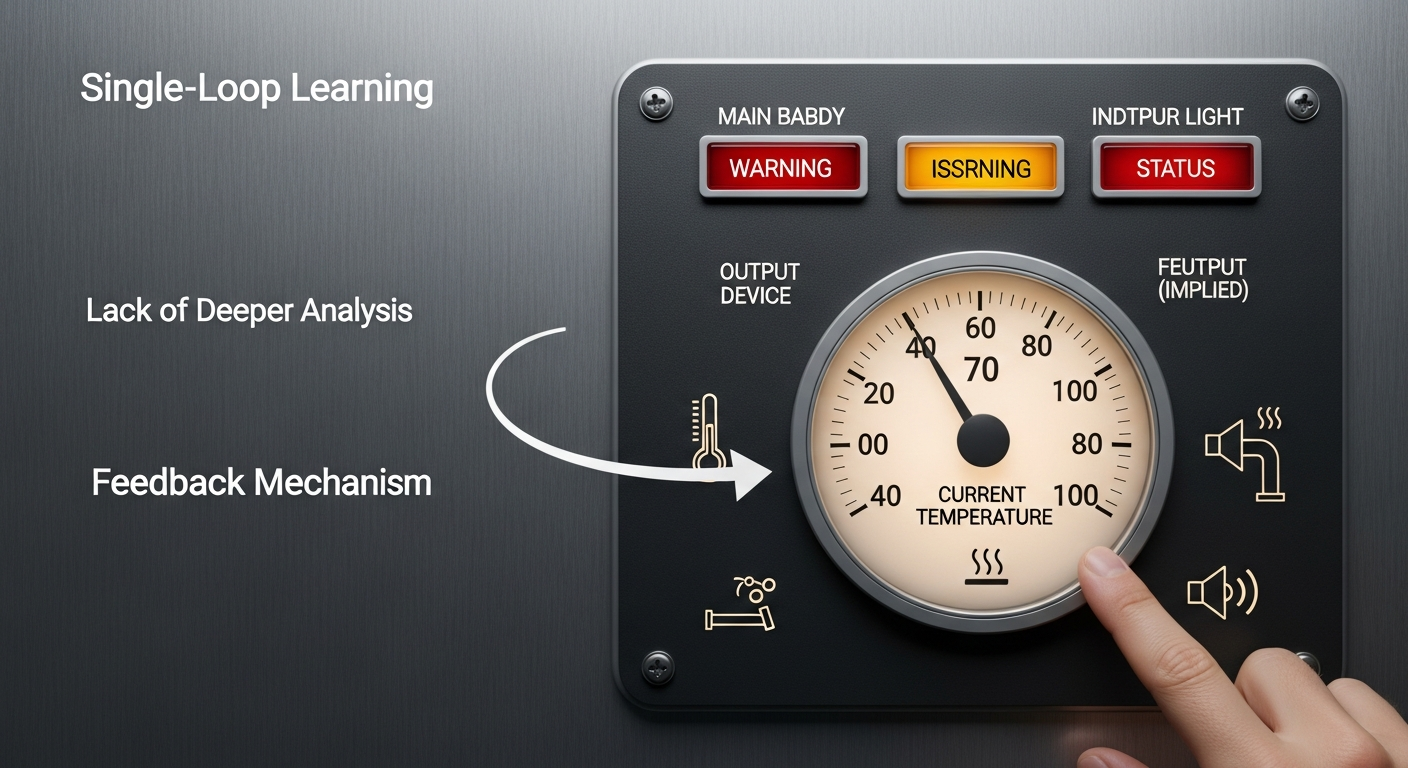
Single-loop learning is best understood as a reactive process where individuals or organizations detect an error or a problem and then correct it by modifying their actions within existing frameworks, norms, and assumptions. It's akin to a thermostat: when the room gets too cold, the thermostat turns on the heater to reach the desired temperature. It doesn't question *why* the room got cold, or if the desired temperature setting is appropriate; it simply acts to correct the immediate deviation.
In the context of L&D, single-loop learning manifests when training interventions are designed to address a direct, observable performance gap or a compliance failure, without critically examining the underlying assumptions or systemic factors that contributed to the problem in the first place. It's about 'doing things better' within the current system, rather than 'doing better things' by questioning the system itself.
A Single-Loop Learning Example: The Compliance Conundrum in Banking
Imagine a large financial institution, operating across multiple regions, that experiences a recurring issue with its customer service representatives (CSRs) failing to adequately explain specific terms and conditions for new credit card products. This leads to customer complaints, potential regulatory scrutiny, and a tarnished brand reputation. Let's trace the typical single-loop response:
Scenario Setup: Recurring Compliance Breach
In this banking environment, auditors identify that a significant percentage of new credit card applications processed by CSRs lack proper documentation of the customer acknowledging understanding of high-interest clauses and late payment fees. This directly violates financial regulations and internal compliance protocols. Customer feedback further reinforces this, with many claiming they were not fully informed about these critical details.
The Single-Loop Response: Remedial Training
The L&D department, in conjunction with the compliance team, identifies the performance gap: CSRs are not consistently providing or documenting comprehensive risk disclosures. Their immediate, single-loop response is to launch a mandatory e-learning module titled "Comprehensive Credit Card Disclosure: A Refresher."
- The module reiterates the regulatory requirements.
- It provides updated scripts and talking points.
- It includes quizzes to ensure comprehension of the material.
- Completion is tracked, and managers are tasked with ensuring all CSRs finish the training within a specified timeframe.
Upon completion, the L&D team observes an initial dip in complaints related to this specific issue. They report success: "Training solved the problem!"
Limitations and Shortcomings
While the immediate symptom (lack of proper disclosure) might see a temporary improvement, the single-loop approach often overlooks the deeper issues. What if:
- CSRs are overwhelmed by the sheer volume of information they need to convey and the pressure to close sales quickly?
- The existing sales incentive structure prioritizes speed and volume over thoroughness and customer understanding?
- The product itself is overly complex, making it difficult for even well-trained CSRs to explain clearly in a limited timeframe?
- The physical or digital tools available to CSRs do not easily facilitate the required documentation or real-time access to disclosure guidelines?
- Managerial feedback emphasizes sales targets more than strict adherence to disclosure protocols?
In this example, the single-loop response corrected the immediate error (insufficient disclosure) but did not question the underlying policies, structures, or cultural norms that might have *caused* the error to occur repeatedly. The "fix" was applied, but the system itself remained unchanged, setting the stage for similar issues to resurface or new, related problems to emerge.
Why Single-Loop Learning Persists in L&D
L&D professionals, especially those managing compliance, sales, or operational training in fast-paced industries, often default to single-loop learning for several reasons:
- Time Pressure: Urgent issues demand quick fixes. Regulatory breaches or performance dips require immediate action, leaving little room for deep systemic analysis.
- Resource Constraints: Investigating root causes extensively can be costly and time-consuming, requiring specialized analytical skills and cross-departmental collaboration.
- Perceived Efficiency: Delivering a targeted training module seems like the most straightforward and measurable solution to a defined problem.
- Comfort with the Status Quo: Questioning fundamental policies, incentive structures, or existing processes can be politically sensitive and challenging.
The Perils of Sticking to the Surface
Relying solely on single-loop learning can lead to significant long-term drawbacks for organizations:
Unaddressed Root Causes
Problems tend to resurface or shift into new forms if their underlying causes are not tackled. This creates a perpetual cycle of "whack-a-mole" where L&D is constantly reacting to symptoms rather than preventing them.
Wasted Resources
Repeatedly training employees on the same or similar issues without addressing systemic barriers is inefficient. It consumes valuable L&D resources, employee time, and budget, with diminishing returns.
Stagnation and Missed Opportunities
Organizations stuck in single-loop learning rarely innovate their processes, products, or services. They miss opportunities to refine their operational models, enhance employee experience, and gain a competitive edge by truly understanding their challenges.
Moving Beyond the Obvious: Informing Deeper Learning Strategies
Recognizing single-loop learning is the first step towards fostering a culture of double-loop learning – where L&D critically examines underlying assumptions, policies, and goals that might be contributing to performance issues. For L&D leaders, this shift requires a strategic approach powered by insightful data and advanced tools. In an era where data drives decisions, leaders often ask: What intricate patterns and correlations can advanced analytical systems uncover within our vast repository of employee performance and training engagement data, helping us predict future skill gaps and compliance vulnerabilities with greater precision?
With global operations and diverse regulatory landscapes, a critical question for L&D leadership is: How do the distinct socio-cultural nuances and varying legislative frameworks across different geographical regions profoundly influence the effectiveness and applicability of a standardized training curriculum, necessitating localized adaptations? Beyond isolated fixes, senior executives are increasingly seeking: What holistic, integrated learning ecosystem, encompassing technology, methodology, and strategic oversight, can we implement to not only remediate immediate performance deficits but also cultivate a culture of continuous improvement and proactive skill development across the entire enterprise?
Leveraging Technology to Inform Learning Strategies
Modern learning technologies offer powerful capabilities to help L&D teams move beyond reactive single-loop fixes:
- A robust Microlearning LMS can provide granular data on learner engagement and performance, highlighting not just who is failing, but *where* and *why* they might be struggling within specific topics. This data can then be analyzed to question the effectiveness of the content or the context in which it's delivered.
- Implementing a Gamified LMS can provide immediate feedback loops that, when analyzed beyond surface-level scores, can reveal patterns in conceptual misunderstandings or procedural errors, prompting a deeper investigation into curriculum design or operational workflows.
- Adaptive Learning technologies are instrumental in tailoring educational paths to individual needs, allowing L&D to respond dynamically to learner performance. This can reveal if the problem lies with universal training design or specific individual learning gaps, pushing us to question the initial assumptions about the "one-size-fits-all" solution.
- An AI Powered Authoring Tool can assist in rapidly developing and iterating content based on performance analytics, potentially creating alternative explanations or scenarios that address a wider array of underlying issues identified through deeper analysis.
- Adopting Risk-focused Training enables L&D to proactively identify and mitigate potential failure points before they escalate. By analyzing high-risk areas in compliance, operations, or customer interaction, training can be designed not just to correct errors, but to build systemic resilience and critical thinking skills that prevent them.
Conclusion
As L&D leaders, your impact extends far beyond delivering training modules. Recognizing the default human and organizational tendency towards single-loop learning is paramount. While it provides immediate relief for symptoms, true organizational transformation and sustained competitive advantage come from adopting a more reflective, analytical stance. By leveraging data-driven insights and advanced learning technologies, you can move your organization from merely correcting errors to profoundly understanding and improving the systems that shape human performance. Empower your teams not just to fix problems, but to fundamentally redesign the conditions that create them, fostering a culture of continuous learning and strategic evolution.
.jpg)


