

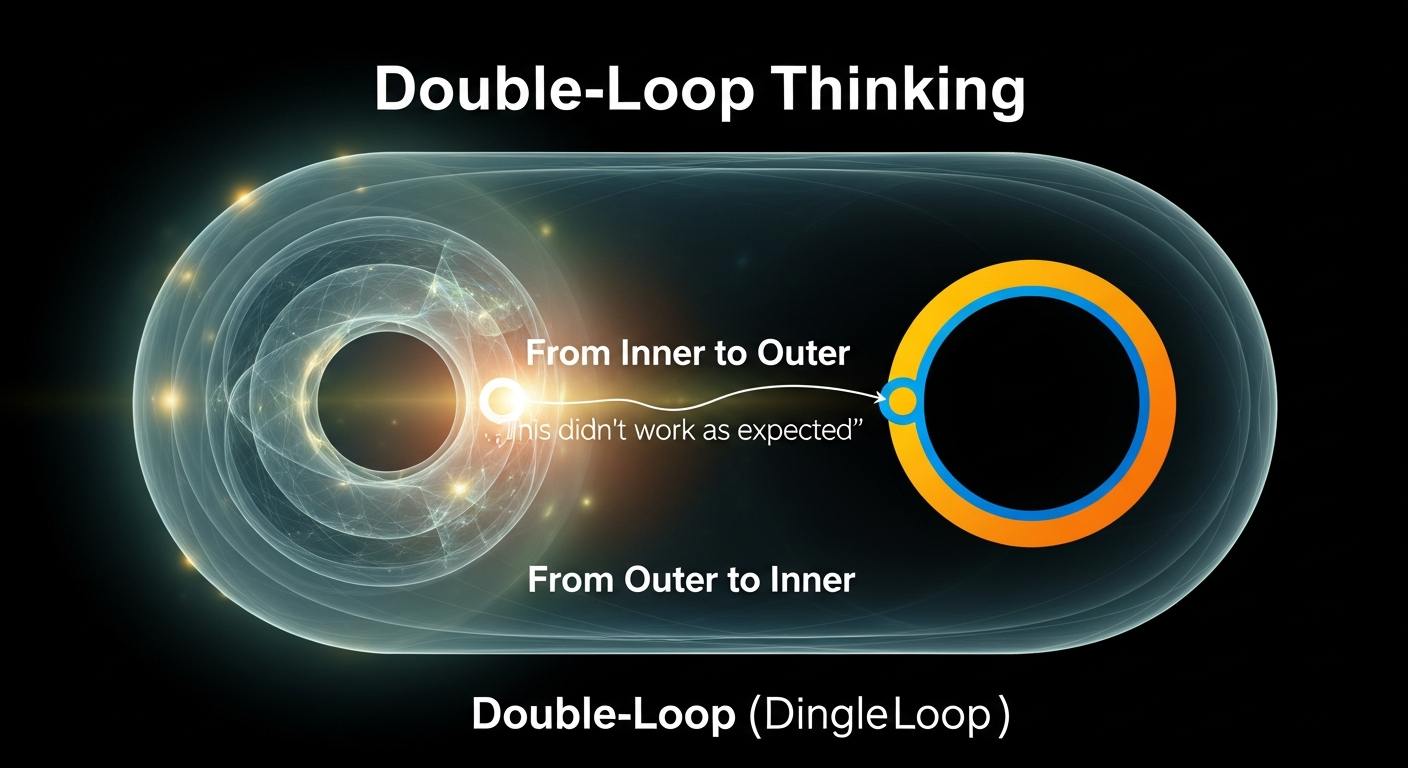
Embracing Double Loop Thinking: A Paradigm Shift for L&D Leaders
In an era defined by rapid technological advancements, evolving market dynamics, and unprecedented global challenges, organizations face a critical imperative: to not just adapt, but to proactively redefine their operating principles. For Vice Presidents, Directors, and Managers of Learning and Development (L&D), this mandate translates into a profound challenge – how to cultivate a workforce that doesn't just solve problems, but fundamentally rethinks the underlying assumptions that create those problems. This is where the power of Double Loop Thinking becomes indispensable, offering a framework for genuine organizational transformation and sustained competitive advantage.
L&D leaders across Compliance, Sales, Banking, Finance, Insurance, Retail, Pharma, Healthcare, Hospitality, Oil and Gas, and Mining sectors are continually striving to build resilient, innovative, and high-performing teams. Traditional training models, while effective for immediate skill acquisition, often fall short in fostering the deep critical inquiry necessary for strategic growth. Double Loop Thinking provides the methodology to move beyond surface-level fixes, enabling organizations to question and redesign their core strategies, policies, and beliefs.
What is Double Loop Thinking? Deeper Than Just Solving Problems
To fully grasp Double Loop Thinking, it's essential to understand its predecessor: Single Loop Thinking. Imagine a thermostat. When the room gets too cold, the thermostat (the system) detects the deviation and turns on the heater (the action) to bring the temperature back to the desired setting (the goal). This is Single Loop Thinking: detecting an error and taking corrective action within the existing framework of rules and goals. It’s about "doing things right."
Now, consider Double Loop Thinking. Instead of just turning on the heater, an individual employing this approach might ask: "Why is the room getting cold in the first place? Is the insulation adequate? Is the thermostat itself calibrated correctly? Are our energy consumption goals realistic given the building's design?" Double Loop Thinking questions the underlying assumptions, goals, and even the "rules of the game" themselves. It’s about "doing the right things" – fundamentally reassessing the framework that guides actions. This level of critical reflection is paramount for true innovation and long-term organizational health.
The Critical Imperative for L&D Leaders
For L&D professionals, fostering Double Loop Thinking isn't merely an academic exercise; it's a strategic necessity. In industries like Banking and Finance, where regulatory landscapes are constantly shifting, or Healthcare, where patient care protocols evolve with new research, simply adhering to existing guidelines (Single Loop) is insufficient. L&D must empower employees to scrutinize processes, anticipate future challenges, and even influence policy changes, thereby driving the organization forward proactively.
Consider the impact across diverse sectors:
- Compliance: Moving beyond rote memorization of rules to understanding the spirit behind regulations, enabling proactive risk mitigation and ethical decision-making. Risk-focused Training becomes about systemic change, not just adherence.
- Sales: Not just training on new product features, but questioning sales strategies, customer segmentation, and market approaches based on performance data and changing consumer behaviors.
- Pharma and Healthcare: Fostering a culture where professionals not only follow established treatment protocols but also critically evaluate their efficacy, propose improvements, and drive evidence-based practice.
- Oil and Gas/Mining: Beyond safety checklists, encouraging a deep dive into root causes of incidents, examining underlying safety cultures, and redesigning operational philosophies.
- Retail and Hospitality: Moving past customer service scripts to truly understanding guest needs, challenging service delivery models, and innovating the customer experience.
Implementing Double Loop Thinking Through Modern eLearning
The challenge for L&D is to design learning experiences that move beyond information dissemination to genuine cognitive restructuring. This requires a shift in pedagogical approach, often facilitated by cutting-edge eLearning technologies.
- Scenario-Based Learning & Simulations: Instead of telling learners what to do, present complex, ambiguous scenarios that force them to analyze, make decisions, and reflect on the outcomes. This is particularly effective for high-stakes environments in Finance or Healthcare.
- Collaborative Problem Solving: Encourage learners to work in groups to deconstruct real-world problems, fostering dialogue and challenging individual assumptions. This can be supported by discussion forums and peer feedback mechanisms within an Microlearning LMS.
- Reflective Practice: Integrate activities that explicitly prompt learners to reflect on their learning journey, biases, and the effectiveness of current strategies. Journaling, peer coaching, and structured debriefs are powerful tools.
- Feedback Loops and Iteration: Design learning programs that are themselves subject to Double Loop Thinking. Gather feedback not just on course satisfaction, but on whether the learning objectives are still relevant, or if the underlying organizational problems have been adequately addressed.
- Personalized Learning Paths: Utilize Adaptive Learning technologies to present content and challenges tailored to individual learners' existing knowledge and identified gaps. This allows for more targeted intervention in addressing underlying assumptions.
- Engaging and Interactive Experiences: A Gamified LMS can provide an environment where experimentation and failure are safe, encouraging learners to take risks and challenge established norms without fear of real-world consequences.
- Efficient Content Creation: An AI Powered Authoring Tool can dramatically speed up the creation of diverse, scenario-rich content, allowing L&D teams to focus more on instructional design that promotes critical thinking rather than just content generation.
Advanced Intelligence and Learning: Answering Key Questions
As L&D leaders navigate this shift, questions naturally arise about how modern technology can aid in fostering deeper thinking.
How can L&D leverage advanced tools to foster deeper learning and critical reflection across diverse industries?
Sophisticated learning platforms, particularly those integrating artificial intelligence, can analyze learner interactions, identify patterns in decision-making, and even flag areas where fundamental assumptions might be hindering progress. They can then present tailored challenges or reflective prompts, nudging learners towards a double-loop perspective. For instance, in a sales training scenario, an intelligent system could highlight repeated failures in closing deals not just due to product knowledge, but due to a learner's underlying belief about customer resistance, prompting a re-evaluation of their approach.
How can intelligent platforms tailor learning experiences to meet specific regional regulations or industry-specific challenges, such as in finance or healthcare?
Learning systems equipped with advanced analytical capabilities can be configured to understand and respond to highly localized or niche industry requirements. By leveraging data on learner performance against specific regulatory or operational challenges (e.g., anti-money laundering protocols in different jurisdictions, specific patient safety guidelines in various hospital settings), these platforms can adapt content, provide hyper-relevant case studies, and simulate scenarios that directly address industry-specific assumptions and procedures, ensuring relevance and compliance.
What role does intelligent automation play in continuously refining and optimizing learning pathways based on learner performance and evolving organizational needs?
Intelligent automation is pivotal in creating truly dynamic learning environments. By continuously monitoring learner progress, engagement, and the efficacy of different learning interventions, these systems can automatically adjust pathways, introduce new modules, or recommend supplementary resources. Furthermore, by integrating with organizational performance data, they can identify emerging skill gaps or strategic challenges, proactively refining the learning content to address these evolving needs, thereby creating a perpetual loop of learning and adaptation that mirrors Double Loop Thinking at an organizational level.
Conclusion: Leading with Insight
Double Loop Thinking is more than just a buzzword; it's a foundational philosophy for L&D leaders striving to build future-ready organizations. By moving beyond single-loop corrections and actively encouraging critical inquiry into underlying assumptions, L&D can cultivate a workforce that is not only proficient but truly innovative and resilient.
The integration of modern eLearning methodologies and advanced technological capabilities provides the tools necessary to embed Double Loop Thinking into the very fabric of organizational learning. As L&D professionals, your role is to champion this shift, transforming your teams from problem-solvers to strategic innovators, capable of not just navigating change, but actively shaping the future of their respective industries.
.jpg)


