

What Is Double-Loop Learning? A Strategic Imperative for L&D Leaders
In today's hyper-competitive and rapidly evolving business landscape, the ability to learn and adapt is no longer a mere advantage—it's a survival mechanism. For Vice Presidents, Directors, and Managers of Learning & Development, guiding an organization through this complexity requires more than just updating skills. It demands a profound shift in how learning itself is understood and implemented. This is where double-loop learning emerges as a critical framework, moving beyond superficial problem-solving to challenge the very foundations of an organization's beliefs and behaviors.
Imagine a scenario where your organization consistently encounters the same issues, despite repeated training interventions. This often points to a single-loop learning approach. Double-loop learning, conversely, is about asking "why" at a deeper level, questioning the underlying assumptions and mental models that lead to those problems in the first place. It's about systemic change, fostering true organizational agility, and preparing your workforce not just for today's challenges but for tomorrow's unknowns across industries like Compliance, Sales, Banking, Finance, Insurance, Retail, Pharma, Health care, Hospitality, Oil and Gas, and Mining.
The Limitations of Single-Loop Learning
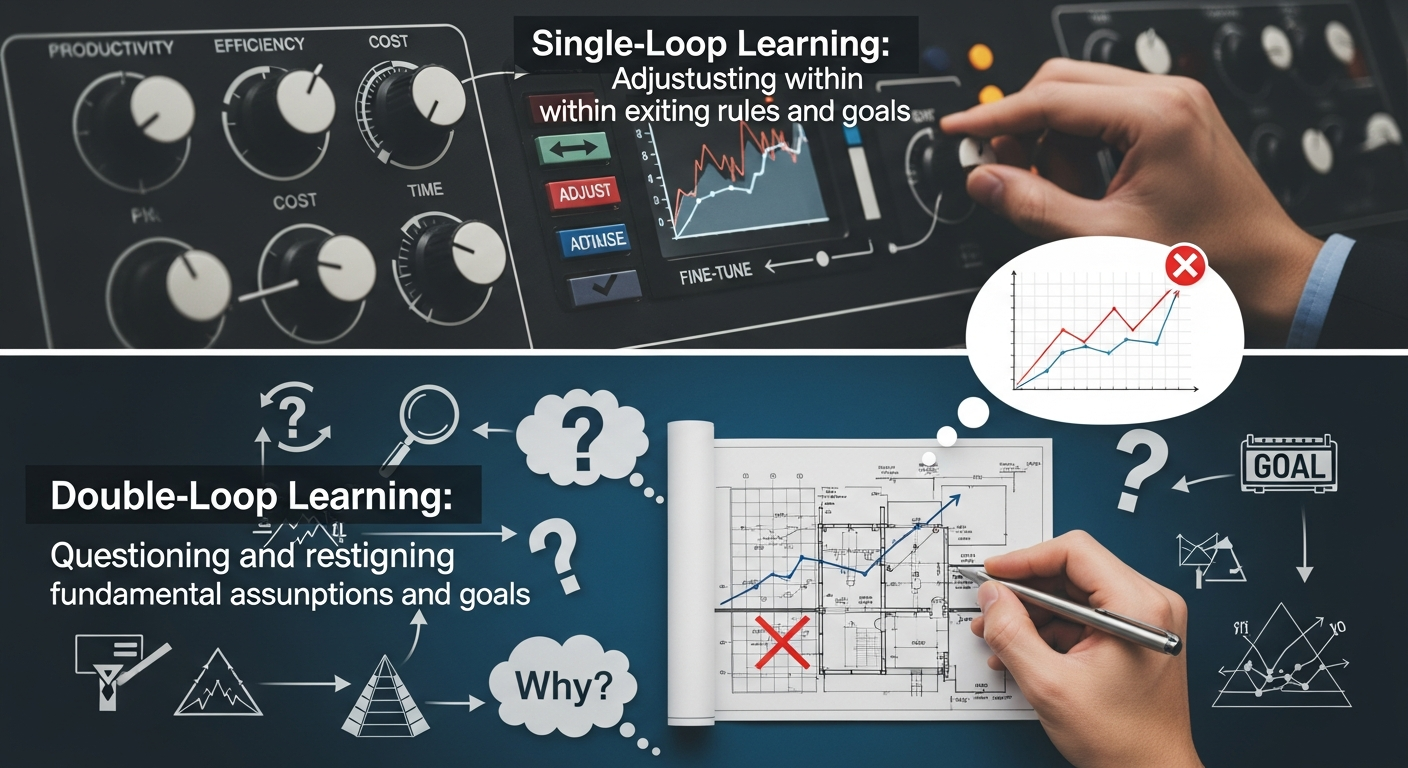
To truly grasp double-loop learning, it's essential to understand its counterpart. Single-loop learning is akin to a thermostat. When the room gets too cold, the thermostat turns on the heater. The goal is to maintain a desired state by detecting an error and correcting it without questioning the underlying setting. In an organizational context, this translates to:
- Identifying a problem (e.g., low sales figures, compliance breaches, customer complaints).
- Implementing a solution within existing rules and norms (e.g., more sales training, new compliance checklist, revised customer service script).
- Evaluating the immediate outcome.
While effective for routine problem-solving, single-loop learning falls short when issues stem from flawed policies, outdated strategies, or deeply ingrained cultural norms. For example, if a banking institution faces recurring data security breaches, single-loop learning might focus on additional cybersecurity training modules. Double-loop learning, however, would ask: "Why are our security protocols insufficient? Are our assumptions about threat vectors outdated? Does our corporate culture inadvertently encourage risky behaviors?"
Delving into Double-Loop Learning
Developed by Chris Argyris and Donald Schön, double-loop learning involves not only changing actions but also modifying the underlying values, beliefs, assumptions, and policies that guide those actions. It’s a process of challenging the fundamental framework within which problems are defined and solutions are sought.
Key Characteristics of Double-Loop Learning:
- Critical Reflection: It encourages individuals and teams to reflect on their own thinking processes, biases, and the mental models they use to interpret situations.
- Questioning the Status Quo: It involves openly challenging existing rules, policies, and organizational structures, rather than simply working within them.
- Systemic Thinking: It looks beyond immediate symptoms to understand root causes and interconnectedness within the broader system.
- Challenging Assumptions: It forces organizations to examine the deeply held beliefs that often go unexamined but dictate behavior. For instance, in pharma, it might mean questioning the traditional drug development pipeline in favor of more agile, patient-centric approaches.
- Promoting Open Dialogue: It thrives in environments where psychological safety allows for candid feedback, dissenting opinions, and uncomfortable truths to be shared.
The benefits are profound: enhanced innovation, greater adaptability, more robust problem-solving, and ultimately, sustainable organizational growth. In industries like Oil and Gas, where safety and operational efficiency are paramount, questioning established procedures and assumptions can prevent catastrophic incidents and unlock new efficiencies. For Retail, it could mean reimagining the entire customer experience based on evolving consumer behaviors, rather than just tweaking existing sales strategies.
The Transformative Power for L&D Leaders
For L&D professionals, embracing double-loop learning means shifting from being mere trainers to strategic partners who facilitate organizational transformation. It requires designing learning experiences that cultivate critical thinking, promote self-awareness, and encourage a culture of inquiry.
This includes:
- Developing programs that go beyond skill acquisition to challenge fundamental mindsets.
- Fostering environments where failure is seen as a learning opportunity, not a punitive event.
- Implementing feedback mechanisms that prompt reflection on underlying assumptions.
- Leveraging tools that enable continuous, reflective learning, such as a Microlearning LMS that supports iterative content development and rapid feedback cycles.
Consider the Health care sector: rather than just training staff on new compliance regulations (single-loop), double-loop learning would prompt an examination of why previous regulations were not fully adhered to, questioning the efficacy of existing protocols or the underlying culture around safety and adherence. This deeper inquiry leads to more robust and lasting improvements.
Implementing Double-Loop Learning in Your Organization
Cultivating a double-loop learning culture is a long-term commitment, but the rewards are significant. Here's how L&D leaders can spearhead this transformation:
- Foster Psychological Safety: Create an environment where employees feel safe to voice concerns, challenge norms, and admit mistakes without fear of retribution. This is foundational.
- Encourage Critical Reflection: Integrate reflection exercises into training programs, project post-mortems, and performance reviews. Ask "why" repeatedly.
- Design Learning for Inquiry: Move beyond prescriptive training. Design modules that encourage exploration, debate, and problem-solving. A Gamified LMS can provide a safe sandbox for challenging assumptions and experimenting with new approaches.
- Champion Data-Driven Insights: Use data not just to measure outcomes but to uncover patterns and discrepancies that challenge existing assumptions.
- Lead by Example: L&D leaders must model double-loop learning by openly questioning their own strategies and seeking feedback on their approaches.
- Invest in Adaptive Methodologies: Employing Adaptive Learning techniques can tailor content not just to what learners know, but to challenge their existing mental models effectively.
AI's Role in Accelerating Double-Loop Learning
The advent of advanced technologies, particularly artificial intelligence, offers unprecedented opportunities to supercharge double-loop learning within organizations. These intelligent systems can act as powerful catalysts for deeper inquiry and systemic change.
How can intelligent systems support deeper organizational learning?
Artificial intelligence, through its capacity for advanced data analytics and pattern recognition, can quickly surface inconsistencies between stated policies and actual behaviors, or highlight gaps in assumptions that human observation might miss. It can analyze vast datasets from customer interactions, operational processes, and employee feedback to reveal underlying systemic issues that drive recurring problems. For instance, in Sales, AI might pinpoint not just *what* training is needed, but *why* specific sales strategies are failing across different regions, prompting a re-evaluation of the core sales philosophy itself. An AI Powered Authoring Tool can then rapidly generate and adapt content to address these newly identified systemic flaws.
What are the implications of promoting such profound organizational learning across geographically dispersed teams and global operations?
Fostering double-loop learning in global contexts can significantly enhance cross-cultural understanding and operational consistency while preserving local adaptability. By leveraging intelligent collaboration platforms, global teams can share insights and challenge assumptions across different markets, breaking down silos. This leads to the development of universally effective strategies that are also sensitive to local nuances, especially critical for multinational corporations in Banking or Insurance. It ensures that lessons learned in one region inform and refine practices globally, moving beyond superficial fixes to address root causes that might manifest differently across various locations.
Which specific technological advancements are proving instrumental in fostering this advanced cognitive learning within enterprises?
Beyond traditional learning management systems, a new generation of technological advancements is facilitating double-loop learning. This includes sophisticated analytics platforms that provide diagnostic insights into learning efficacy and organizational performance, AI-driven simulation environments for safe experimentation with new strategies, and intelligent feedback systems that prompt deeper reflection. Furthermore, tools that enable rapid content iteration and personalization are crucial. For industries like Compliance or Pharma, where regulatory changes are constant and Risk-focused Training is paramount, AI can help identify emerging risks by analyzing regulatory landscapes and internal data, pushing organizations to question their current risk mitigation strategies proactively, rather than reactively.
Conclusion
Double-loop learning is more than a theoretical concept; it's a strategic imperative for any organization aiming for sustained success and innovation in the 21st century. For L&D leaders, championing this approach means moving beyond simply solving problems to transforming the very way your organization thinks, adapts, and grows. By fostering a culture of deep inquiry, critical reflection, and leveraging intelligent technologies, you can empower your workforce to not just navigate change, but to actively shape the future of your industry.
.jpg)


