

Mastering Organizational Agility: Double Loop Learning Vs. Single Loop Learning for L&D Leaders
In the dynamic landscape of modern business, the ability to adapt, innovate, and continuously improve is paramount. For Vice Presidents, Directors, and Managers of Learning & Development, this challenge translates into fostering an organizational culture that not only reacts to change but proactively shapes its future. At the heart of this transformative capability lie two distinct approaches to learning: Single Loop Learning and Double Loop Learning. Understanding their nuances is not just academic; it's a strategic imperative for driving sustainable growth and competitive advantage across all industries, from Compliance and Sales to Banking, Healthcare, and Oil & Gas.
Understanding Single-Loop Learning: The 'Fix the Problem' Approach
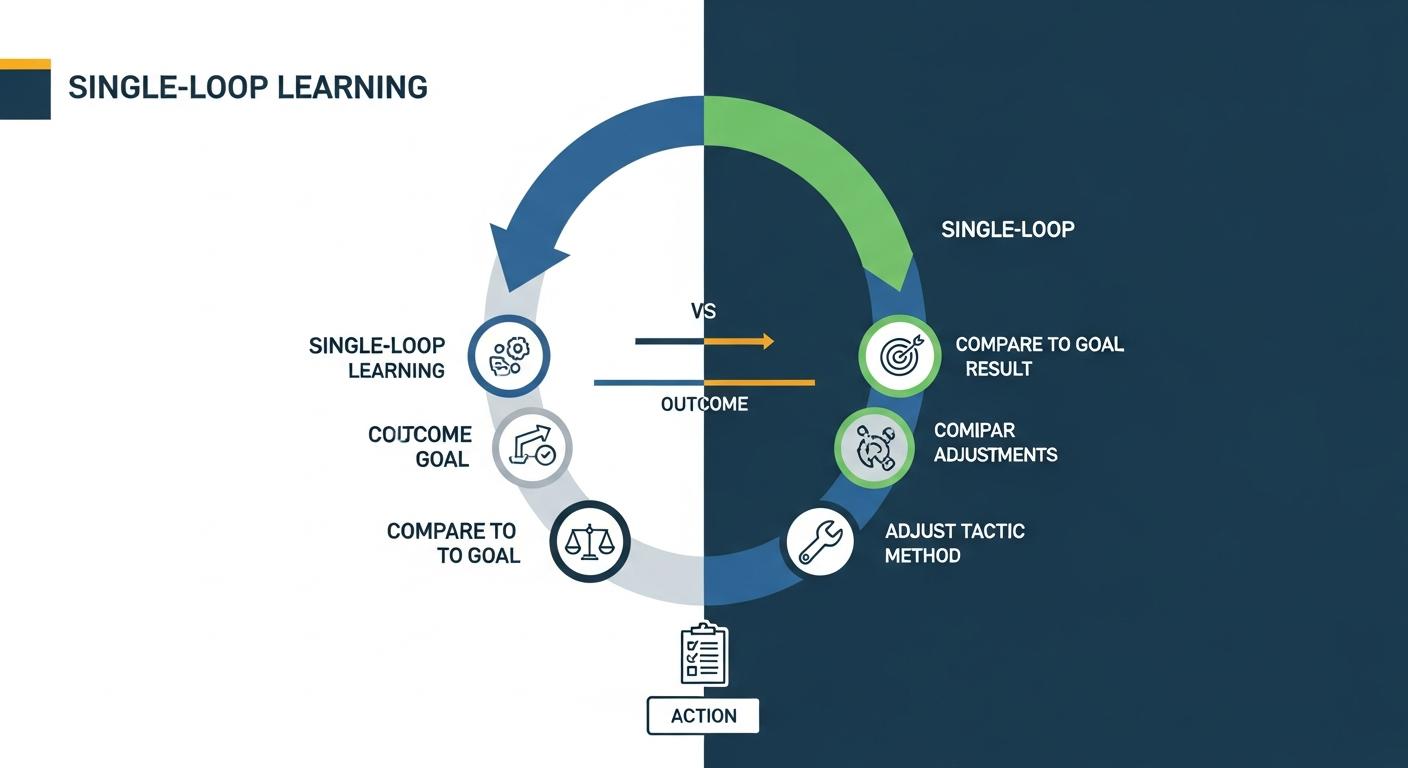
Single Loop Learning is the most common and often the initial response to performance gaps or errors. It involves detecting and correcting errors to maintain existing norms and achieve predefined goals. Think of it as a thermostat: when the room gets too cold, it switches on the heater to bring the temperature back to the set point. The thermostat doesn't question why the temperature dropped, nor does it re-evaluate the ideal temperature setting itself.
In the context of L&D, Single Loop Learning often manifests when training programs are modified based on immediate feedback. For instance:
- If a compliance training module yields low pass rates, an L&D team might revise specific questions or add more explanatory content to improve scores.
- When sales figures drop after a new product launch, a sales training program might be adjusted to include more objection-handling techniques.
- If employee engagement surveys show dissatisfaction with a particular policy, managers might receive training on how to better communicate or enforce that policy.
While efficient for quick fixes and essential for maintaining operational standards, Single Loop Learning has its limitations. It operates within the existing framework, values, and assumptions of an organization. It doesn't ask the deeper "why" questions, nor does it challenge the fundamental beliefs or strategies that might be contributing to the problems in the first place. This can lead to a cycle of addressing symptoms without ever curing the underlying disease.
The Power of Double-Loop Learning: Questioning the 'Why'
Double Loop Learning, a concept introduced by Chris Argyris and Donald Schön, goes a significant step further. Instead of just correcting errors, it involves questioning the underlying assumptions, values, policies, and mental models that led to those errors. It's about changing the 'master program' or the 'rules of the game' itself, rather than just playing within them more effectively.
To use the thermostat analogy again: Double Loop Learning would involve asking why the room gets cold in the first place (e.g., is the insulation poor? Is the window open?) and also questioning whether the set temperature is truly optimal for comfort and energy efficiency. It leads to a fundamental re-evaluation and potential transformation of the system.
For L&D professionals, embracing Double Loop Learning means shifting from merely updating training content to critically examining the entire learning ecosystem and its relationship with organizational goals. Examples include:
- Instead of just improving a compliance module, asking: "Are our compliance policies outdated or inherently confusing? Does our organizational culture inadvertently encourage non-compliance?"
- Beyond adjusting sales training, asking: "Is our sales strategy flawed? Are we targeting the right customers? Does our compensation structure disincentivize certain behaviors?"
- When facing employee dissatisfaction, asking: "Are our HR policies aligned with our stated values? Does our leadership style create a psychologically unsafe environment?"
Double Loop Learning is inherently more challenging because it requires introspection, vulnerability, and a willingness to confront ingrained beliefs and power structures. However, its payoff is significant: profound, sustainable change, increased innovation, and enhanced organizational resilience.
Why Double-Loop Learning Matters in Modern L&D
In today's fast-evolving business environment, Single Loop Learning is no longer sufficient. Industries are being disrupted at unprecedented rates, regulatory landscapes are constantly shifting, and talent expectations are evolving. L&D leaders must champion Double Loop Learning to:
- Drive True Innovation: By questioning fundamental assumptions, organizations can uncover entirely new ways of operating, leading to breakthrough products, services, and processes.
- Enhance Agility & Resilience: Companies that engage in Double Loop Learning are better equipped to anticipate and respond to market shifts, rather than merely reacting to them.
- Foster a Culture of Continuous Improvement: It moves beyond tactical adjustments to embed a strategic mindset where questioning and learning are core to the organizational DNA.
- Optimize Resource Allocation: By addressing root causes, L&D investments become more impactful, moving beyond superficial fixes to strategic interventions that yield lasting results.
- Boost Employee Engagement & Development: Empowering employees to challenge the status quo fosters a sense of ownership, psychological safety, and growth.
Real-World Application in Various Industries
Compliance
In highly regulated sectors, Double Loop Learning ensures that training isn't just about checking boxes, but about instilling a deep understanding of ethical frameworks and risk mitigation. For instance, rather than just updating anti-money laundering training based on new regulations, a financial institution might question its entire risk assessment methodology and the cultural factors that could lead to non-compliance. This can be enhanced through Risk-focused Training strategies.
Sales
Beyond sales techniques, Double Loop Learning allows sales organizations to re-evaluate their customer acquisition strategies, product positioning, and even the core value proposition. If sales are stagnant, it might not be the pitch that's failing, but the underlying market analysis or product-market fit. Leveraging an AI Powered Authoring Tool can help analyze performance data at a deeper level to identify these systemic issues.
Banking & Finance
In this sector, Single Loop Learning might involve adjusting fraud detection software. Double Loop Learning would entail examining the entire security protocol, employee training on digital hygiene, and the organizational culture around reporting anomalies, thereby leading to truly robust systems. An Adaptive Learning approach can customize training to address specific departmental vulnerabilities.
Healthcare & Pharma
Addressing medical errors via Single Loop Learning means retraining on procedures. Double Loop Learning asks: "Are our patient safety protocols designed effectively? Do staff have sufficient psychological safety to report errors without fear of reprisal? Is the organizational structure itself contributing to fatigue or miscommunication?"
Leveraging Technology for Double-Loop Learning
Modern eLearning solutions are powerful enablers of Double Loop Learning. They provide the infrastructure and analytics to move beyond superficial corrections to deep-seated organizational transformation:
- Agile Content Development and Delivery: A Microlearning LMS allows L&D teams to quickly deploy new learning modules, gather immediate feedback, and iterate not just on content, but on the very assumptions behind the training objectives. This agility supports rapid cycles of questioning and recalibration.
- Experiential Learning and Behavioral Shifts: A Gamified LMS can create safe environments for learners to experiment with new behaviors, challenge existing norms, and experience the consequences of different approaches without real-world repercussions. This helps in internalizing new mental models.
- Personalized and Reflective Journeys: Adaptive Learning platforms can guide individuals through personalized learning paths that not only teach new skills but also encourage critical thinking about existing practices and beliefs. This helps individuals to question their own cognitive biases and assumptions.
- Data-Driven Insights for Systemic Change: An AI Powered Authoring Tool can analyze vast amounts of performance data, learner interactions, and feedback to identify patterns and root causes that Single Loop Learning might miss. This data can then inform strategic discussions about organizational policies, processes, and culture.
- Proactive Risk Mitigation: By integrating insights from Risk-focused Training with a Double Loop Learning mindset, organizations can move from merely addressing compliance failures to proactively redesigning systems to prevent future risks based on a deeper understanding of human behavior and systemic vulnerabilities.
Common Online Queries & Their Answers
Question: How can L&D leaders foster a culture of profound organizational transformation?
Answer: True transformation in an organization starts when leaders encourage questioning not just 'how' things are done, but 'why' they are done that way. By promoting a Double Loop Learning mindset, L&D leaders can shift focus from quick fixes to challenging underlying assumptions, policies, and values. This involves creating safe spaces for reflection, critical dialogue, and experimentation, allowing teams to re-evaluate their mental models and design more effective systems from the ground up.
Question: What advanced learning strategies improve long-term employee performance across diverse enterprise settings?
Answer: To achieve sustained improvements in employee performance within large, complex organizations, L&D must implement strategies that move beyond mere skill acquisition. Advanced approaches like Adaptive Learning, gamified simulations, and scenario-based training that mirror real-world complexities are crucial. These methods, when integrated with analytics from powerful eLearning platforms, allow for continuous feedback and the examination of the effectiveness of core operational principles, leading to systemic improvements rather than temporary gains.
Question: How do leading organizations implement continuous improvement in training to meet evolving global standards?
Answer: Leading organizations achieve continuous improvement by embedding a reflective and inquisitive culture into their L&D practices. They don't just update training content; they continuously analyze the impact of training on business outcomes, questioning the very premises of their learning objectives and delivery methods. By leveraging flexible platforms like Microlearning Learning Management Systems and AI-powered authoring tools, they can rapidly iterate, gather deep insights into learner behavior and organizational effectiveness, and make strategic adjustments to their learning frameworks to align with ever-changing global regulatory and market demands.
Conclusion
For L&D VPs, Directors, and Managers, the choice between Single Loop and Double Loop Learning is a strategic one that defines the trajectory of organizational growth and resilience. While Single Loop Learning offers essential tactical corrections, it's Double Loop Learning that unlocks the potential for true innovation, sustainable change, and a genuinely adaptive enterprise. By consciously cultivating a culture that dares to question its own foundations and leveraging the power of advanced eLearning technologies, L&D can elevate its role from a support function to a central driver of strategic competitive advantage across every industry.
.jpg)


