

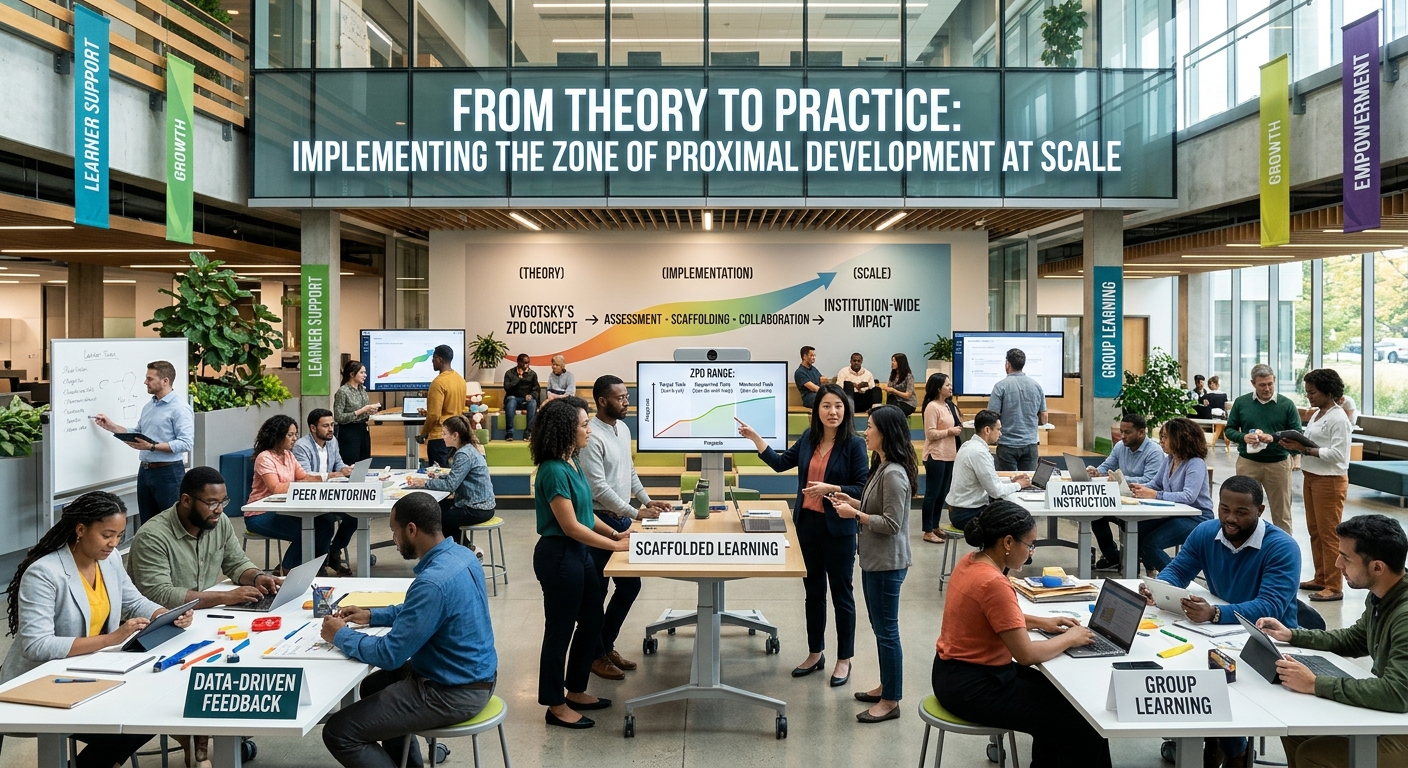
From Theory to Practice: Implementing the Zone of Proximal Development at Scale
In the dynamic landscape of corporate learning and development, the pursuit of truly effective training remains a paramount objective for L&D Vice Presidents, Directors, and Managers. One powerful pedagogical concept, often discussed in academic circles, holds immense potential for transforming organizational learning: Lev Vygotsky’s Zone of Proximal Development (ZPD). While its principles are well-understood, the challenge lies in moving from theory to practice, specifically in implementing ZPD at scale across diverse industries like Compliance, Sales, Banking, Finance, Insurance, Retail, Pharma, Healthcare, Hospitality, Oil and Gas, and Mining.
This article explores how L&D leaders can leverage modern LMS platforms and strategic frameworks to bring the personalized, growth-oriented power of ZPD to their entire workforce, fostering continuous skill enhancement and boosting business outcomes.
Understanding the Zone of Proximal Development in Corporate Learning
The Core Principle: Bridging the Gap
The Zone of Proximal Development describes the sweet spot in a learner's development – the range of tasks that a learner cannot yet perform independently but can accomplish with the guidance and encouragement of a more knowledgeable other (MKO). In a corporate context, the MKO could be a manager, a senior colleague, an expert, or even an intelligent learning management system. The goal is to provide just enough "scaffolding" to help the learner bridge the gap between their current ability and their potential, gradually internalizing new skills.
For L&D professionals, this means moving beyond one-size-fits-all training. It requires identifying individual skill gaps, understanding what each employee is ready to learn next, and providing targeted support to help them master those next-level competencies. This approach dramatically enhances engagement, retention, and ultimately, performance.
The Scalability Challenge: Why ZPD Isn't Just for One-on-One
Traditionally, ZPD has been associated with individualized tutoring or small group instruction, making L&D leaders question its feasibility for thousands of employees across different departments and global locations. How can you provide personalized scaffolding to an entire sales team across various regions, or ensure every healthcare professional receives tailored updates on new protocols? The answer lies in technology-driven solutions that enable intelligent personalization and flexible delivery.
Modern `enterprise learning management` solutions, particularly those offering advanced features, are pivotal in overcoming this scalability hurdle. They provide the infrastructure to manage vast amounts of `learning content management system` data and deliver customized experiences.
Leveraging Technology for ZPD at Scale
Personalized Learning Paths with Adaptive Learning
At the heart of scaled ZPD is the ability to adapt content and pathways to individual learner needs. Adaptive Learning systems analyze a learner's current knowledge, performance data, and learning style to recommend the next most relevant content or activity. This ensures that employees are always operating within their ZPD – not bored by redundant information, nor overwhelmed by overly complex material. For industries like Banking and Finance, where regulatory changes are constant, `adaptive learning` ensures that compliance training remains relevant and effective for every employee, irrespective of their role or prior experience.
Engaging Learners with Gamified LMS
Engagement is crucial for sustained learning, especially when asking employees to step outside their comfort zone. A Gamified LMS transforms learning into an interactive, motivating experience. By incorporating points, badges, leaderboards, and challenges, a `gamified learning management system` encourages learners to tackle new tasks, overcome obstacles, and collaborate with peers – all elements that naturally support ZPD. This is particularly effective for Sales training, where friendly competition can drive mastery of product knowledge or objection handling techniques, or in Hospitality for mastering customer service scenarios.
Efficient Content Creation with AI Powered Authoring Tool
Developing diverse, scaffolding-rich content for personalized learning can be resource-intensive. An AI Powered Authoring Tool dramatically streamlines this process. These tools can assist in generating scenarios, quizzes, and even full `microlearning modules` based on learning objectives and target competencies. They can also help break down complex topics into smaller, digestible chunks, making it easier to build progressive learning paths essential for ZPD. This is invaluable for industries with rapidly evolving information, such as Pharma and Healthcare, ensuring timely and accurate content delivery.
Delivering Targeted Learning via Microlearning LMS
Scaffolding doesn't have to be lengthy. Microlearning LMS solutions are perfectly suited for delivering bite-sized, on-demand support exactly when a learner needs it. A short video explaining a complex concept, an interactive simulation for practice, or a quick reference guide – these micro-interventions act as effective scaffolding, guiding learners through challenging tasks without overwhelming them. For frontline staff in Retail or for technicians in Oil and Gas, having access to immediate, relevant support through a `microlearning LMS` can significantly improve on-the-job performance and safety compliance.
Leading `learning management software` providers like MaxLearn LMS offer comprehensive `learning management solutions` that integrate these functionalities, making it easier for organizations to implement ZPD at scale.
Implementing ZPD: A Strategic Framework for L&D Leaders
To successfully integrate ZPD principles into your corporate learning strategy, consider the following framework:
- Assessment & Diagnostics: Utilize advanced analytics within your `lms learning management system` to accurately assess current skill levels and identify specific learning gaps. Pre-assessments, performance data, and feedback mechanisms are crucial.
- Scaffolding & Support: Design diverse learning resources that offer varying levels of support. This includes structured courses, interactive simulations, collaborative projects, expert mentorship, and on-demand reference materials. A robust `LCMS` can manage this content effectively.
- Feedback & Iteration: Implement continuous feedback loops. Leverage AI for immediate feedback on practice exercises, peer feedback for collaborative tasks, and manager feedback for real-world application. Use this data to refine learning paths.
- Measuring Impact: Beyond completion rates, measure the actual application of new skills and their impact on business KPIs. Your `cloud based learning management system` should provide comprehensive reporting capabilities to demonstrate ROI.
AI-Driven Insights for ZPD Implementation
Artificial intelligence is not just a buzzword; it's a powerful enabler for scaling ZPD. L&D leaders often ask:
Question: How can artificial intelligence personalize learning experiences for diverse employee skill levels?
Answer: AI algorithms can analyze vast amounts of learner data – including previous course performance, role requirements, career aspirations, and even learning style preferences – to create highly individualized learning paths. Predictive analytics can anticipate potential learning roadblocks and proactively suggest targeted `microlearning modules` or additional resources. This dynamic personalization ensures each employee is continuously working within their Zone of Proximal Development, receiving content that is challenging yet achievable, significantly more effective than generic training programs.
Question: What regional training initiatives benefit most from a scalable, AI-supported Zone of Proximal Development approach?
Answer: Industries requiring high levels of regulatory compliance or specialized skills, such as Pharma, Healthcare, and Oil and Gas, can significantly benefit. For example, compliance training related to local regulations can be dynamically adapted for employees in different countries, ensuring relevance while maintaining a global standard. Sales teams operating across diverse markets can receive `adaptive learning` content tailored to regional product variations or cultural selling nuances. AI helps localize and personalize at scale, ensuring every region receives training that is precisely within their ZPD for optimal impact.
Question: How do intelligent learning systems optimize instructional design to target individual learner's immediate developmental needs?
Answer: Intelligent learning systems utilize machine learning to observe learner interactions and performance in real-time. If a learner struggles with a particular concept, the system can immediately offer alternative explanations, provide additional practice exercises, or suggest collaborating with a peer or expert. Conversely, if a learner demonstrates mastery, the system can fast-track them to more advanced topics. This dynamic adjustment of scaffolding and content ensures that instructional design is constantly optimized to meet the learner precisely where they are, pushing them forward efficiently within their ZPD.
ZPD in Specific Industries: Practical Applications
- Compliance: For Banking, Finance, and Insurance, Risk-focused Training built on ZPD principles ensures employees understand not just the rules, but the nuanced application of those rules in complex scenarios, minimizing organizational exposure.
- Sales: In Retail and Sales, ZPD supports continuous skill refinement, from product knowledge to advanced negotiation techniques. An `enterprise learning management` system can track progress and recommend next steps.
- Healthcare: For clinical procedures or patient interaction, ZPD-informed training allows healthcare professionals to practice new skills in safe, simulated environments with immediate feedback, progressing from guided practice to independent execution.
Conclusion
Implementing the Zone of Proximal Development at scale is no longer an academic ideal; it's a practical, achievable strategy for L&D leaders committed to elevating workforce capabilities. By embracing advanced `learning management solutions` such as Microlearning LMS, Gamified LMS, and `AI Powered Authoring Tools`, organizations can create a learning ecosystem that genuinely fosters growth, enhances engagement, and drives measurable business outcomes across all industries. The future of corporate learning is personalized, adaptive, and scalable – and it starts with a strategic embrace of ZPD, powered by a robust `MaxLearn LMS`.


