

Bridging the Skills Gap: Vygotsky’s Theory of Learning Meets Enterprise Tech
In today's rapidly evolving business landscape, the skills gap is more than just a buzzword; it's a critical challenge impacting productivity, innovation, and competitive advantage across industries ranging from Compliance and Sales to Banking, Finance, Insurance, Retail, Pharma, Healthcare, Hospitality, Oil and Gas, and Mining. Learning and Development (L&D) leaders – VPs, Directors, and Senior Managers – are constantly seeking strategies to empower their workforces with the capabilities needed to thrive. What if the answer lies not just in cutting-edge enterprise technology, but in a profound psychological theory of learning developed almost a century ago? Enter Lev Vygotsky, whose socio-cultural theory offers a timeless framework for understanding how people learn, a framework now being powerfully amplified by modern enterprise tech.
Vygotsky's Legacy: The Social-Cultural Lens on Learning
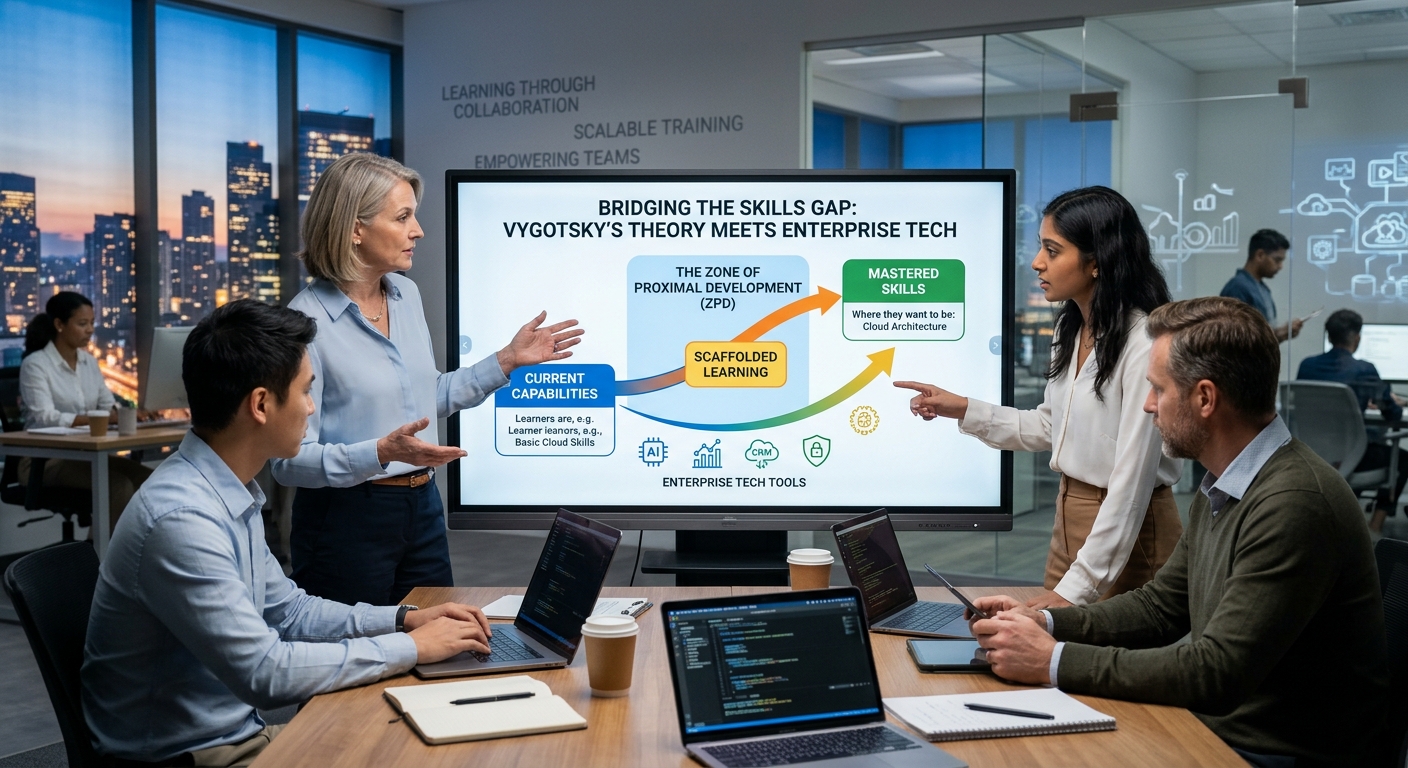
Lev Vygotsky, a Soviet psychologist, posited that learning is fundamentally a social process. His key concepts – the Zone of Proximal Development (ZPD) and the More Knowledgeable Other (MKO) – provide a compelling blueprint for effective instruction:
- Zone of Proximal Development (ZPD): This is the sweet spot of learning – the difference between what a learner can achieve independently and what they can achieve with guidance from a more skilled individual. It's where optimal learning occurs, challenging without overwhelming.
- More Knowledgeable Other (MKO): The MKO is anyone (or anything) that has a better understanding or higher ability level than the learner regarding a specific task, concept, or process. Traditionally, this was a teacher, mentor, or peer. In the modern enterprise, the MKO takes on new, technology-driven forms.
- Social Interaction: Vygotsky emphasized that learning happens through collaborative dialogues and interactions, where knowledge is co-constructed.
For L&D professionals, these insights are gold. They underscore the importance of tailored support, peer learning, and environments that foster guided discovery, rather than just passive information consumption. The challenge has always been how to scale such personalized, interactive learning across a large, diverse enterprise.
The Modern Skills Gap: An Enterprise Challenge
The imperative to bridge the skills gap has never been more urgent. Whether it’s compliance officers needing to master new regulatory frameworks, sales teams adapting to AI-driven CRM tools, bankers navigating FinTech innovations, or healthcare professionals learning new treatment protocols, the pace of change demands continuous upskilling and reskilling. Traditional training methods often fall short, struggling with issues of scale, relevance, engagement, and measurable impact. This is where the synthesis of Vygotsky's theory and advanced enterprise learning solutions becomes transformative.
Consider a key question for L&D leaders: How can we precisely identify global skill deficiencies across our diverse workforce? The answer often lies in leveraging data analytics within a robust LMS. By understanding specific departmental, regional, and individual skill sets, L&D can pinpoint ZPDs more accurately. Furthermore, what are the most effective strategies to personalize learning pathways for each employee's unique development needs? This moves beyond one-size-fits-all training to an Adaptive Learning approach, driven by intelligent systems that act as an MKO, guiding learners through their specific ZPD.
Enterprise Tech as the MKO: Facilitating the ZPD
Today, enterprise technology can powerfully embody the role of the More Knowledgeable Other, creating environments ripe for learning within the Zone of Proximal Development. Here’s how:
1. Microlearning and Focused Development
Vygotsky's ZPD suggests that learning is most effective when content is just beyond a learner's current grasp, but not overwhelmingly complex. Microlearning LMS platforms deliver bite-sized, highly focused content that aligns perfectly with this principle. Instead of lengthy courses, learners receive targeted modules addressing specific skill gaps, allowing them to master one concept at a time within their ZPD, whether they are in retail learning new POS systems or in pharma understanding a new drug's mechanisms.
2. Gamified LMS for Engagement and Social Interaction
Vygotsky emphasized social interaction. Modern Gamified LMS platforms leverage competition, collaboration, and immediate feedback to simulate rich social learning environments. Leaderboards, badges, and team challenges encourage learners to interact, share knowledge, and even compete constructively, fostering the kind of peer-to-peer MKO relationships Vygotsky envisioned. This is particularly effective in sales training, where role-playing and competitive scenarios can be simulated.
3. Adaptive Learning for Personalized Guidance
An Adaptive Learning system intelligently analyzes a learner's performance and knowledge gaps, then tailors the content delivery path accordingly. This technology acts as a dynamic MKO, constantly assessing the learner’s ZPD and providing the precise level of scaffolding needed. For instance, in banking compliance, an adaptive system can guide an employee through complex regulations, providing extra resources on areas where they struggle, much like a human mentor would.
4. AI-Powered Authoring for Scalable Content Creation
Creating vast amounts of relevant, high-quality learning content for a global workforce can be a bottleneck. An AI Powered Authoring Tool dramatically speeds up this process, enabling L&D teams to generate personalized modules, assessments, and scenarios. This ensures that the "MKO" – the learning content itself – is always fresh, relevant, and targeted, allowing L&D leaders to focus on strategic initiatives rather than manual content creation. This is invaluable in industries like healthcare, where information changes rapidly.
5. Risk-Focused Training for Critical Competencies
In high-stakes industries like oil and gas, mining, and finance, identifying and mitigating risks through targeted training is paramount. Risk-focused Training, often powered by intelligence, proactively identifies areas of potential exposure and delivers precise interventions. This ensures that employees are equipped with the knowledge to handle critical situations, effectively closing ZPDs in crucial risk areas and preventing costly errors.
Implementing Vygotsky in Enterprise Learning Systems
To truly bridge the skills gap, L&D leaders need more than just individual tech solutions; they need an integrated ecosystem. A robust LMS forms the backbone of such an ecosystem, bringing together microlearning, gamification, adaptive paths, and intelligent content creation. A modern learning management system should not merely be a content repository but a dynamic platform that facilitates Vygotskian principles at scale.
For large organizations, a cloud based learning management system offers unparalleled accessibility and flexibility, enabling employees across different time zones and locations to engage with their MKOs (both human and technological) seamlessly. An effective enterprise learning management strategy also considers how a comprehensive learning content management system (LCMS) integrates content creation, delivery, and tracking, ensuring a cohesive learning experience.
Ultimately, a transformative learning management software goes beyond basic functionalities, providing learning management solutions that are deeply rooted in how people actually learn. The goal is to maximize the impact of every learning intervention. Beyond just tracking completion, how do we measure the actual impact of training on performance and business outcomes? This requires advanced analytics capabilities within the MaxLearn LMS, allowing L&D to demonstrate ROI and continuously refine their strategy.
Conclusion
The synergy between Vygotsky’s socio-cultural theory of learning and advanced enterprise technology offers a powerful paradigm for L&D leaders. By consciously designing learning experiences that leverage enterprise tech as the More Knowledgeable Other, we can effectively guide employees through their Zone of Proximal Development. From personalized Microlearning LMS paths to engaging Gamified LMS experiences and intelligent Adaptive Learning systems, the tools are now available to create truly transformative learning environments. For L&D VPs, Directors, and Managers, this isn't just about implementing new tech; it's about embracing a deeper understanding of human learning to cultivate a continuously skilled, adaptive, and high-performing workforce ready for tomorrow’s challenges across every industry.


