

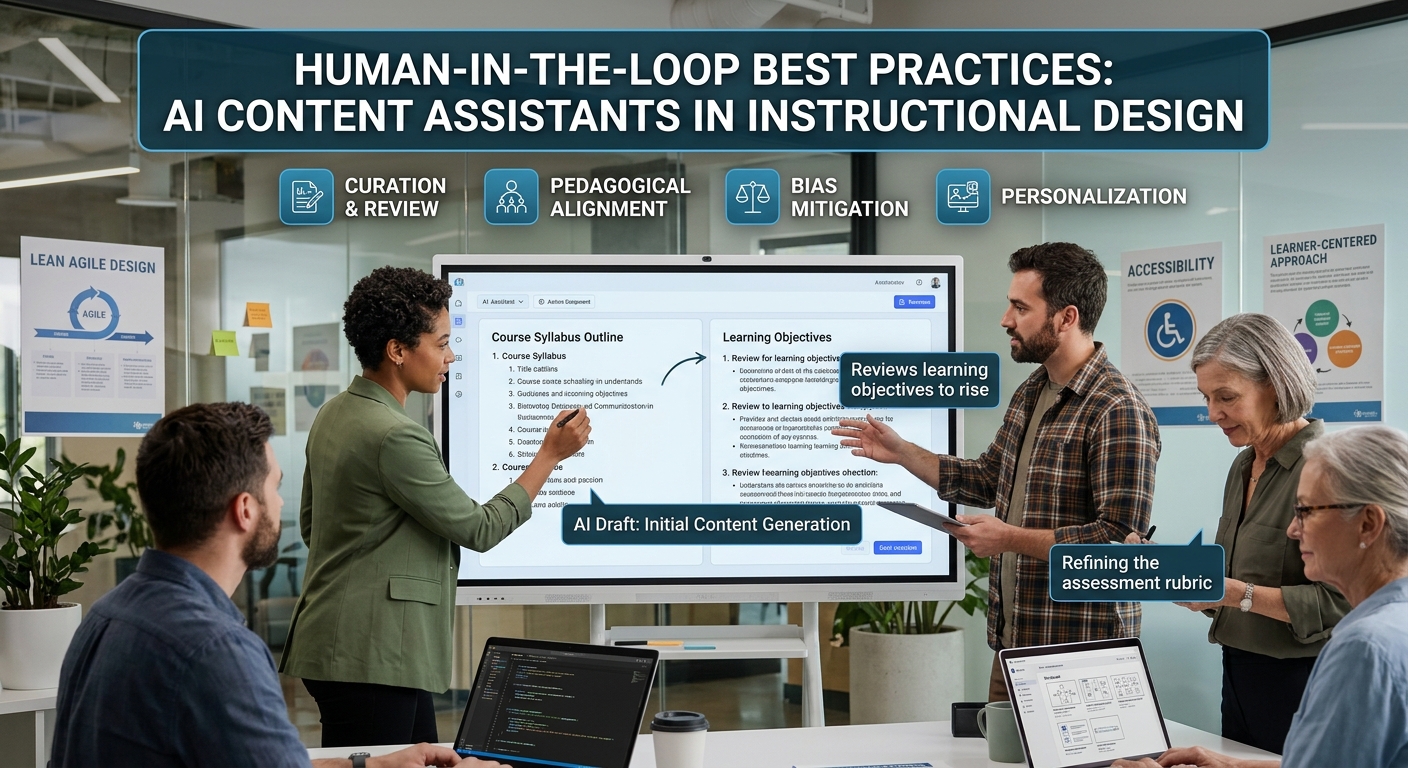
AI Content Assistants in Instructional Design: Human-in-the-Loop Best Practices for L&D Leaders
The landscape of corporate learning and development is undergoing a transformative shift, driven by advancements in artificial intelligence. For Vice Presidents, Directors, and Managers of L&D across diverse industries—from Compliance and Sales to Banking, Finance, Insurance, Retail, Pharma, Healthcare, Hospitality, Oil and Gas, and Mining—the integration of AI content assistants presents both unprecedented opportunities and unique challenges. These powerful tools promise to revolutionize how we create, deliver, and manage learning experiences, yet their true potential is unlocked only when coupled with strategic human oversight. This article delves into the critical best practices for implementing a "human-in-the-loop" approach, ensuring that AI enhances, rather than replaces, the invaluable expertise of instructional designers.
Understanding the Role of AI Content Assistants in L&D
What exactly are AI content assistants in the realm of corporate training? Simply put, these are sophisticated software applications powered by artificial intelligence that can generate, analyze, and optimize various forms of content. For instructional design, their capabilities range from drafting initial course outlines, generating quiz questions, summarizing complex texts, or even crafting entire module scripts. They excel at processing vast amounts of information quickly, identifying patterns, and producing content at scale.
How do these digital tools benefit the instructional design process? By automating repetitive tasks, AI content assistants free up instructional designers to focus on higher-level strategic thinking, creativity, and learner engagement. They can significantly accelerate content creation, reduce time-to-market for new training programs, and help maintain consistency across large content libraries. This efficiency gain is particularly valuable in fast-paced environments like sales training or in sectors requiring frequent updates, such as compliance or healthcare.
The Indispensable Human Element: Why Oversight Matters
While AI content assistants are powerful, they are tools, not replacements for human intelligence and empathy. Why is human involvement so crucial in AI-powered instructional design? The core reason lies in the inherent limitations of AI. These systems lack true understanding, creativity, ethical judgment, and the nuanced contextual awareness that defines effective human communication and learning. They operate on algorithms and data, not intuition or pedagogical expertise. Without a human-in-the-loop, AI-generated content can be:
- Factually inaccurate or misleading.
- Lacking in pedagogical soundness or learning efficacy.
- Biased, reflecting prejudices present in its training data.
- Devoid of emotional intelligence, storytelling, or cultural relevance.
- Inconsistent with organizational values or specific learning objectives.
Therefore, integrating AI effectively means establishing clear guidelines and processes for human review, refinement, and strategic direction. It’s about leveraging AI for speed and scale while preserving the quality, integrity, and impact of learning experiences.
Best Practices for Human-in-the-Loop Integration
To maximize the benefits of AI content assistants while mitigating risks, L&D leaders must establish robust human-in-the-loop protocols. Here are key best practices:
Strategic Content Curation and Refinement
The human role begins before AI even starts generating content. Instructional designers must provide clear, precise prompts and directives to the AI, acting as strategic curators of information. Once content is generated, human experts must rigorously review, fact-check, and refine it. This includes ensuring:
- Accuracy: Verifying all facts, figures, and technical details, especially critical in industries like finance, pharma, and oil and gas.
- Clarity and Conciseness: Adapting AI output to fit specific learner levels and organizational communication styles.
- Relevance: Tailoring generic AI suggestions to specific company policies, products, or industry scenarios.
- Branding and Tone: Ensuring the content aligns with the organization's voice and brand identity.
Utilizing an AI Powered Authoring Tool can streamline this iterative process, allowing instructional designers to quickly edit and enhance AI-generated drafts.
Ethical Considerations and Bias Mitigation
AI models learn from vast datasets, which can inadvertently contain biases present in society or historical data. Human-in-the-loop practices are essential for identifying and mitigating these biases in learning content. This means:
- Reviewing for Fairness: Ensuring content does not promote stereotypes or exclude any demographic.
- Promoting Inclusivity: Actively adjusting language and examples to be inclusive and representative.
- Ensuring Privacy and Confidentiality: Being vigilant about sensitive information used in prompts or generated output, particularly crucial in banking and healthcare.
L&D teams should establish a diverse review panel to scrutinize AI output for potential ethical issues and biases before publication.
Ensuring Pedagogical Soundness and Learning Effectiveness
AI can generate text, but it cannot inherently design effective learning experiences. This is where the instructional designer's core expertise becomes indispensable. Humans must:
- Align with Learning Objectives: Ensure AI-generated content directly supports measurable learning outcomes.
- Apply Learning Theories: Integrate established pedagogical principles, such as cognitive load theory, constructivism, or experiential learning, into the course design.
- Design for Engagement: Add interactive elements, case studies, role-playing scenarios, and reflective questions that an AI might not instinctively create.
- Implement Adaptive Learning Paths: Use human insight to configure AI systems to personalize content delivery based on learner performance and preferences.
The strategic deployment of Microlearning LMS platforms, for instance, requires human expertise to break down complex topics into digestible, impactful learning nuggets that AI can then help populate.
Iterative Review and Feedback Loops
The human-in-the-loop process is not a one-time check but an ongoing cycle. Establish continuous feedback loops where AI-generated content is reviewed, piloted with learners, and refined based on performance data and qualitative feedback. This includes:
- Pilot Programs: Testing AI-assisted modules with small groups of learners to gather initial reactions and identify areas for improvement.
- Performance Analytics: Analyzing learner data (completion rates, quiz scores, time spent) to assess content effectiveness and guide revisions.
- Learner Surveys and Interviews: Gathering qualitative feedback on clarity, engagement, and relevance.
Incorporating elements of a Gamified LMS can provide richer data on learner engagement and progress, which human designers can then use to further optimize AI-generated content.
Contextualization and Nuance
Different industries and organizational cultures require highly specialized and nuanced learning content. An AI, without human guidance, cannot fully grasp these subtleties. Instructional designers bring the essential contextual layers, ensuring that AI-generated content:
- Addresses Industry-Specific Challenges: Tailoring examples and scenarios for particular sectors, such as Risk-focused Training in banking or safety protocols in mining.
- Reflects Corporate Culture: Aligning with the organization's unique values, jargon, and internal processes.
- Resonates with the Target Audience: Crafting messages that connect emotionally and intellectually with specific employee segments, from frontline staff to senior management.
This human touch transforms generic AI output into truly impactful, relevant learning experiences.
Benefits of a Synergistic Approach
When L&D leaders champion a robust human-in-the-loop strategy, the synergy between AI content assistants and instructional designers yields significant advantages:
- Enhanced Efficiency: Accelerating content creation and updates without sacrificing quality.
- Improved Quality: Combining AI's speed with human expertise ensures accuracy, pedagogical soundness, and cultural relevance.
- Greater Innovation: Freeing up designers to focus on creative instructional strategies and advanced learning interventions.
- Personalized Learning at Scale: Leveraging AI for customization while ensuring human oversight maintains pedagogical integrity.
- Reduced Risk: Mitigating potential issues related to bias, inaccuracy, or ethical concerns in AI-generated content.
Implementing a comprehensive learning content management system (LCMS) or an enterprise learning management solution that integrates seamlessly with AI tools is paramount. A robust LMS, like MaxLearn LMS, provides the infrastructure to manage, deliver, and track these sophisticated learning experiences effectively. Whether it’s a cloud based learning management system or a dedicated lms learning management system, the software capabilities must support this dynamic interaction.
Future Outlook and Strategic Implementation
As AI technology continues to evolve, so too will its role in instructional design. For L&D leaders, the imperative is to stay ahead of the curve. This means investing not just in learning management software and AI tools, but also in upskilling instructional design teams to become proficient in prompt engineering, AI output evaluation, and ethical AI integration. The future of corporate training lies in a collaborative ecosystem where AI content assistants handle the heavy lifting of content generation, and skilled human instructional designers provide the critical intelligence, creativity, and empathy that transform information into impactful learning.
Conclusion
The journey towards fully leveraging AI in instructional design is an exciting one, promising unprecedented efficiencies and highly personalized learning experiences. However, the path to success is undeniably paved with a strong "human-in-the-loop" philosophy. For Vice Presidents, Directors, and Managers of L&D, embracing these best practices isn't just about managing technology; it's about strategically empowering your human talent to shape the future of learning, ensuring that every piece of AI-generated content is not only efficient but also effective, ethical, and profoundly human in its impact.


