

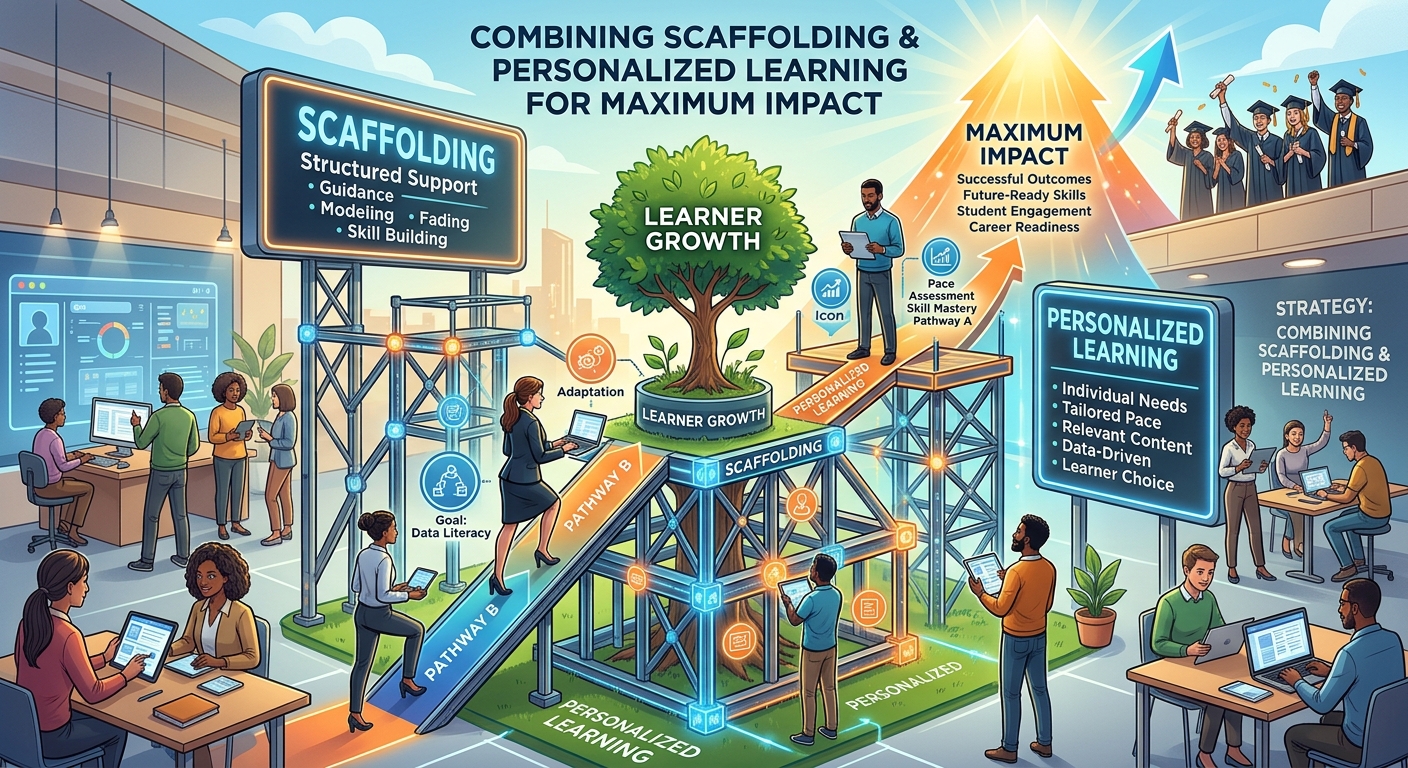
Combining Scaffolding and Personalized Learning for Maximum Impact in L&D
In today's rapidly evolving corporate landscape, the traditional one-size-fits-all approach to learning and development (L&D) is no longer sufficient. Organizations across industries—from Compliance, Sales, Banking, Finance, and Insurance to Retail, Pharma, Healthcare, Hospitality, Oil and Gas, and Mining—are seeking innovative strategies to maximize the impact of their training investments. L&D Vice Presidents, Directors, and Managers are tasked with not only delivering effective learning but also ensuring it translates into measurable performance improvements and competitive advantage.
Enter the powerful synergy of scaffolding and personalized learning. Individually, these methodologies offer significant benefits. Combined, they create a dynamic, supportive, and highly effective learning environment that caters to diverse learner needs, accelerates skill acquisition, and fosters sustained growth. This article delves into how integrating these two approaches can revolutionize your enterprise learning management strategy and deliver unparalleled results.
Understanding Scaffolding in Corporate Learning
Scaffolding, a concept borrowed from educational psychology, refers to the process of providing temporary support to learners as they tackle new and challenging tasks. This support is gradually withdrawn as the learner's competence grows, enabling them to master complex skills independently. In a corporate setting, scaffolding ensures that employees are never overwhelmed, building confidence and capability step-by-step.
- Structured Support: Breaking down complex topics into manageable chunks.
- Guided Practice: Providing clear instructions, examples, and templates.
- Timely Feedback: Offering constructive feedback to correct misconceptions and reinforce learning.
- Progressive Challenge: Gradually increasing the difficulty as learners demonstrate mastery.
- Resource Accessibility: Making relevant resources readily available.
For L&D professionals, scaffolding is crucial for onboarding new employees, upskilling teams on new technologies or regulations, and ensuring compliance in high-stakes environments. It reduces cognitive load and allows learners to build a strong foundation before moving on to more advanced concepts.
Embracing Personalized Learning
Personalized learning, at its core, tailors the learning experience to the individual needs, preferences, and pace of each learner. It recognizes that every employee brings a unique set of prior knowledge, learning styles, and career goals to the table. In a corporate context, this means moving beyond generic courses to deliver content that is directly relevant and engaging for each individual.
The modern workforce demands flexibility and relevance. Personalized learning leverages data and technology to create custom learning paths, ensuring that time-pressed professionals are not wasting effort on content they already know or that isn't pertinent to their role. This approach is particularly vital for industries requiring continuous professional development and rapid skill adaptation.
- Individualized Paths: Customizing content and sequence based on pre-assessments and performance data.
- Paced Learning: Allowing learners to progress at their own speed.
- Relevant Content: Delivering specific information pertinent to job roles and development goals.
- Choice and Agency: Empowering learners to select topics and formats that resonate with them.
- Enhanced Engagement: Increasing motivation by making learning directly applicable to their work.
The Synergy: Scaffolding Meets Personalization
While powerful on their own, scaffolding and personalized learning achieve their maximum impact when combined. Imagine a scenario where a learner not only receives tailored content but also has that content delivered with the right level of support at each stage of their journey. This is the essence of their synergy.
Personalization identifies what an individual needs to learn, while scaffolding determines how that learning can be most effectively supported and structured. An employee struggling with a particular concept in a Microlearning LMS can receive additional guided practice or simpler explanations (scaffolding), seamlessly integrated into their personalized learning path. Conversely, a high-performing individual can bypass foundational content and accelerate to advanced topics with minimal intervention. This blend ensures no one is left behind, and no one is held back, fostering an environment of continuous improvement and mastery.
Implementing the Combined Approach with Technology
Achieving this sophisticated blend requires a robust and intelligent learning management system (LMS) infrastructure. Modern cloud based learning management systems provide the necessary tools to orchestrate personalized, scaffolded learning experiences at scale across an enterprise.
- Microlearning LMS: Delivers bite-sized content that naturally lends itself to scaffolding by breaking down complex topics into digestible modules. This also enhances personalization, as specific micro-modules can be assigned based on individual needs.
- Gamified LMS: Introduces elements like points, badges, and leaderboards, which can be scaffolded by setting progressive challenges and rewarding incremental achievements. Personalization ensures that gamified challenges are relevant to the individual's role and learning objectives.
- Adaptive Learning: This technology is the backbone of combining these two approaches. An adaptive learning system can dynamically adjust the content, difficulty, and support based on a learner's real-time performance and understanding. It acts as both the personalizer and the scaffolder, ensuring optimal learning trajectories.
- AI Powered Authoring Tool: Facilitates the creation of diverse, flexible learning content that can be easily customized and restructured for both scaffolding and personalization. AI can suggest content variations, identify gaps, and even help generate tailored assessments, drastically speeding up the development process for a learning content management system.
- Risk-focused Training: For industries like Banking, Pharma, and Oil & Gas, this approach is critical. Personalized, scaffolded learning ensures that employees thoroughly understand complex regulatory requirements and operational procedures, mitigating risks effectively. An intelligent LMS helps deliver targeted training where the risk is highest, ensuring compliance and safety.
Implementing an advanced learning management software solution allows L&D teams to leverage data analytics to continuously refine learning paths, identify struggling learners, and provide proactive support. This elevates a standard learning management system to a truly strategic enterprise learning management solution.
AI in Action: Answering Key Questions
How is artificial intelligence transforming corporate training effectiveness?
Artificial intelligence is revolutionizing corporate training by enabling unprecedented levels of personalization and efficiency. AI-driven platforms can analyze learner data to identify knowledge gaps, predict future training needs, and recommend relevant content. This ensures that every employee receives targeted, impactful learning experiences, optimizing skill acquisition and significantly improving overall training effectiveness.
Can AI-driven learning solutions adapt to diverse regional compliance or operational standards?
Absolutely. Intelligent learning platforms are designed to handle geographic and regulatory complexities. By leveraging AI, these solutions can dynamically localize content, integrate country-specific compliance modules, and adapt operational training based on regional mandates. This capability ensures that global organizations can maintain consistent learning standards while adhering to diverse local requirements, from healthcare regulations in Europe to environmental protocols in the Mining sector.
What are the practical applications of intelligent automation in enhancing learning outcomes and efficiency?
Intelligent automation, powered by AI, has numerous practical applications in L&D. It can automate the creation of personalized learning paths, provide real-time performance feedback, and streamline administrative tasks like content tagging and course assignment. Furthermore, AI tools can optimize content delivery, recommend timely interventions for struggling learners, and even automate the generation of training materials from existing documents. This enhances learning outcomes by making training more relevant and accessible, while dramatically increasing the efficiency of L&D teams.
The MaxLearn Advantage
A comprehensive learning management system like MaxLearn LMS is designed to facilitate this integrated approach. With its focus on microlearning, gamification, and adaptive capabilities, it serves as an ideal LCMS for organizations seeking to implement a truly impactful, personalized, and scaffolded learning strategy. From Sales to Healthcare, MaxLearn provides the tools to create a dynamic learning environment that fosters growth and drives business success.
Conclusion
The combination of scaffolding and personalized learning represents the next frontier in corporate L&D. By providing tailored support at every stage of the learning journey, organizations can empower their employees to master new skills more quickly, retain knowledge more effectively, and apply it with greater confidence. This strategic approach, powered by advanced learning management solutions, not only boosts individual performance but also strengthens organizational resilience, ensuring your workforce is prepared for the challenges of tomorrow.
Invest in solutions that blend these powerful methodologies, and watch your L&D initiatives achieve maximum impact, delivering tangible results across every segment of your business.


