

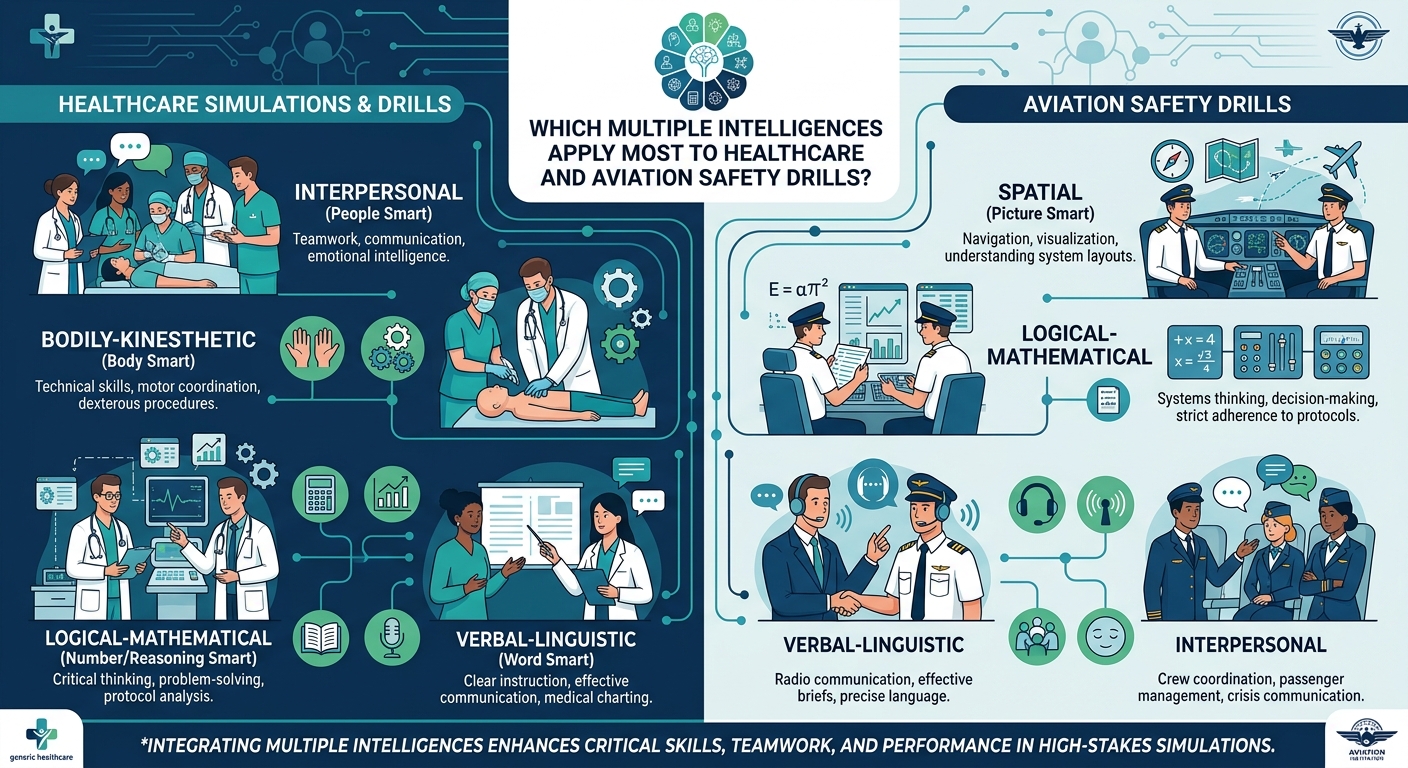
Optimizing High-Stakes Training: Identifying Key Multiple Intelligences for Healthcare and Aviation Safety Drills
In high-stakes environments like healthcare and aviation, where human error can have catastrophic consequences, effective safety drills are paramount. Learning & Development (L&D) leaders constantly seek innovative strategies to enhance training efficacy, moving beyond rote memorization to foster true competence and resilience. One powerful framework for understanding and optimizing learning is Howard Gardner’s theory of Multiple Intelligences (MI). This theory posits that intelligence is not a single, monolithic entity, but rather a spectrum of distinct intellectual capabilities. For L&D professionals, recognizing and leveraging these diverse intelligences can transform compliance training, making safety drills more engaging, relevant, and ultimately, life-saving.
This article explores which of Gardner’s Multiple Intelligences apply most critically to the design and execution of safety drills in healthcare and aviation, and how modern learning solutions, including a robust learning management system, can be tailored to cultivate these vital cognitive strengths.
Understanding Gardner's Theory of Multiple Intelligences
Howard Gardner originally proposed eight intelligences: Linguistic, Logical-Mathematical, Spatial, Bodily-Kinesthetic, Musical, Interpersonal, Intrapersonal, and Naturalistic. Each intelligence represents a different way of processing information and interacting with the world. While individuals possess all intelligences to varying degrees, some are naturally more dominant, influencing how they learn and perform. For L&D, the goal isn't to categorize individuals, but to design training that appeals to a wide range of intelligences, thereby maximizing engagement and retention across the workforce. An effective learning content management system (LCMS) allows for such diverse content delivery.
Applying Multiple Intelligences to Healthcare Safety Drills
Healthcare safety drills, from emergency codes to infection control protocols, demand a complex interplay of cognitive and practical skills. Optimizing these drills requires an appreciation for the various intelligences at play.
Bodily-Kinesthetic Intelligence: Precision and Procedure
This intelligence is crucial for healthcare professionals. Think of a surgeon performing a delicate procedure, a nurse administering medication, or paramedics executing CPR. Safety drills often involve hands-on practice: simulating patient transfers, operating medical equipment, or donning/doffing PPE correctly. Training environments that allow for physical interaction, repetition, and muscle memory development are vital. A Gamified LMS can simulate real-world scenarios, allowing learners to practice procedures in a safe, interactive environment.
Interpersonal Intelligence: Teamwork and Communication
Healthcare is inherently collaborative. Effective communication, empathy, and conflict resolution are indispensable during crises. Safety drills involving multiple team members — such as mock emergency response or surgical team huddles — heavily rely on interpersonal intelligence. Training should focus on role-playing, group problem-solving, and debriefing sessions to refine communication pathways and foster team cohesion.
Logical-Mathematical Intelligence: Diagnostics and Decision-Making
From diagnosing symptoms to calculating medication dosages, logical reasoning is at the core of healthcare. During safety drills, this intelligence is applied when analyzing a situation, prioritizing actions, and problem-solving under pressure. Scenarios that present complex dilemmas, require data interpretation, and demand critical thinking help hone this intelligence. An Adaptive Learning platform can tailor challenges based on a learner's mastery of logical reasoning tasks.
Spatial Intelligence: Navigating Environments and Interpreting Data
Understanding anatomical structures, interpreting imaging scans, or navigating complex hospital layouts during an evacuation are all functions of spatial intelligence. Drills involving mapping emergency exits, understanding equipment placement, or even visualizing internal bodily processes benefit from activities that enhance spatial awareness. Virtual reality (VR) or augmented reality (AR) simulations, deliverable through a modern learning management software, can be particularly effective here.
Applying Multiple Intelligences to Aviation Safety Drills
Aviation safety is non-negotiable, and its drills are among the most rigorous in any industry. Pilots, cabin crew, and ground staff must perform flawlessly under pressure, often relying on a nuanced understanding of their environment and equipment.
Spatial Intelligence: Navigation and Situational Awareness
For pilots, spatial intelligence is paramount. It involves interpreting instruments, visualizing flight paths, understanding aircraft orientation, and maintaining situational awareness. Safety drills, particularly in flight simulators, are designed to challenge and develop this intelligence through complex navigation tasks, adverse weather conditions, and emergency landing scenarios. Visual aids and 3D modeling are crucial components of an effective enterprise learning management system for aviation.
Logical-Mathematical Intelligence: Problem-Solving and Systems Analysis
From troubleshooting engine malfunctions to calculating fuel loads and flight parameters, aviation demands exceptional logical-mathematical reasoning. Safety drills simulate system failures, requiring rapid diagnosis, adherence to checklists, and decisive action based on complex data. Training programs often include detailed system schematics and interactive troubleshooting exercises. This intelligence is also heavily supported by Risk-focused Training scenarios.
Bodily-Kinesthetic Intelligence: Control and Precision
The physical act of flying an aircraft, operating cabin controls, or performing emergency procedures (like opening an exit door) requires finely tuned bodily-kinesthetic intelligence. Simulators provide the tactile feedback and physical practice necessary to embed these motor skills, ensuring instinctive and precise responses during real emergencies. A robust cloud based learning management system can track and assess physical task performance.
Interpersonal Intelligence: Crew Resource Management (CRM)
Similar to healthcare, aviation relies heavily on team coordination. CRM training and drills focus on communication, leadership, followership, and decision-making within the cockpit and among the entire crew. Scenario-based training that emphasizes clear, concise communication under stress is vital for developing this intelligence.
Intrapersonal Intelligence: Self-Awareness and Stress Management
Pilots and crew must maintain composure under extreme pressure, manage their own stress, and make critical self-assessments. Intrapersonal intelligence involves understanding one's own capabilities, limitations, and emotional responses. Drills that expose individuals to high-stress situations, followed by detailed debriefs and self-reflection exercises, cultivate this vital aspect of readiness. A comprehensive Microlearning LMS can deliver short, focused modules on mental resilience and self-assessment techniques.
Synergies and Leveraging Modern Learning Technologies
Both healthcare and aviation safety drills emphasize logical reasoning, physical precision, and effective teamwork. L&D professionals can capitalize on these overlaps by adopting a holistic approach to training design. The goal is to create rich, multi-modal learning experiences that cater to various intelligences simultaneously. This is where advanced learning solutions become indispensable. An efficient MaxLearn LMS can host a variety of content types, from interactive simulations to video-based scenarios.
For instance, an Adaptive Learning platform can identify a learner's strengths and weaknesses across different intelligence domains, then deliver personalized content to optimize their development. A AI Powered Authoring Tool can streamline the creation of diverse training materials, from kinesthetic simulations to interpersonal role-playing scripts, ensuring content is fresh and relevant. By integrating these tools into a comprehensive learning management system, organizations can move beyond generic compliance training to truly empower their workforce.
Frequently Asked Questions on Smart Training & High-Stakes Performance
Here are some common queries that L&D professionals consider when optimizing training for critical industries:
How can intelligent systems support skill development in critical sectors?
Intelligent training systems, powered by advanced algorithms, can significantly enhance skill development by providing personalized learning paths. These systems, often integrated into a sophisticated Microlearning LMS, analyze a learner's performance and knowledge gaps, then recommend specific modules, simulations, or practice scenarios. This targeted approach ensures that training addresses individual needs, reinforcing weaker areas while building upon strengths. For instance, in aviation, an intelligent system could identify a pilot struggling with spatial reasoning during emergency maneuvers and provide additional simulator practice focusing on those specific challenges.
What cognitive abilities are essential for effective emergency response?
Effective emergency response relies on a blend of cognitive abilities. These include logical-mathematical reasoning for rapid problem-solving, spatial awareness for navigating complex environments, bodily-kinesthetic skills for precise physical actions, and strong interpersonal intelligence for seamless team coordination. Additionally, intrapersonal intelligence, which encompasses self-awareness and emotional regulation, is crucial for maintaining composure under pressure. Training programs delivered via a robust learning management software should aim to cultivate all these areas.
How do advanced learning platforms personalize professional development?
Advanced learning platforms personalize professional development by employing sophisticated analytics and recommendation engines. They track a learner’s progress, engagement, and performance data to create a dynamic profile. Based on this profile, an Adaptive Learning system can then recommend relevant content, suggest specific practice exercises, or offer alternative learning formats (e.g., video, interactive simulation, text-based) that align with the individual's preferred learning styles and identified areas for improvement. This ensures that each professional receives the most impactful and relevant training experience, maximizing efficiency and effectiveness.
Can machine learning improve training for risk mitigation?
Absolutely. Machine learning plays a pivotal role in improving Risk-focused Training. By analyzing vast datasets of past incidents, near misses, and performance metrics, machine learning algorithms can identify patterns and predict potential risks more accurately. This insight allows L&D teams to design highly targeted training scenarios that address the most prevalent and high-impact risks. Furthermore, these systems can continually refine training content based on new data, ensuring that risk mitigation strategies are always current and highly effective. An advanced Microlearning LMS can deploy these risk-specific modules efficiently.
What is the role of intelligent content creation in modern corporate learning?
Intelligent content creation, often facilitated by an AI Powered Authoring Tool, revolutionizes modern corporate learning by making content development faster, more scalable, and highly relevant. These tools can assist instructional designers in generating diverse learning materials, from interactive quizzes and simulations to personalized feedback mechanisms. They can also help tailor content to specific roles, industries, and even individual learning preferences, ensuring that training resonates deeply with the target audience. This leads to more engaging and effective learning experiences across various sectors, from finance to retail.
Conclusion: Building Resilient Workforces with Intelligence-Based Training
The principles of Multiple Intelligences offer L&D professionals a sophisticated lens through which to view and optimize safety drills in critical sectors like healthcare and aviation. By designing training that consciously addresses bodily-kinesthetic, interpersonal, logical-mathematical, spatial, and intrapersonal intelligences, organizations can foster a deeper level of competence and preparedness. Implementing a cutting-edge learning management system is key to this transformation. Modern platforms, including an enterprise learning management system, offer the tools to create Gamified LMS experiences, deliver Microlearning LMS modules, and leverage Adaptive Learning capabilities. A comprehensive MaxLearn LMS, for example, empowers L&D teams to move beyond one-size-fits-all training, cultivating a resilient, highly skilled workforce ready to face any challenge. Investing in intelligence-aware, technology-driven training is not just a compliance measure; it's a strategic imperative for safety, efficiency, and ultimate business growth.
.jpg)


