

Cracking the Code: Designing 5-Minute Microlearning for Logical-Mathematical Learners
In today's fast-paced corporate landscape, marked by continuous change and an unrelenting demand for efficiency, Learning and Development (L&D) leaders face the monumental task of delivering effective, engaging, and impactful training. From navigating complex compliance regulations in banking and insurance to mastering intricate product knowledge in sales and pharma, or ensuring operational excellence in hospitality and oil and gas, the need for agile learning solutions is paramount. For Vice Presidents, Directors, Senior Managers, and Managers of L&D, understanding how to cater to diverse learning styles within the constraints of busy professional schedules is a strategic imperative.
Among these diverse styles, the logical-mathematical learner stands out. These individuals thrive on structure, data, problem-solving, and clear cause-and-effect relationships. Traditional, lengthy training modules often fall short, struggling to maintain their engagement and failing to capitalize on their inherent analytical strengths. This is where the power of 5-minute microlearning snippets, meticulously designed for this specific cognitive profile, emerges as a game-changer. By delivering focused, bite-sized content, L&D can meet the logical-mathematical learner where they are: ready for precision, not protracted lectures.
Understanding the Logical-Mathematical Learner
Logical-mathematical learners, often found in roles requiring critical analysis, strategic planning, and data interpretation across industries, exhibit distinct characteristics:
- Analytical Thinkers: They naturally seek patterns, connections, and underlying principles.
- Problem Solvers: They are drawn to challenges that require a systematic approach and logical deduction.
- Data-Driven: Facts, figures, statistics, and concrete evidence are their preferred forms of information.
- Systematic and Orderly: They appreciate clear structures, step-by-step instructions, and logical progressions.
- Questioning Nature: They often ask "why" and "how," seeking rational explanations and proofs.
For these learners, abstract concepts without concrete examples or lengthy theoretical discussions without practical applications can quickly lead to disengagement. They need to see the logic, understand the system, and apply the knowledge to solve a specific problem. A modern Microlearning LMS is ideally positioned to deliver content that resonates with these specific learning preferences.
The Power of Precision: Why 5-Minute Snippets?
The appeal of 5-minute microlearning for logical-mathematical learners is multifaceted:
- Respects Attention Spans: In an era of constant information overload, brief modules prevent cognitive fatigue.
- Optimizes Busy Schedules: Professionals, especially those in management and senior roles, can easily fit a 5-minute learning burst into their day – between meetings, during commutes, or while waiting.
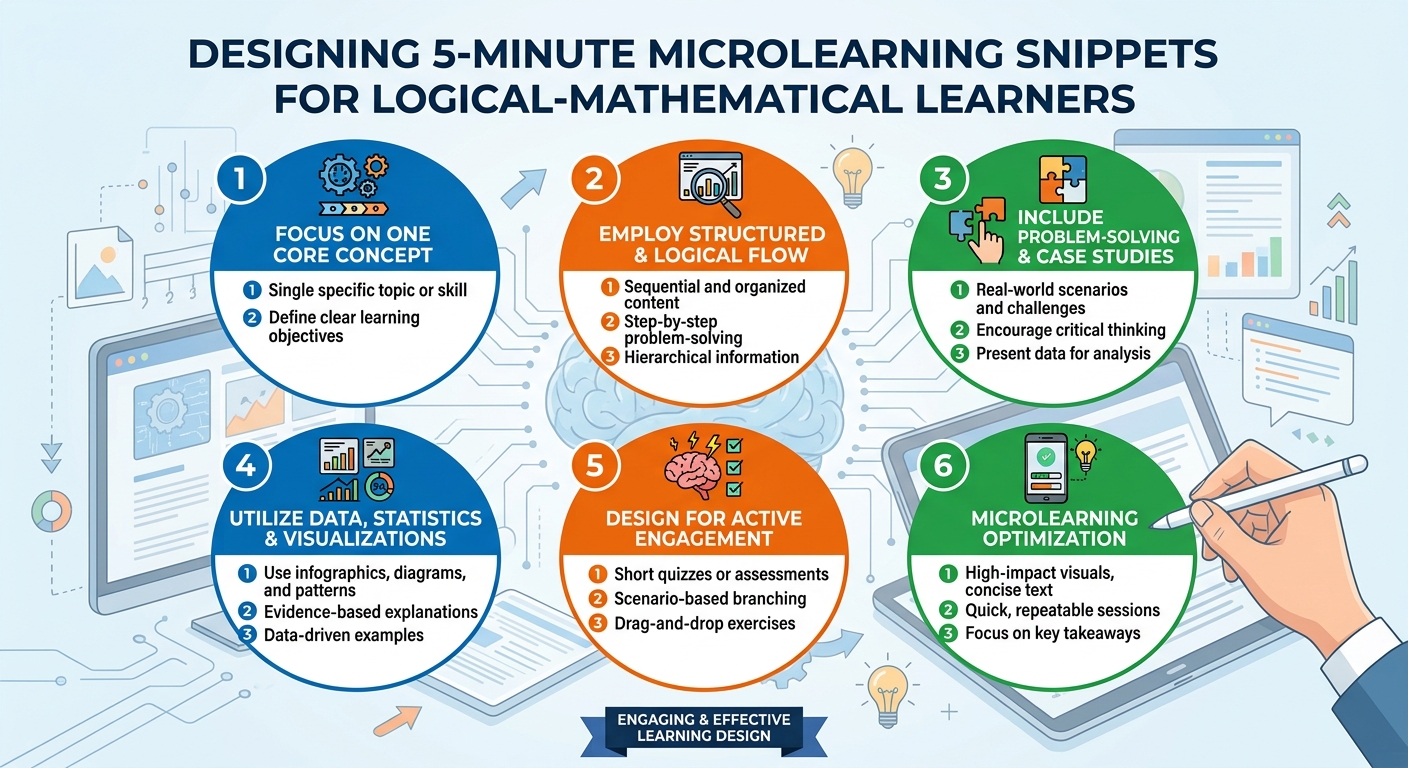
- Focuses on Core Concepts: Each snippet can be designed to teach one specific skill, concept, or process, aligning with their preference for clear, distinct ideas.
- Enables Just-In-Time Learning: Critical for sectors like retail or sales where quick access to information (e.g., a new product feature, a revised compliance procedure) is essential for immediate application.
An effective learning management software not only hosts these snippets but also ensures they are easily discoverable and accessible, turning knowledge acquisition into an on-demand resource.
Blueprint for Brilliance: Crafting Engaging Snippets
Designing microlearning for logical-mathematical learners requires a strategic approach that mirrors their cognitive processes. Here’s a blueprint:
Start with the Problem
Every snippet should begin by presenting a clear, relatable problem or question. This immediately taps into their problem-solving nature. For example, in financial services, a snippet could pose: "How do you identify and mitigate the risk of a specific type of fraud given these transactional patterns?" In healthcare, it might be: "What is the correct protocol for data privacy in this patient interaction scenario?" This approach aligns perfectly with Risk-focused Training, embedding critical thinking from the outset.
Introduce the Logic & Data
Once the problem is set, provide the necessary data, rules, algorithms, or principles needed to solve it. This could involve:
- Presenting a decision tree for a complex operational procedure in manufacturing or mining.
- Displaying a chart comparing key performance indicators (KPIs) in a sales training module.
- Outlining the specific regulatory steps for a compliance requirement in insurance.
- Explaining the mathematical formula behind a financial model.
Use visuals like flowcharts, graphs, or structured tables to convey information efficiently and clearly. The focus should be on explaining the "why" and "how" with logical coherence.
Show the Solution
This section demonstrates the application of the logic and data to arrive at the correct solution. It should be presented as a clear, step-by-step process. Interactive elements can be particularly effective:
- A mini-simulation where the learner inputs data and sees the logical outcome.
- A guided walkthrough of a complex calculation or a software interface.
- A case study showing how the principles were applied in a real-world scenario, with the results explicitly linked back to the initial logic.
This hands-on, demonstrative approach ensures that the learning is actionable and concrete, reinforcing the MaxLearn methodology for powerful microlearning and enabling true Adaptive Learning experiences.
Reinforce & Test
Conclude the 5-minute snippet with a quick assessment that challenges the learner to apply what they've just learned. This could be a multiple-choice question requiring a logical deduction, a drag-and-drop exercise to order steps in a process, or a brief calculation. Immediate feedback, explaining the logic behind the correct answer, is crucial for reinforcing learning. Incorporating elements of a Gamified LMS, such as points or progress indicators, can significantly boost engagement and retention for this learner type.
Leveraging Smart Technology for Scalable Impact
To truly optimize microlearning for logical-mathematical learners across an enterprise, L&D needs more than just well-designed content; they need powerful technology. A robust learning management system (LMS) is the backbone, transforming individual snippets into a comprehensive learning ecosystem.
Streamlining Content Creation
One of the persistent challenges for L&D teams is the rapid creation of high-quality, targeted learning content. How can L&D teams rapidly produce high-quality, personalized content for diverse learning styles and specific industry needs? An AI Powered Authoring Tool within a learning content management system (LCMS) is the answer. It can accelerate the development of structured, data-rich snippets, suggesting relevant scenarios, generating question prompts, and even assisting with the logical flow, significantly reducing development time and effort.
Personalized Learning Paths
In complex sectors like banking or pharma, how do we ensure every professional receives precisely the training they need, without wasted effort? Adaptive Learning capabilities, often powered by advanced algorithms within an enterprise learning management system, are critical. They analyze a learner's performance and preferences, dynamically recommending the next 5-minute snippet that fills a knowledge gap or builds upon existing strengths. This ensures that logical-mathematical learners are always challenged appropriately, receiving content that is neither too simple nor too complex, optimizing their learning trajectory.
Global Reach and Consistency
What's the most efficient way to roll out critical compliance updates or new product training to a global workforce, ensuring consistency and local relevance? A sophisticated learning management software operating as a cloud based learning management system can deliver microlearning snippets seamlessly across different geographies and languages. This ensures that whether a banking professional in New York or a healthcare provider in London needs to understand a new regulation, the core logical framework of the training remains consistent, while supporting necessary localization.
Best Practices for L&D Leaders
- One Concept, One Snippet: Adhere strictly to the "one idea per 5 minutes" rule. This is crucial for maximum impact on logical thinkers.
- Real-World Relevance: Always ground snippets in practical, industry-specific scenarios (e.g., a specific sales objection, a common compliance pitfall, a technical operational challenge).
- Incorporate Data & Analytics: Use statistics, graphs, and figures to substantiate claims and illustrate points, appealing directly to their data-driven nature.
- Challenge, Don't Lecture: Frame content as a problem to be solved, rather than information to be passively absorbed.
- Leverage an Integrated Learning Management System: Utilize a powerful LMS that supports microlearning, adaptive paths, and gamification to maximize engagement and measurable outcomes. Solutions like MaxLearn LMS are designed for this precise purpose.
- Iterate and Refine: Use data from learner performance to continuously improve snippets, ensuring they remain relevant and effective.
For L&D professionals seeking to empower their workforce across industries – from the highly regulated environments of finance and pharma to the dynamic landscapes of retail and sales – designing targeted microlearning for logical-mathematical learners is not just a best practice, but a strategic advantage. By embracing precision, structured logic, and advanced learning management solutions, organizations can unlock unprecedented levels of engagement, knowledge retention, and measurable business impact, ensuring a highly skilled and adaptable workforce ready for the challenges of tomorrow.
.jpg)


