

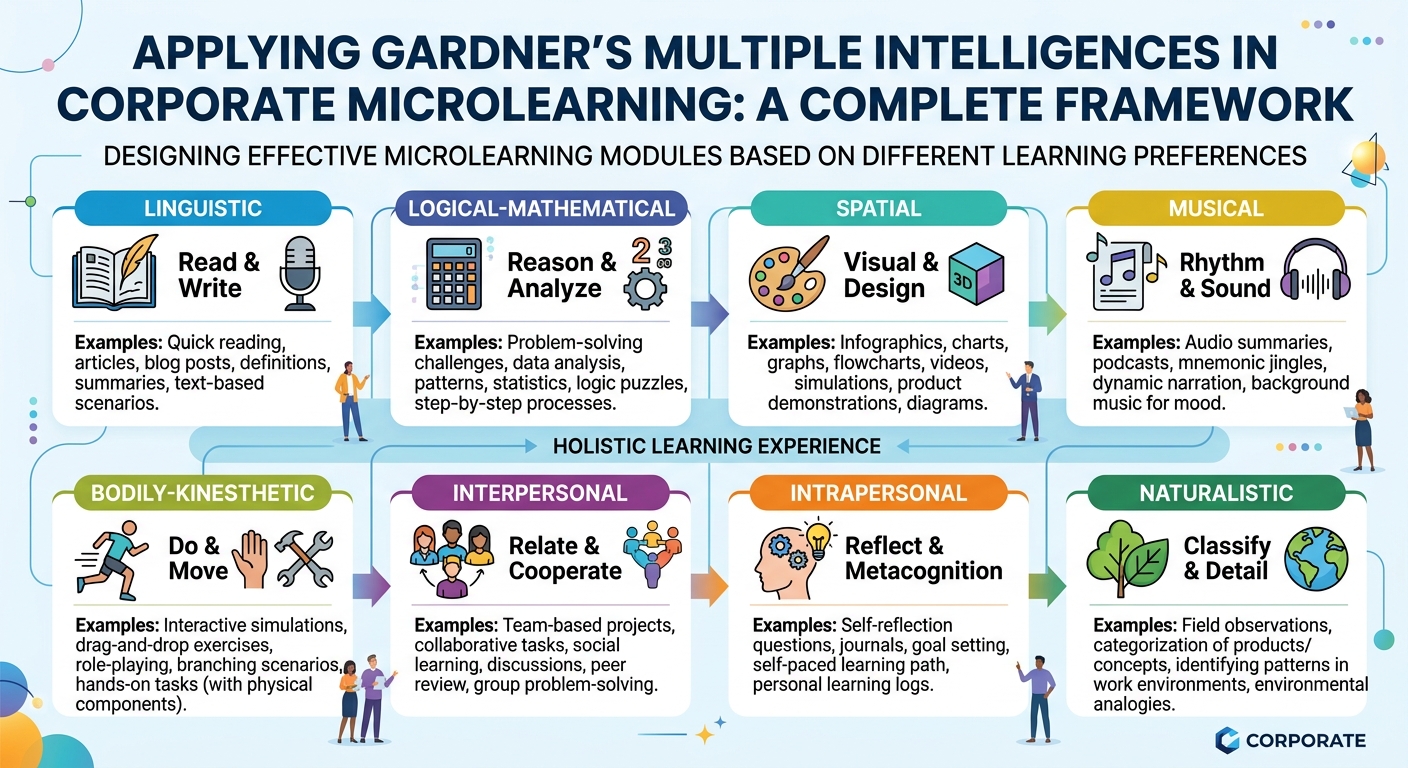
Applying Gardner’s Multiple Intelligences in Corporate Microlearning: A Complete Framework
In the dynamic landscape of corporate learning and development, the one-size-fits-all approach is rapidly becoming obsolete. L&D leaders recognize the critical need for training methodologies that resonate deeply with individual learners, fostering better engagement, retention, and ultimately, performance. Enter Howard Gardner's theory of Multiple Intelligences (MI) and the agile, impactful methodology of microlearning. When fused, these two concepts offer a potent framework for creating highly effective, personalized corporate training programs.
This article provides L&D Vice Presidents, Directors, Senior Managers, and Managers with a comprehensive framework for integrating Gardner's Multiple Intelligences into Microlearning LMS strategies. By understanding and catering to diverse cognitive strengths, organizations across industries—from Compliance and Banking to Pharma and Oil & Gas—can unlock unprecedented learning potential, driving business growth and fostering a truly intelligent workforce.
Understanding Gardner’s Multiple Intelligences
Introduced by Dr. Howard Gardner in 1983, the theory of Multiple Intelligences posits that human intelligence is not a single, monolithic entity but rather a collection of distinct capabilities. Instead of asking "How smart are you?", Gardner encourages us to ask "How are you smart?". This perspective challenges traditional views of intelligence, suggesting that individuals possess varying degrees of at least eight intelligences:
- Linguistic Intelligence: The ability to think in words and use language to express meaning.
- Logical-Mathematical Intelligence: The ability to carry out mathematical operations and solve problems logically.
- Spatial Intelligence: The ability to think in three dimensions and visualize the world accurately.
- Bodily-Kinesthetic Intelligence: The ability to manipulate objects and use one's body skillfully.
- Musical Intelligence: The capacity to discern pitch, rhythm, timbre, and tone.
- Interpersonal Intelligence: The ability to understand and interact effectively with others.
- Intrapersonal Intelligence: The capacity to understand oneself and one's feelings.
- Naturalistic Intelligence: The ability to recognize and categorize elements of the natural world.
Recognizing these diverse strengths is the first step towards creating truly inclusive and impactful corporate learning experiences.
The Power of Microlearning in Corporate Environments
Microlearning delivers learning content in small, digestible chunks, typically 3-10 minutes in duration, designed to achieve a specific learning outcome. It's perfectly suited for the fast-paced corporate world where time is a precious commodity. For industries like Sales needing quick product updates, or Healthcare professionals requiring immediate procedural refreshers, microlearning offers unparalleled advantages:
- Flexibility: Learners can access content anytime, anywhere, fitting seamlessly into busy schedules.
- Engagement: Short bursts of focused content prevent cognitive overload and maintain attention.
- Retention: The spaced repetition inherent in microlearning significantly boosts long-term memory recall.
- Relevance: Content can be highly targeted to specific job roles, tasks, or immediate needs.
- Cost-Effective: Easier and faster to produce and update than lengthy traditional courses.
A robust learning management system that supports microlearning is foundational to harnessing these benefits.
Bridging the Gap: MI and Microlearning
The synergy between Gardner's Multiple Intelligences and microlearning is profound. Microlearning's modular nature allows L&D professionals to craft diverse learning assets, each appealing to different intelligence types, without overwhelming the learner. Instead of forcing everyone through the same linear course, an MI-infused microlearning strategy offers multiple pathways to master the same objective. This approach enhances intrinsic motivation and ensures that every employee, whether a visual learner in Retail or a logical problem-solver in Finance, finds their optimal learning experience.
A Complete Framework for Implementation
Here’s how L&D teams can systematically integrate Multiple Intelligences into their corporate microlearning programs:
1. Assess Learner Profiles (Informally)
While formal MI assessments can be complex, L&D managers can leverage existing data (job roles, feedback, performance reviews) and anecdotal evidence to infer dominant intelligences within teams or departments. For instance, a Sales team might show high Interpersonal and Linguistic intelligence, while an Engineering team might lean towards Logical-Mathematical and Spatial.
2. Design Intelligence-Specific Micro-Modules
For each core learning objective, create several microlearning assets, each tailored to a different intelligence:
- Linguistic Intelligence:
- Microlearning Assets: Short articles, blog posts, annotated case studies, audio podcasts, quick summaries, interactive quizzes with text-based scenarios.
- Application: Compliance training (e.g., explaining new regulations in concise text), Pharma sales (script analysis for product pitches), Banking (understanding complex financial terms).
- Logical-Mathematical Intelligence:
- Microlearning Assets: Infographics with data points, interactive simulations (e.g., a mini-game to calculate ROI), problem-solving exercises, flowcharts, decision trees.
- Application: Financial analysis, process optimization in Manufacturing or Oil & Gas, Risk-focused Training scenarios for Insurance, debugging skills for IT.
- Spatial Intelligence:
- Microlearning Assets: Short animated videos, interactive 3D models (e.g., equipment walkthroughs), visual diagrams, mind maps, infographics, virtual tours.
- Application: Equipment maintenance in Mining, understanding complex system architectures, store layout optimization in Retail, surgical procedures in Healthcare.
- Bodily-Kinesthetic Intelligence:
- Microlearning Assets: Short "how-to" video demonstrations, interactive simulations requiring user input, virtual reality (VR) snippets for hands-on practice, gamified exercises.
- Application: Hospitality service protocols, using new tools in Manufacturing, practicing sales pitches with role-play simulations facilitated by a Gamified LMS, emergency response drills.
- Musical Intelligence:
- Microlearning Assets: Jingles for memorizing key policies, background music for focus, mnemonic songs, audio cues for critical alerts, podcasts with engaging sound design.
- Application: Remembering safety procedures, brand jingles for sales teams, setting a positive atmosphere in customer service training.
- Interpersonal Intelligence:
- Microlearning Assets: Scenario-based interactive videos, short peer-to-peer discussion prompts, role-playing simulations, mini-group project assignments, social learning features within a learning management software.
- Application: Customer service training, leadership development, team collaboration, negotiation skills for Sales, conflict resolution.
- Intrapersonal Intelligence:
- Microlearning Assets: Reflective journal prompts, self-assessment quizzes, guided meditation for stress management, personal goal-setting exercises within the learning platform.
- Application: Leadership reflection, personal development, ethical decision-making in Banking and Finance, stress management in high-pressure roles.
- Naturalistic Intelligence:
- Microlearning Assets: Case studies analyzing environmental impact, examples drawn from nature (e.g., supply chain optimization likened to ecological systems), sustainability best practices, field observation tasks (if applicable).
- Application: Environmental compliance in Oil & Gas, sustainable practices in Retail, understanding supply chain dependencies.
3. Create Diverse Learning Paths with Adaptive Learning
Instead of a single, mandatory path, leverage your enterprise learning management system to offer learners choices. Allow them to select micro-modules that align with their preferred learning styles. This is where Adaptive Learning shines, guiding learners through content based on their performance and expressed preferences.
4. Leverage Advanced Technology for Content Creation and Delivery
Modern learning platforms, including robust cloud based learning management system solutions, are essential. An AI Powered Authoring Tool can significantly accelerate the creation of diverse microlearning content, automatically generating variations to appeal to different intelligences, while an advanced LCMS ensures efficient content management and delivery.
AI-Driven Microlearning: Enhancing Intelligence-Specific Training
The advent of artificial intelligence supercharges the application of Multiple Intelligences in microlearning. Smart technologies can personalize learning at scale in ways previously impossible.
How can intelligent platforms personalize learning paths for diverse learners? AI algorithms can analyze learner interactions, performance data, and even pre-assessment results to dynamically recommend micro-modules best suited to their dominant intelligences. This ensures that a sales representative with high interpersonal intelligence might receive more role-playing simulations, while a compliance officer strong in logical-mathematical intelligence gets more data-driven case studies.
What are the benefits of using intelligent platforms for global corporate training? For multinational corporations, AI in a lms learning management system can automatically translate and localize microlearning content, ensuring cultural and linguistic relevance for various geographic regions. This means that a visual aid designed for spatial learners in the US could be instantly adapted with region-specific imagery for a similar learner in Asia, all while maintaining the core learning objective.
How can advanced analytics identify individual learning needs and preferences? Modern learning management solutions powered by AI can track intricate patterns in learner behavior—which content formats they engage with most, their completion rates, time spent, and performance on different types of assessments. This deep insight allows L&D teams to continuously refine their microlearning offerings, creating an ever more responsive and effective learning ecosystem. Such an intelligent learning content management system empowers L&D to proactively address skill gaps and nurture specific talents across the organization.
Benefits of an MI-Infused Microlearning Strategy
Adopting this framework offers significant advantages for L&D leaders:
- Increased Engagement: Learners are more likely to engage with content that aligns with their natural strengths.
- Improved Retention: Learning through preferred modes enhances memory and recall.
- Higher Completion Rates: Personalized and engaging content leads to better course completion.
- Enhanced Performance: Better understanding and retention directly translate to improved on-the-job performance.
- Inclusive Learning Culture: Recognizes and values diverse cognitive strengths, fostering a more equitable learning environment.
- Future-Proofing Workforce: Equips employees with relevant skills faster and more effectively, adapting to industry changes.
Choosing the Right Tools
Implementing this framework requires a robust technological backbone. A sophisticated learning management system that supports microlearning, offers adaptive learning capabilities, and integrates with AI-powered authoring tools is crucial. Look for a comprehensive MaxLearn LMS that provides flexible content delivery, advanced analytics, and features for diverse learning experiences.
The right learning management solutions will empower your L&D team to manage a vast library of microlearning assets, track individual learner progress across different intelligence paths, and demonstrate the tangible ROI of a personalized learning approach.
Conclusion
Integrating Gardner’s Multiple Intelligences into corporate microlearning is not just an innovative approach; it's a strategic imperative for organizations aiming to cultivate a truly intelligent, adaptable, and engaged workforce. By recognizing and catering to the diverse ways employees learn, L&D professionals can move beyond generic training, delivering powerful, personalized experiences that drive measurable business outcomes across every industry segment. Embrace this framework to transform your corporate learning landscape and empower every learner to reach their full potential.
.jpg)


