

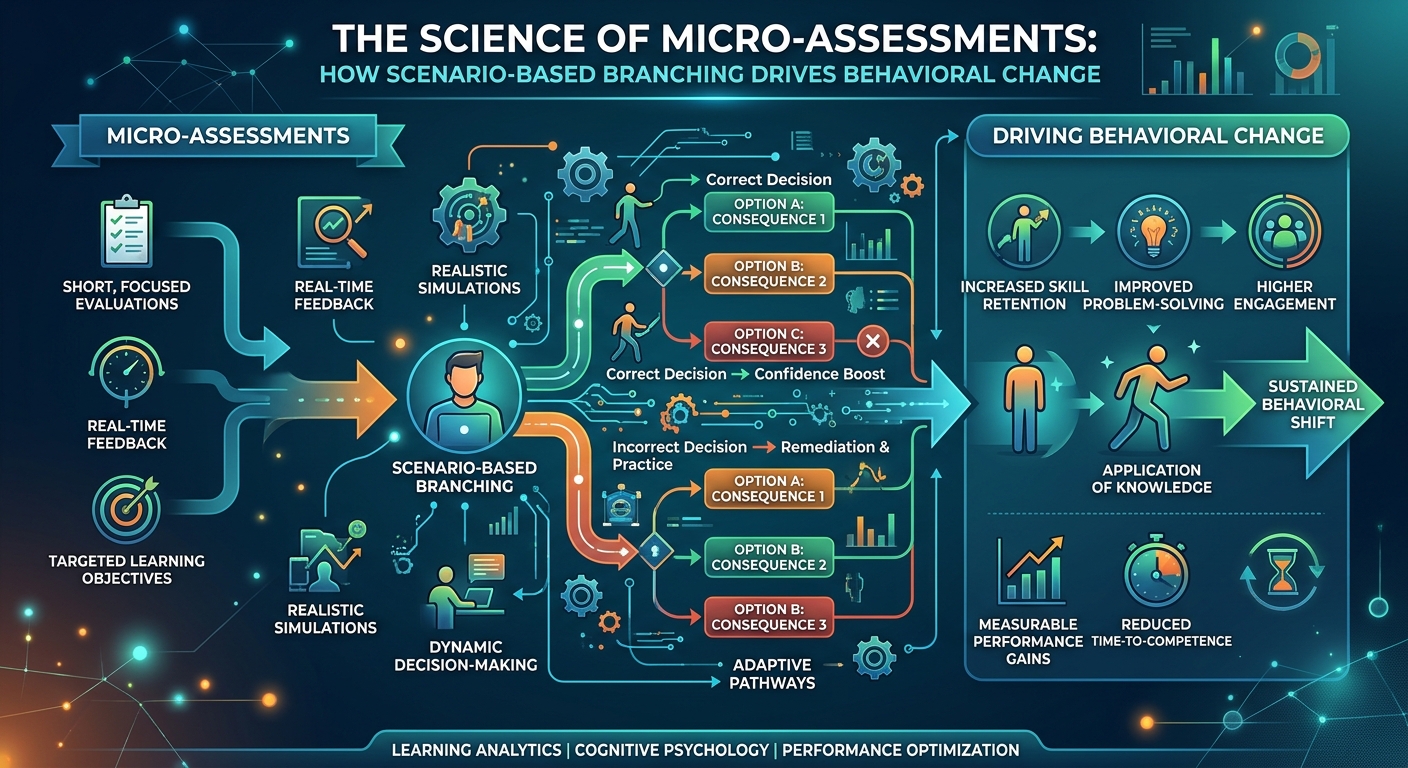
The Science of Micro-Assessments: How Scenario-Based Branching Drives Behavioral Change
In today's rapidly evolving corporate landscape, traditional training methods often fall short in delivering measurable behavioral change. Vice Presidents, Directors, and Senior Managers of Learning & Development are constantly seeking innovative strategies to enhance employee performance, improve compliance, and drive organizational growth. The answer, increasingly, lies in the scientific application of micro-assessments coupled with scenario-based branching – a powerful duo designed to foster deep learning and tangible shifts in behavior.
The goal isn't just to impart knowledge; it's to cultivate the right actions and responses in critical situations. This is where the science of micro-assessments comes into play, creating a dynamic learning environment that transcends rote memorization and empowers employees to apply their learning effectively. A sophisticated Microlearning LMS is often the engine behind such transformative initiatives.
Understanding Micro-Assessments: More Than Just Quizzes
Micro-assessments are short, focused evaluations designed to gauge comprehension and application of specific learning objectives. Unlike lengthy traditional tests, they are typically integrated directly into the learning experience, often immediately after a piece of content, making them less intimidating and more effective for knowledge retention. They serve several critical functions:
- Reinforcement: They solidify recently acquired knowledge.
- Identification of Gaps: They quickly pinpoint areas where learners struggle.
- Feedback Loops: They provide immediate feedback, crucial for correcting misunderstandings.
- Engagement: Their brevity maintains learner interest and reduces cognitive load.
When delivered through a robust Gamified LMS, these micro-assessments can transform into engaging challenges that motivate learners and encourage repeated interaction.
The Power of Scenario-Based Branching: Simulating Reality
Scenario-based branching takes micro-assessments to the next level by placing learners in realistic, interactive situations. Instead of simply answering a multiple-choice question about a policy, learners face a dilemma, make a decision, and then experience the consequences of that choice. This methodology is incredibly effective because it:
- Mirrors Real-World Complexity: It presents situations with nuanced outcomes, reflecting actual workplace challenges in fields like sales, compliance, or customer service.
- Encourages Critical Thinking: Learners must analyze the situation, weigh options, and anticipate results, rather than just recalling facts.
- Provides a Safe Space for Failure: Mistakes made in a simulated environment are learning opportunities, without the real-world repercussions.
- Drives Experiential Learning: The act of doing and experiencing the outcome creates stronger neural pathways, leading to more lasting behavioral change.
This approach moves beyond simple knowledge transfer to skill development and behavioral shaping, making it a cornerstone for modern learning management system strategies.
The Science Behind Behavioral Change
The effectiveness of scenario-based branching and micro-assessments is rooted in established psychological and cognitive science principles:
- Active Recall & Retrieval Practice: Instead of passively receiving information, learners actively retrieve it by applying it in a scenario, strengthening memory traces.
- Spaced Repetition: Micro-assessments can be strategically repeated over time, combating the forgetting curve and ensuring long-term retention.
- Immediate and Constructive Feedback: Learning is optimized when feedback is prompt, specific, and actionable. Scenario-based learning excels here, showing learners the direct impact of their choices.
- Self-Efficacy: Successfully navigating challenging scenarios builds confidence and belief in one's ability to perform tasks effectively in real situations.
- Cognitive Engagement: The interactive nature of branching scenarios keeps learners deeply engaged, preventing mental fatigue often associated with passive learning.
These principles are fundamental to Adaptive Learning systems, which tailor the learning path based on individual performance and needs, further accelerating behavioral change.
Integrating Intelligence for Enhanced Learning Journeys
The synergy between micro-assessments, scenario-based branching, and advanced intelligence technologies is unlocking unprecedented potential for L&D leaders. Here's how intelligence is transforming the learning experience:
How can artificial intelligence optimize the relevance and accessibility of our learning content for diverse employee roles?
Intelligent systems analyze vast amounts of data, including learner performance, job role requirements, and content metadata, to dynamically curate and recommend the most relevant learning paths. By understanding individual proficiencies and deficiencies through micro-assessments, an advanced LMS can ensure that employees receive precisely the content they need, exactly when they need it. This highly personalized approach eliminates information overload and boosts efficiency, making training more pertinent and less time-consuming for busy professionals. A cutting-edge AI Powered Authoring Tool can even help L&D teams rapidly create tailored content at scale.
In what ways can intelligence technologies ensure our training programs resonate across different geographical and cultural contexts?
Leveraging intelligence, training programs can achieve remarkable global relevance. These technologies can aid in localizing scenario content, adapting cultural nuances, and even translating materials while preserving the original intent and contextual accuracy. This ensures that a global workforce receives training that feels authentic and directly applicable to their specific environment, fostering a sense of inclusion and maximizing engagement regardless of location. For enterprise learning management, this capability is invaluable.
How do intelligent systems provide concrete data and insights that drive measurable improvements in employee performance and compliance?
Intelligent platforms track every interaction within micro-assessments and branching scenarios, compiling comprehensive data on learner choices, common mistakes, and areas of excellence. This data provides L&D leaders with unparalleled insights into knowledge gaps and skill proficiencies across the organization. By correlating learning outcomes with business metrics, these systems can demonstrate a clear return on investment, identifying how specific training interventions lead to measurable improvements in compliance adherence, sales performance, or customer satisfaction. This actionable intelligence allows for continuous optimization of the learning content management system and overall training strategy.
Applications Across Industries
The versatility of micro-assessments and scenario-based branching makes them invaluable across diverse sectors:
- Compliance: For industries like Banking, Finance, Insurance, and Healthcare, this method excels in teaching complex regulations and ethical guidelines. Learners can practice handling situations like data privacy breaches or anti-money laundering protocols in a safe, controlled environment, reducing organizational risk through Risk-focused Training.
- Sales: Sales professionals in Retail, Pharma, and Oil and Gas can rehearse difficult client conversations, objection handling, or product pitching, honing their persuasive skills before facing real customers.
- Healthcare: Medical staff can practice patient communication, emergency response protocols, or sensitive diagnostic procedures, improving patient outcomes and safety.
- Hospitality: Employees can refine customer service interactions, de-escalation techniques, or standard operating procedures for various guest scenarios.
- Mining & Oil and Gas: Crucial for safety training, allowing personnel to simulate responses to hazardous situations or equipment malfunctions, fostering immediate and correct reactions.
Choosing the Right Platform for Behavioral Transformation
Implementing a strategy centered on micro-assessments and scenario-based branching requires a robust learning management software. An ideal enterprise learning management solution, such as a cloud based learning management system, should offer:
- Intuitive authoring tools for creating complex branching scenarios.
- Seamless integration of micro-assessments within learning paths.
- Advanced analytics to track learner progress and identify behavioral patterns.
- Support for various content types, including video, simulations, and interactive exercises.
- Scalability to support a large, diverse workforce.
- Features that foster an engaging learner experience, akin to a Gamified LMS.
A comprehensive learning management system, or MaxLearn LMS, functioning as a complete LCMS (learning content management system), can provide the infrastructure necessary for L&D departments to drive significant, measurable behavioral change across their organizations.
Conclusion
The science of micro-assessments and scenario-based branching offers a powerful paradigm shift for corporate learning. By moving beyond passive information delivery to active, experiential engagement, L&D leaders can cultivate a workforce that not only knows what to do but instinctively acts in alignment with organizational goals and values. The integration of intelligence technologies further amplifies this impact, creating personalized, globally relevant, and data-driven learning journeys that measurably improve performance and drive strategic advantage. Investing in such advanced learning management solutions is not just about training; it's about engineering a culture of continuous improvement and proactive behavioral excellence.


