

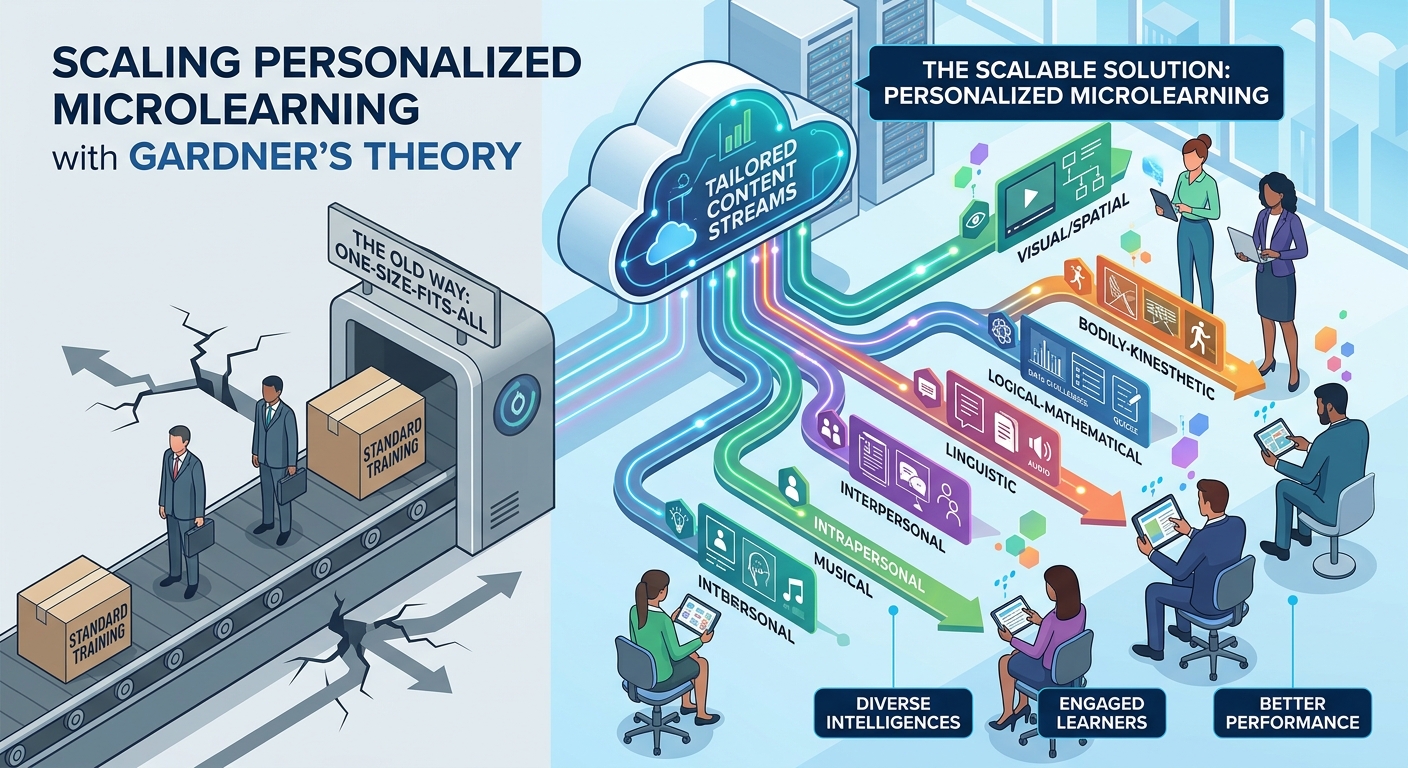
Moving Away from "One-Size-Fits-All": Scaling Personalized Microlearning with Gardner’s Theory
In today's fast-paced corporate world, the traditional "one-size-fits-all" approach to learning and development is increasingly ineffective. L&D leaders, VPs, Directors, and Managers across industries like Compliance, Sales, Banking, Finance, Insurance, Retail, Pharma, Health care, Hospitality, Oil and Gas, and Mining are constantly seeking innovative strategies to boost employee engagement, knowledge retention, and ultimately, organizational performance. The challenge lies not just in delivering content, but in delivering the right content, in the right format, at the right time, to each individual learner. This is where the powerful combination of personalized microlearning, informed by Gardner's Theory of Multiple Intelligences, and supported by an advanced Microlearning LMS, emerges as a game-changer.
The Undeniable Flaws of Uniform Training
Imagine a global corporation with employees spanning diverse roles, cultural backgrounds, and learning preferences. A generic eLearning module, while cost-effective to produce, often falls flat. It fails to resonate with learners who require different stimuli or who process information in unique ways. This lack of personalization leads to:
- Disengagement: Learners quickly lose interest if the content doesn't speak to their individual needs or learning style.
- Poor Retention: Information not presented in an optimal way is easily forgotten, undermining the investment in training.
- Inefficient Resource Utilization: Time and money are wasted on training that doesn't yield measurable improvements in skills or performance.
- Compliance Gaps: In critical sectors like Pharma or Finance, ineffective training can lead to serious compliance failures and associated risks.
The need for a more dynamic and adaptable approach to learning management has never been more pressing. An effective LMS is no longer just about content delivery; it's about enabling a truly personalized learning journey.
Embracing the Power of Microlearning
Microlearning breaks down complex topics into bite-sized, focused learning units that can be consumed quickly and on-demand. These short bursts of content – typically 3-5 minutes – are perfectly suited for busy professionals who need to acquire specific skills or knowledge without disrupting their workflow. The benefits are clear:
- Increased Accessibility: Learning content is available whenever and wherever it's needed.
- Higher Engagement: Shorter modules prevent cognitive overload and maintain learner focus.
- Better Retention: Focused content allows for deeper processing of specific concepts.
- Agility: Content can be updated and deployed rapidly to respond to changing business needs or regulations.
However, simply chopping up existing content isn't enough. True effectiveness comes from personalizing this microlearning experience, and this is where Howard Gardner's Theory of Multiple Intelligences provides an invaluable framework.
Gardner's Theory: A Blueprint for Personalized Learning
Howard Gardner's Theory of Multiple Intelligences posits that individuals possess varying degrees of eight distinct intelligences, rather than a single, monolithic intelligence. These include:
- Linguistic: Word smart (reading, writing, speaking)
- Logical-Mathematical: Number/reasoning smart (problem-solving, patterns)
- Spatial: Picture smart (visualizing, graphic design)
- Bodily-Kinesthetic: Body smart (hands-on learning, role-playing)
- Musical: Music smart (rhythm, sound recognition)
- Interpersonal: People smart (collaboration, empathy)
- Intrapersonal: Self smart (self-reflection, independent study)
- Naturalistic: Nature smart (understanding patterns in nature, classification)
By recognizing that a sales professional might excel with interpersonal, scenario-based training, while a compliance officer might thrive with logical-mathematical case studies and detailed textual analysis, L&D teams can move beyond generic modules. A robust learning management system that integrates these insights can dramatically enhance learning outcomes.
Bridging the Gap: Scaling Personalized Microlearning with Intelligence-Based Design
The challenge for L&D leaders is not just understanding Gardner's theory, but scaling its application across vast and diverse employee populations. Here’s how an advanced learning content management system can facilitate this transformation:
Content Curation and Design
Instead of a single video, imagine offering multiple microlearning pathways for the same objective:
- A short infographic (Spatial intelligence)
- An interactive quiz (Logical-Mathematical, Linguistic)
- A quick role-play simulation (Bodily-Kinesthetic, Interpersonal)
- A concise podcast or audio summary (Musical, Linguistic)
- A reflective journaling prompt (Intrapersonal)
By providing options, learners can choose the format that best aligns with their dominant intelligences, making the learning experience more effective and enjoyable. This multi-modal approach is a hallmark of truly effective enterprise learning management.
Delivery Mechanisms and Engagement
Modern learning management solutions go beyond simple content delivery. A Gamified LMS can incorporate elements like points, badges, and leaderboards to appeal to logical-mathematical and interpersonal intelligences, fostering healthy competition and motivation. Furthermore, features like peer-to-peer discussions within the platform cater to interpersonal intelligence, allowing learners to share insights and learn from each other. A cloud based learning management system ensures these diverse content types are accessible anytime, anywhere.
Adaptive Learning and Assessment
The future of corporate learning lies in its ability to adapt. Adaptive Learning pathways, powered by data analytics within an lms learning management system, can identify a learner's strengths and weaknesses and then automatically recommend microlearning modules tailored to fill knowledge gaps or reinforce understanding in their preferred learning style. This ensures that a learner struggling with a concept presented visually might be offered an auditory or text-based alternative, rather than simply repeating the same ineffective material. This intelligence-driven approach is vital for sectors requiring rigorous Risk-focused Training, such as Banking or Health care.
Leveraging AI for Scalable Personalization
The vision of highly personalized learning at scale becomes truly achievable with the integration of Artificial Intelligence. AI can transform how L&D teams design, deliver, and manage microlearning experiences:
- AI for Learner Profiling: AI algorithms can analyze learner interactions, performance data, and even initial assessments to build dynamic profiles of each employee's preferred learning styles and dominant intelligences, recommending content that aligns perfectly.
- AI Powered Authoring Tool: Imagine an AI Powered Authoring Tool that can suggest variations of microlearning content (e.g., convert a text module into a script for an interactive dialogue, or propose a visual summary) based on identified learning preferences. This dramatically reduces the burden on content creators, making it feasible to produce diverse materials quickly.
- Intelligent Recommendation Engines: An LCMS with AI can act like a Netflix for learning, suggesting relevant microlearning paths, courses, and resources to employees based on their roles, career aspirations, performance data, and intelligence profiles.
- Automated Feedback and Support: AI chatbots can provide instant answers to learner questions, guide them through modules, and offer targeted feedback, acting as a personal tutor available 24/7.
This level of sophistication allows an organization to truly implement a personalized learning experience across thousands of employees without an exponential increase in L&D staff.
Benefits for L&D Leaders and the Organization
Adopting a personalized microlearning strategy, powered by Gardner's theory and AI-driven platforms like MaxLearn LMS, offers profound benefits:
- Enhanced Engagement and Satisfaction: Employees feel valued when training is relevant and tailored to them, leading to higher participation and satisfaction.
- Improved Knowledge Retention and Application: Learning in preferred styles and in bite-sized chunks leads to deeper understanding and better on-the-job application.
- Demonstrable ROI: More effective training translates directly into improved performance, reduced errors, faster onboarding, and better compliance, impacting the bottom line.
- Future-Proofing L&D: Staying ahead with cutting-edge learning management software ensures the organization is agile and responsive to future skill demands.
- Stronger Compliance and Reduced Risk: In industries like Insurance or Oil and Gas, precise and effective Risk-focused Training, tailored to individual needs, significantly mitigates operational and regulatory risks.
Addressing Key Questions on Intelligent Learning Systems
What are the core advantages of using advanced technology for personalized learning in global teams?
Leveraging intelligent learning platforms offers the distinct advantage of delivering highly relevant, culturally sensitive, and individually tailored content to employees scattered across different regions. This approach breaks down geographical barriers by providing consistent, high-quality learning experiences that adapt to local nuances and personal preferences, thereby unifying skill development and ensuring uniform excellence across diverse global operations without heavy travel or resource duplication. It ensures that every team member, regardless of location, receives optimized training for their specific role and learning style.
How can intelligent systems improve learning outcomes for diverse individual needs?
Intelligent learning systems drastically enhance outcomes by moving beyond generic content. They analyze each learner's past performance, interactions, and stated preferences to dynamically recommend microlearning modules that resonate with their unique cognitive strengths and interests. For example, a system might offer a visual simulation for a spatially inclined learner, an interactive case study for a logical-mathematical mind, or a collaborative project for someone strong in interpersonal intelligence. This adaptive content delivery ensures that information is presented in the most effective format for each individual, leading to deeper understanding, greater engagement, and more successful skill acquisition.
What are the immediate benefits for organizations adopting intelligent learning platforms?
Organizations adopting such platforms typically see immediate improvements in several critical areas. Employee engagement and completion rates for training modules significantly increase because the learning experience is more relevant and enjoyable. This leads to faster skill development and a more competent workforce, particularly in areas requiring rapid upskilling. Furthermore, these platforms often streamline content creation and delivery, reducing the operational costs and time associated with traditional training methods. Crucially, they empower L&D teams to demonstrate clear ROI through robust analytics on individual and organizational learning progress, making training a strategic asset rather than just an expense.
Conclusion
The journey away from "one-size-fits-all" training is not merely an aspiration but a strategic imperative for modern L&D leadership. By embracing personalized microlearning, informed by Gardner's Theory of Multiple Intelligences, and powered by an advanced LMS like MaxLearn LMS, organizations can unlock unprecedented levels of employee engagement, knowledge retention, and business performance. The future of learning is personal, agile, and intelligently designed to meet the unique potential of every individual. It’s time for L&D leaders to harness this transformative power and build a truly intelligent, adaptive learning ecosystem.
.jpg)


