

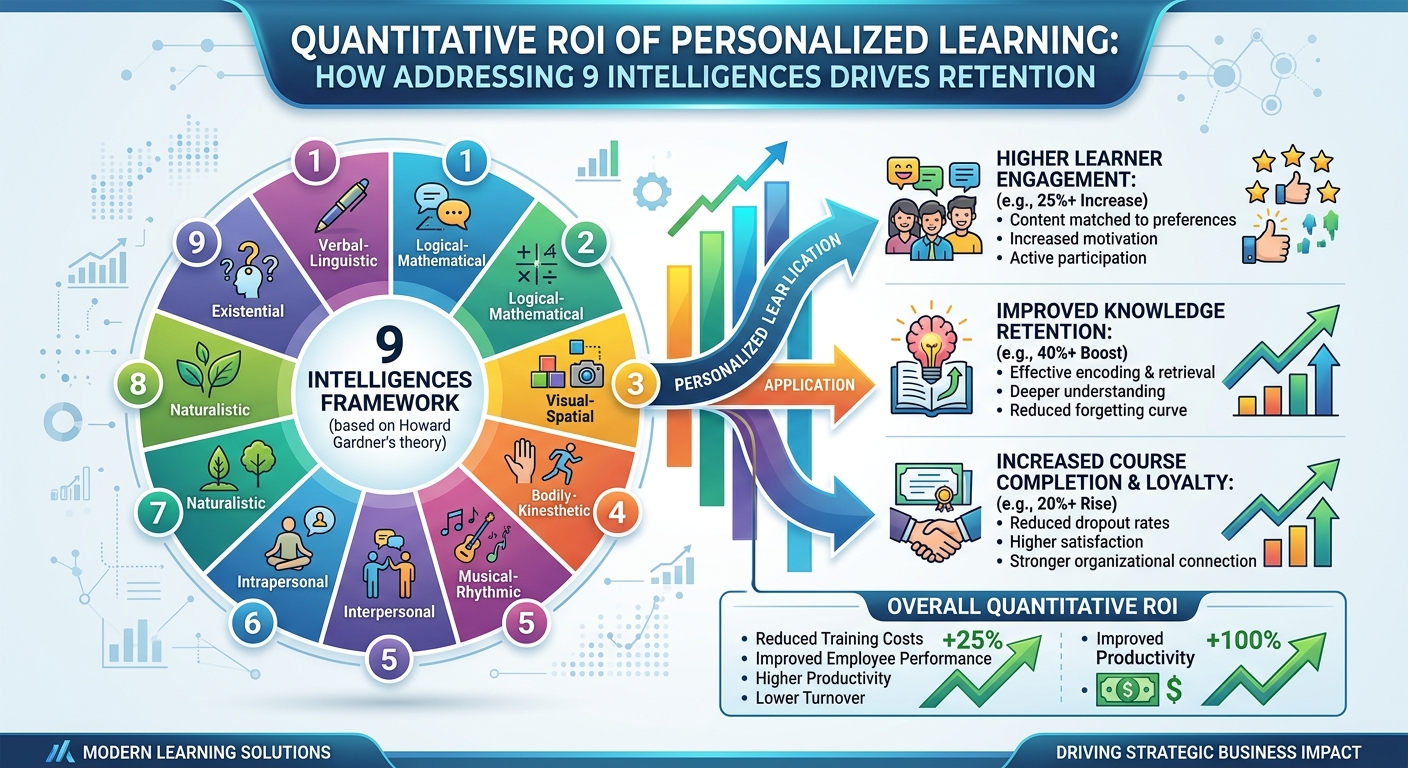
Quantitative ROI of Personalized Learning: How Addressing 9 Intelligences Drives Retention
In today's fast-paced corporate landscape, where knowledge is power and continuous upskilling is a necessity, Learning & Development (L&D) leaders face a persistent challenge: ensuring that training not only engages but truly sticks. For Vice Presidents, Directors, and Senior Managers across industries like Compliance, Sales, Banking, Finance, Insurance, Retail, Pharma, Healthcare, Hospitality, Oil and Gas, and Mining, the call for demonstrable ROI on L&D investments is louder than ever. The key to unlocking this ROI, particularly in knowledge retention and skill application, lies in personalized learning – a strategy that deeply resonates when it acknowledges the diverse ways individuals learn.
This article explores how a personalized approach, specifically one that considers Howard Gardner's theory of Multiple Intelligences, can dramatically improve learning retention, reduce re-training costs, and ultimately deliver a significant quantitative return on your organization's learning investment.
The Business Imperative: Retention as a Strategic Asset
Employee churn, skill gaps, and compliance failures are expensive. In financial services, a single error can lead to millions in losses. In healthcare, inadequate training can jeopardize patient safety. For sales teams, forgotten product knowledge means missed revenue. The cost of repeatedly training the same material due to poor retention, or worse, facing penalties due to non-compliance, underscores the urgent need for more effective learning strategies.
Traditional, one-size-fits-all training often falls short because it assumes a homogeneous learning style across a diverse workforce. This leads to disengagement, superficial understanding, and rapid knowledge decay. The result? Wasted resources, frustrated employees, and a stagnant skill base that fails to keep pace with industry demands. This is where the power of personalized learning, underpinned by an understanding of multiple intelligences, becomes indispensable.
Beyond Generic: Personalization and the 9 Intelligences
Personalized learning tailors content, pace, and delivery methods to individual learner needs and preferences. While often discussed in terms of adaptive pathways or learner control, its deepest impact comes from acknowledging how different people process and retain information. Gardner's theory posits that individuals possess varying strengths across nine distinct intelligences:
- Linguistic Intelligence: Proficient with words, language, and writing.
- Logical-Mathematical Intelligence: Adept at reasoning, numbers, and abstract patterns.
- Spatial Intelligence: Understands visuals, navigation, and spatial relationships.
- Bodily-Kinesthetic Intelligence: Learns through physical activity, doing, and hands-on experiences.
- Musical Intelligence: Sensitive to rhythm, tone, and sound.
- Interpersonal Intelligence: Skilled in understanding and interacting with others.
- Intrapersonal Intelligence: Strong self-awareness and understanding of one's own feelings.
- Naturalistic Intelligence: Connects with nature, patterns, and categories in the natural world.
- Existential Intelligence: Ponders deep questions about life, meaning, and values.
By designing learning experiences that appeal to these diverse strengths, organizations can significantly boost engagement and, critically, retention.
Driving Retention Through Tailored Experiences
-
For the Linguistic & Logical-Mathematical Learner: Structured modules, detailed case studies, data analysis exercises, and problem-solving scenarios. For a compliance professional, this might mean deep dives into regulatory text or dissecting financial fraud cases. An Microlearning LMS can deliver bite-sized content with clear, concise language and logical progression, perfect for retaining complex information.
-
For the Spatial & Bodily-Kinesthetic Learner: Interactive simulations, virtual reality (VR) training for equipment operation (e.g., in Oil & Gas), role-playing for sales scenarios or customer service, and hands-on workshops. Imagine a retail employee practicing store layout optimization in a virtual environment or a healthcare worker rehearsing a medical procedure. Gamified LMS platforms can provide the interactive, experiential elements these learners crave.
-
For the Interpersonal & Intrapersonal Learner: Collaborative projects, group discussions, peer coaching, mentorship programs, and opportunities for self-reflection through journaling or personal goal setting. For a banking manager, this could involve leading a team through a simulated crisis or reflecting on personal leadership styles. Learning paths that offer both collaborative and individual reflective tasks enhance understanding and application.
-
For the Naturalistic & Existential Learner: Real-world contextual examples, ethical dilemmas, discussions on the "why" behind policies or procedures, and understanding the broader impact of their work. A pharma representative might explore the societal impact of new drug development, while an insurance agent might discuss the long-term human implications of financial planning. Connecting learning to broader purpose boosts intrinsic motivation and deeper retention.
-
For the Musical Learner: While less direct in traditional L&D, this can be addressed through rhythmic processes (e.g., memorizing steps), mnemonic devices, or even using background music to aid focus during self-study, or integrating audio elements into complex explanations.
Quantifying the Return: Measuring Impact on Retention
The beauty of addressing multiple intelligences is that its impact translates directly into measurable ROI. When learners are engaged and their natural learning preferences are accommodated, retention skyrockets, leading to tangible business benefits:
-
Reduced Training & Re-training Costs: High retention means less need for refresher courses or repeating initial training. Learners achieve proficiency faster, reducing employee onboarding time and associated costs. For instance, an Adaptive Learning system can identify knowledge gaps quickly, offering targeted content rather than forcing learners through redundant modules.
-
Improved Performance & Productivity: Deeper retention translates into better on-the-job application. Sales teams close more deals, compliance teams make fewer errors, and healthcare professionals deliver higher quality care. This directly impacts revenue, reduces operational risks, and enhances customer satisfaction.
-
Higher Engagement & Lower Attrition: When learning is engaging and effective, employees feel valued and competent. This boosts morale, increases job satisfaction, and can significantly reduce employee turnover, saving substantial recruitment and onboarding expenses.
-
Enhanced Compliance & Reduced Risk: In industries like Banking, Pharma, and Insurance, robust knowledge retention directly correlates with adherence to complex regulations. Effective Risk-focused Training ensures employees not only understand but internalize compliance requirements, mitigating financial and reputational risks.
Key Metrics for L&D Leaders:
To quantify this ROI, L&D leaders should track:
- Completion Rates: Higher rates indicate engagement.
- Assessment Scores: Improved scores demonstrate better comprehension and retention.
- Post-Training Performance Data: Look for measurable improvements in sales figures, error rates, compliance audit results, or customer service metrics.
- Time-to-Proficiency: How quickly do new hires or upskilling employees become fully productive?
- Employee Surveys: Gauge perceived effectiveness and satisfaction with learning programs.
- Re-training Frequency: A reduction here is a direct cost saving.
Leveraging Modern Technology for Personalized Learning at Scale
Achieving truly personalized learning across a large enterprise without overwhelming L&D teams is only possible with advanced technology. A robust LMS (Learning Management System) is the backbone for delivering, tracking, and optimizing these experiences.
Modern learning management software offers features like skill gap analysis, AI-driven content recommendations, and varied media formats that cater to different intelligences. A comprehensive learning content management system (LCMS) allows for the creation, curation, and dynamic delivery of diverse learning assets – from interactive simulations for kinesthetic learners to detailed reports for logical thinkers. An enterprise learning management system must be capable of handling the complexity of personalized paths for thousands of employees across diverse roles and industries.
Platforms like MaxLearn LMS provide the sophisticated infrastructure needed for an lms learning management system to be more than just a content repository. With an AI Powered Authoring Tool, L&D teams can rapidly develop and customize content tailored to specific learning preferences, ensuring that every learner receives the most effective training for their individual intelligence profile.
Common Questions About Advanced Learning Solutions
How can advanced intelligence help personalize learning experiences?
Intelligent algorithms within a learning management system can analyze learner data—such as previous performance, learning paths chosen, and engagement levels—to dynamically recommend content, adapt difficulty, and suggest learning strategies that align with an individual's strengths. This means a learner who excels with visual aids might receive more infographics and videos, while another might get more interactive quizzes and analytical problems.
What are the benefits of using sophisticated learning technologies for global teams?
For globally distributed teams, sophisticated platforms allow for consistent, high-quality training delivery regardless of location. They facilitate localization of content, provide access to diverse learning modalities to cater to different cultural and educational backgrounds, and enable robust tracking and reporting across all regions. This ensures that every employee, from a new hire in retail to a seasoned professional in mining, benefits from an optimized and relevant learning journey.
Where can organizations find comprehensive platforms for tailored training?
Organizations seeking a robust cloud based learning management system that supports personalized learning should look for providers offering a complete suite of features: adaptive learning paths, extensive content authoring capabilities (including AI assistance), advanced analytics, and integrations with other HR systems. A powerful learning management solutions provider will offer a platform that supports multiple content types, gamification, and social learning to address the full spectrum of learner intelligences.
Conclusion
For L&D leaders committed to driving tangible business results, embracing personalized learning that intelligently addresses the nine intelligences is not merely an educational philosophy; it's a strategic imperative. By moving beyond generic training and investing in a sophisticated learning management system, organizations can foster deeper retention, enhance performance, mitigate risk, and cultivate a truly engaged and skilled workforce. The quantitative ROI is clear: less re-training, fewer errors, higher productivity, and a stronger bottom line across every industry.


