

Unlocking Biotech: How Naturalist and Spatial Learning Analogies Revolutionize Microlearning for L&D Leaders
The biotechnology landscape is a rapidly evolving frontier, characterized by intricate processes, complex molecular structures, and groundbreaking innovations. For Vice Presidents, Directors, and Senior Managers in Learning & Development across sectors like Pharma, Healthcare, and even Compliance, ensuring that teams not only grasp these complex concepts but also retain them for critical application is a monumental challenge. Traditional training methodologies often fall short, leading to information overload and a disconnect between theory and practice.
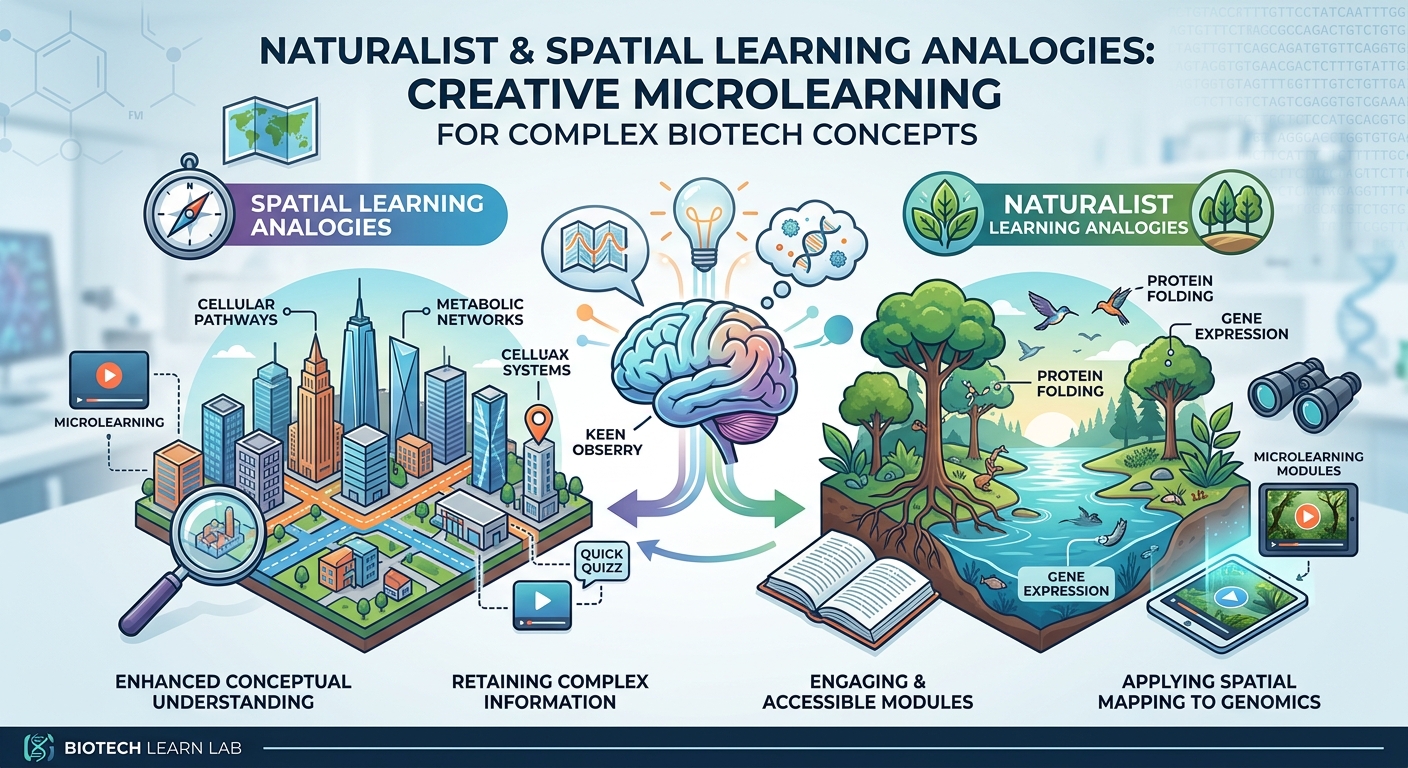
Enter a refreshing approach: leveraging naturalist and spatial learning intelligences through the power of microlearning. By tapping into our innate abilities to understand patterns in nature and visualize relationships in space, L&D can transform daunting biotech topics into digestible, engaging, and memorable learning experiences. This isn't just about making learning 'fun'; it's about making it profoundly effective, enhancing everything from compliance adherence to sales efficacy and risk mitigation.
Understanding Naturalist Intelligence in Learning
Naturalist intelligence, as theorized by Howard Gardner, is the ability to recognize, categorize, and understand the relationships between living things and the environment. While often associated with biologists or environmentalists, its principles are profoundly applicable to biotech training. Biological systems, after all, are microcosms of nature: they exhibit intricate feedback loops, interconnected pathways, and adaptive mechanisms similar to ecosystems.
Imagine explaining complex cellular respiration by drawing analogies to an urban power grid, or likening a drug's mechanism of action to a specific predator-prey relationship within an ecosystem. These analogies don't just simplify; they create a framework for understanding causality, interaction, and emergent properties. For learners in Pharma, understanding a new therapeutic pathway becomes less about memorizing jargon and more about observing a natural system in miniature. This approach makes the content inherently more relatable and sticky, fostering a deeper, intuitive comprehension that rote memorization cannot achieve.
Leveraging Spatial Intelligence for Conceptual Clarity
Spatial intelligence involves the ability to perceive the visual-spatial world accurately and to perform transformations upon one's initial perceptions. In biotech, this intelligence is invaluable. Think about visualizing the 3D structure of a protein, the folding of DNA, the precise configuration of a chemical compound, or even the layout of a sterile lab environment and the flow of a manufacturing process. These are all inherently spatial challenges.
Traditional textual explanations often struggle to convey the dynamic, multi-dimensional nature of these concepts. However, with modern learning tools, we can leverage spatial analogies effectively. For instance, explaining protein-ligand binding can be compared to a precisely engineered lock and key mechanism, or the intricate docking of spacecraft. Visual aids, 3D models, virtual reality (VR) simulations, and interactive diagrams become critical assets. For those in manufacturing or quality control within biotech, understanding process flowcharts or facility layouts through a spatial lens significantly improves their ability to identify bottlenecks or potential contamination points, directly impacting Risk-focused Training and operational efficiency.
The Power of Microlearning for Complex Concepts
The beauty of integrating naturalist and spatial analogies lies in their perfect synergy with microlearning. Microlearning breaks down complex topics into short, focused bursts of information, typically 2-10 minutes in duration. This format is ideal for delivering a single, powerful analogy or a concise spatial visualization without overwhelming the learner.
Microlearning in Action: Biotech Examples
- Genetics & Heredity: Instead of dense text, a microlearning module could compare DNA replication to a self-assembling LEGO set or a biological xerox machine, using an animated spatial analogy to show base pairing.
- Pharmacokinetics & Pharmacodynamics: Analogies could liken drug absorption, distribution, metabolism, and excretion (ADME) to a journey through a complex city's transport system (naturalist) or illustrate receptor binding with a 3D interactive model (spatial).
- Laboratory Protocols: A short video or interactive simulation could spatially guide a learner through the precise movements and sequences required for aseptic technique, much like following a recipe with visual cues.
- Disease Mechanisms: Explain an autoimmune disease by comparing the immune system's misdirected attack to a malfunctioning security system attacking friendly entities (naturalist analogy), using visual flowcharts.
These bite-sized, analogy-rich modules not only enhance comprehension but also boost engagement and retention, making learning a more intuitive and less arduous process, especially for busy professionals in high-stakes industries.
Integrating Naturalist and Spatial Analogies with Microlearning Platforms
To effectively deploy these innovative learning strategies, L&D leaders need robust, modern tools. A sophisticated Microlearning LMS is the backbone for delivering, tracking, and managing such content.
The Role of a Modern Microlearning LMS
A cutting-edge Microlearning LMS provides the infrastructure to host diverse content formats—from short videos and interactive simulations to animated infographics and analogy-driven quizzes. It ensures that these modules are easily accessible on any device, anywhere, catering to the on-the-go nature of professionals across industries like Finance, Retail, Hospitality, or even Oil and Gas, where field-based learning is crucial. A powerful learning management system facilitates seamless content delivery, while a comprehensive learning content management system (LCMS) makes it easy to author, update, and manage the extensive library of biotech-specific modules.
Enhancing Engagement with Gamified LMS Features
Imagine microlearning modules where mastering a spatial analogy of a molecular pathway unlocks the next level, or correctly identifying a naturalist analogy for a biological process earns points and badges. A Gamified LMS can transform learning into an interactive, competitive, and rewarding experience. Leaderboards, points, badges, and progress tracking motivate learners to engage more deeply with content, fostering a positive learning culture across an entire enterprise learning management system.
Personalized Journeys with Adaptive Learning
Not all learners grasp concepts at the same pace or respond to the same analogies. This is where Adaptive Learning shines. An intelligent lms learning management system can assess a learner's proficiency and preferred learning style, then dynamically tailor the sequence and type of microlearning modules they receive. If a learner struggles with spatial visualizations, the system can provide additional modules with different spatial analogies or interactive exercises, ensuring a truly personalized and effective learning path.
AI's Role in Scaling Analogical Microlearning
The integration of artificial intelligence further amplifies the potential of naturalist and spatial microlearning. L&D leaders are increasingly asking: How can we leverage technology to make these creative approaches scalable and highly effective?
Consider how L&D can ensure these creative microlearning modules genuinely resonate with diverse learners across the organization. AI can analyze learner engagement, performance data, and feedback to identify which analogies are most effective for specific demographics or learning profiles. It can then recommend optimal learning paths, content modifications, and even identify gaps where new analogy-based modules are needed, thus optimizing the entire learning experience for maximum impact and retention.
For global enterprises, how can these specialized biotech learning experiences be effectively deployed and localized across different regions and cultures? An AI Powered Authoring Tool, integrated into a cloud based learning management system, can rapidly translate and culturally adapt analogy-based content. AI can suggest culturally relevant analogies, adjust imagery, and ensure linguistic nuances are preserved, making complex biotech concepts accessible and relatable to teams from Mumbai to Manhattan, ensuring global consistency in critical training.
What advanced capabilities does artificial intelligence bring to the table for both creating and optimizing such sophisticated analogical microlearning content? Beyond personalization and localization, AI can assist in the very creation of these modules. An AI Powered Authoring Tool can analyze complex biotech texts and suggest suitable naturalist or spatial analogies, generate quiz questions, or even draft initial visual concepts. Furthermore, AI can monitor learner interactions within spatial simulations, providing real-time feedback and identifying common misconceptions, allowing for continuous refinement of the learning content.
Addressing Compliance and Risk-focused Training with Innovative Approaches
For industries like Banking, Finance, Insurance, and particularly Pharma and Healthcare, compliance training is non-negotiable. Complex regulations, protocols, and safety standards often require deep understanding, not just surface-level recall. Using naturalist and spatial analogies in microlearning can significantly improve the effectiveness of Risk-focused Training. By making the 'why' behind a regulation or a safety procedure more intuitive and memorable through an analogy, employees are more likely to internalize the information and apply it correctly, reducing errors and ensuring adherence.
Whether it's understanding the flow of anti-money laundering regulations (like water through a filtration system) or visualizing the sterile zone protocols in a healthcare setting (like an impenetrable fortress), these methods make abstract concepts concrete and actionable, directly supporting organizational growth and mitigating potential liabilities across all segments.
Conclusion
The convergence of naturalist and spatial learning intelligences with microlearning represents a paradigm shift for L&D leaders tackling complex biotech concepts. It’s an approach that not only enhances comprehension and retention but also boosts engagement and performance across diverse industries. By embracing modern learning management software and platforms like MaxLearn LMS, which offer a full suite of features from gamification to AI Powered Authoring Tool capabilities, L&D can equip their teams with the deep understanding necessary to thrive in an increasingly complex world. It's time to move beyond traditional training and unlock the innate learning potential within every professional.


