

Mastering Workplace Performance: How Skinner's Operant Conditioning Powers Modern eLearning
For Learning and Development (L&D) leaders, the pursuit of effective training methodologies is constant. Whether you're a VP overseeing global initiatives, a Director shaping departmental strategies, or a Manager implementing daily programs, the goal remains the same: to foster desired behaviors and cultivate essential skills that drive organizational success. But what if the blueprint for optimizing workplace performance has been available for decades, refined and waiting for its full potential to be unlocked by modern technology?
Enter B.F. Skinner and his groundbreaking work on Operant Conditioning. While often associated with laboratory animals, the core principles of Skinner's theory offer a profoundly practical framework for designing corporate training programs across diverse sectors like Compliance, Sales, Banking, Finance, Insurance, Retail, Pharma, Health Care, Hospitality, Oil and Gas, and Mining. Understanding how reinforcement and punishment shape behavior is not merely academic; it’s a strategic advantage for L&D professionals seeking to enhance engagement, accelerate learning, and ensure long-term knowledge retention in the digital age.
Understanding the Mechanics of Operant Conditioning
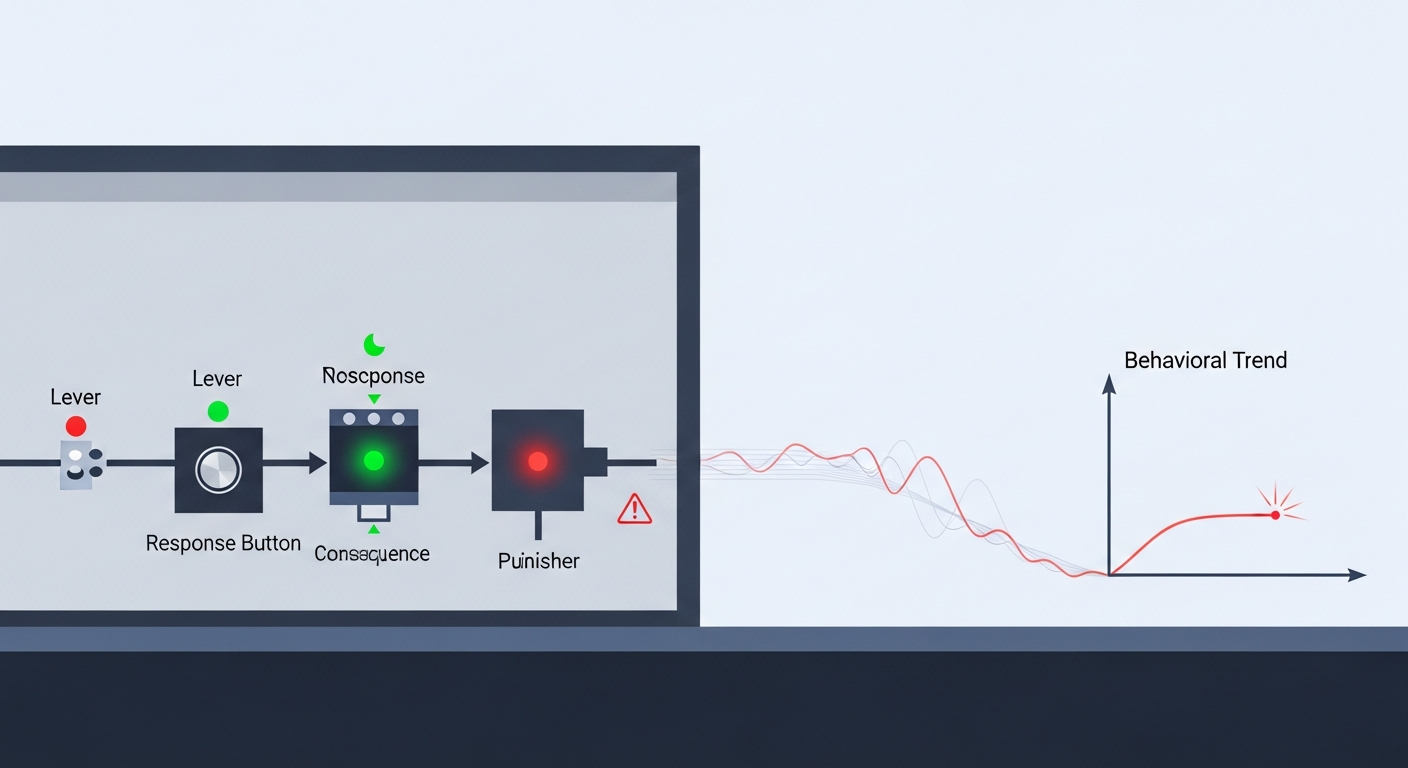
At its heart, operant conditioning is a method of learning that occurs through rewards and punishments for behavior. Through operant conditioning, an individual makes an association between a particular behavior and a consequence. Skinner identified two key components:
- Reinforcement: Any consequence that strengthens the likelihood of a behavior being repeated.
- Punishment: Any consequence that weakens the likelihood of a behavior being repeated.
Both reinforcement and punishment can be either positive or negative:
- Positive Reinforcement: Adding something desirable to increase a behavior (e.g., praise for completing a module).
- Negative Reinforcement: Removing something undesirable to increase a behavior (e.g., a trainer stops nagging when a task is done).
- Positive Punishment: Adding something undesirable to decrease a behavior (e.g., a penalty for failing to follow a safety protocol).
- Negative Punishment: Removing something desirable to decrease a behavior (e.g., loss of access to certain privileges due to non-compliance).
For L&D, the focus is overwhelmingly on reinforcement, particularly positive reinforcement, as it fosters a more engaging and motivating learning environment, which is crucial for adult learners in corporate settings.
The Power of Reinforcement in Learning
Positive reinforcement is the bedrock of effective behavioral change in the workplace. When an employee successfully completes a complex financial regulation training or correctly applies a new sales technique, immediate positive feedback, recognition, or a sense of accomplishment acts as a powerful motivator. This feedback loop encourages the learner to repeat the desired action, solidifying the new skill or knowledge.
Negative reinforcement, when used judiciously, can also be effective. Imagine a cumbersome, manual reporting process that is automatically eliminated for employees who complete a new, automated data entry training. The removal of the tedious task serves as a powerful incentive to adopt the new, more efficient method. The key is to design learning experiences where desired outcomes are consistently and appropriately reinforced.
Applying Operant Conditioning in Modern eLearning
Today's cutting-edge eLearning solutions are inherently designed to leverage operant conditioning principles, whether explicitly or implicitly. By understanding this foundation, L&D leaders can make more informed decisions about their technology investments.
Consider the structure of a Microlearning LMS. Its inherent design of delivering content in short, digestible bursts provides immediate opportunities for reinforcement. Each completed mini-lesson, quiz, or simulation offers quick feedback and a sense of accomplishment, reinforcing the learner's progress and motivating them to continue. This constant stream of small successes aligns perfectly with Skinner's principle of continuous reinforcement, ensuring engagement and knowledge retention in fast-paced corporate environments.
The immersive nature of a Gamified LMS is another prime example. Points, badges, leaderboards, virtual rewards, and level-ups are all forms of positive reinforcement. They provide tangible recognition for progress and achievement, tapping into intrinsic motivation and fostering healthy competition. This makes even the most complex compliance or sales training enjoyable, translating into higher completion rates and better application of skills.
The dynamic nature of Adaptive Learning platforms also applies operant conditioning. By adjusting the learning path based on an individual's performance, these systems provide targeted reinforcement. When a learner answers correctly, they might advance to more challenging material; if they struggle, the system offers additional support or practice. This personalized feedback loop ensures that learners are consistently reinforced for their progress and guided through areas of weakness, optimizing efficiency and mastery.
Furthermore, an AI Powered Authoring Tool empowers L&D teams to create content that inherently embodies these principles. AI can analyze learning patterns, suggest optimal reinforcement schedules, and even help design scenarios where desired behaviors are explicitly rewarded. This takes the guesswork out of designing effective learning experiences, allowing for the creation of truly impactful training modules that align with behavioral science.
Finally, in areas like compliance or safety, Risk-focused Training utilizes the principles of negative reinforcement and punishment (or rather, the avoidance of it). By clearly demonstrating the negative consequences of non-compliance or unsafe practices, learners are motivated to adopt the correct behaviors to avoid undesirable outcomes like fines, accidents, or reputational damage. This approach effectively uses the avoidance of an adverse stimulus to strengthen desired actions.
Intelligent Systems and Behavioral Change Optimization
The convergence of behavioral psychology and advanced technology presents unprecedented opportunities for L&D. How can technology predict and shape employee learning behaviors? Intelligent analytics within modern learning platforms can meticulously track learner interactions, identifying patterns in engagement, comprehension, and completion rates. By analyzing this vast dataset, AI can predict potential knowledge gaps or areas where motivation might wane, allowing L&D to proactively deploy targeted interventions or adjust reinforcement schedules to sustain desired learning trajectories.
In diverse global workforces, how does behavioral science translate across cultures and learning environments? AI-driven localization tools and content personalization engines are key. These systems can process cultural nuances and local regulations, ensuring that the reinforcement mechanisms—whether it's the type of recognition offered or the format of the feedback—are culturally appropriate and maximally effective. This capability allows for highly contextualized learning experiences that resonate deeply with employees regardless of their geographical location or cultural background, ensuring uniform behavioral shaping towards organizational goals.
What are the practical applications of intelligent systems in creating more effective learning interventions based on behavioral psychology? Modern platforms are moving towards "smart reinforcement." For instance, an AI can determine the optimal time and frequency for feedback, delivering praise for correct answers instantly or nudging learners at just the right moment to prevent frustration. It can also dynamically adapt challenges, ensuring tasks are neither too easy (leading to boredom) nor too difficult (leading to disengagement), thereby maximizing the efficacy of positive reinforcement and ensuring sustained learning progress for every individual.
Benefits for L&D Leaders
By consciously incorporating Skinner's principles, L&D leaders can expect tangible benefits:
- Improved Compliance Rates: Clear reinforcement for adhering to regulations.
- Enhanced Skill Acquisition & Retention: Consistent positive feedback for correct application.
- Increased Employee Engagement: Gamified elements and immediate rewards make learning enjoyable.
- Better ROI on Training Initiatives: Effective learning translates directly to improved performance and reduced risks.
Challenges and Considerations
While powerful, applying operant conditioning requires thoughtful design. L&D leaders must consider:
- Ethical Implications: The goal is motivation and skill development, not manipulation. Transparency and learner autonomy are crucial.
- Designing Effective Reinforcement Schedules: When and how often should reinforcement occur? Continuous reinforcement is great for initial learning, but intermittent schedules often lead to more persistent behavior.
- Avoiding Unintended Consequences: Ensure that the behaviors being reinforced are truly the desired ones and that punishment doesn't inadvertently suppress other valuable actions.
Conclusion
B.F. Skinner's Operant Conditioning Theory, developed decades ago, remains profoundly relevant in today's fast-evolving corporate learning landscape. For L&D Vice Presidents, Directors, Senior Managers, and Managers, understanding and consciously applying these principles is not just academic; it’s a strategic imperative. By leveraging modern eLearning technologies that naturally embody these behavioral insights—from microlearning to gamification and adaptive platforms—you can design training programs that not only educate but genuinely inspire and shape desired workplace behaviors. The future of corporate learning lies in intelligently bridging behavioral science with cutting-edge technology to unlock unparalleled human potential.
.jpg)


