

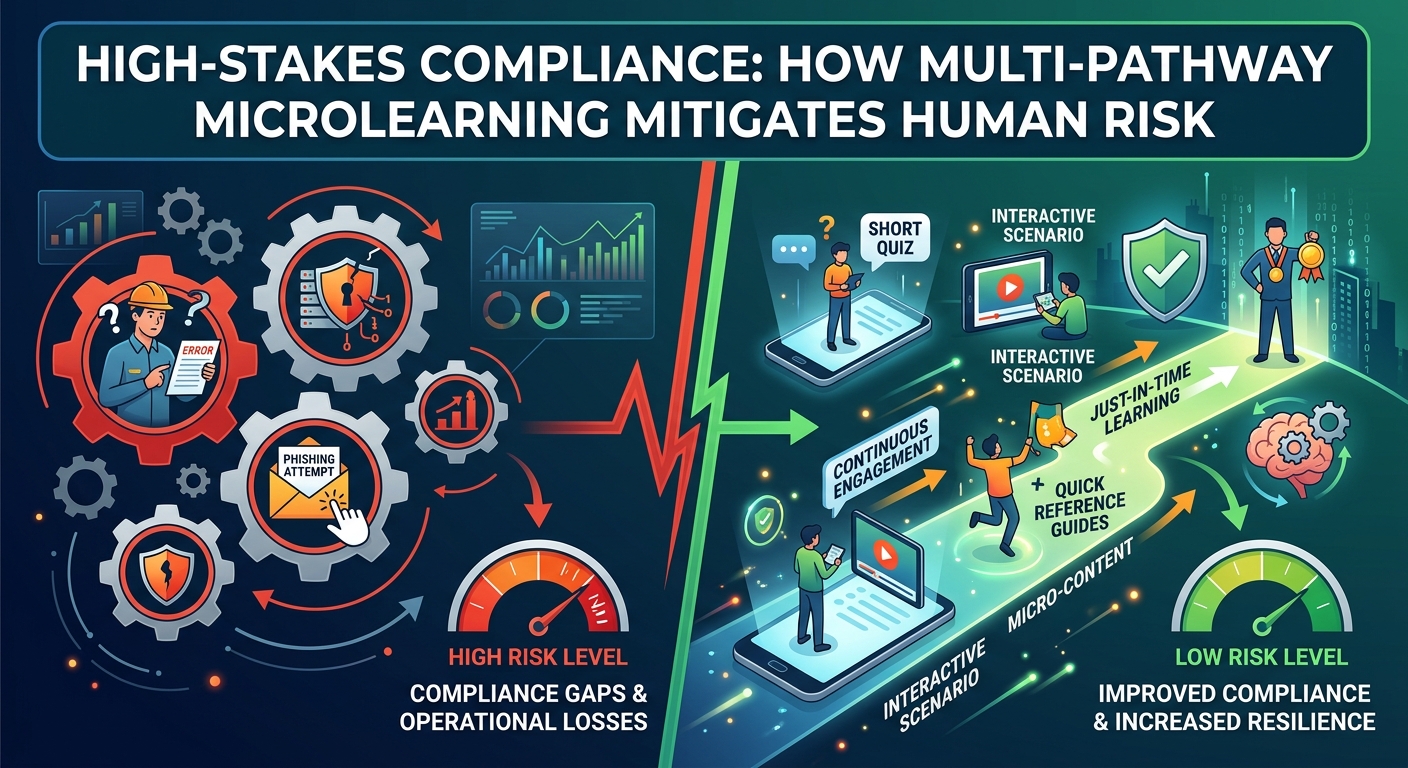
High-Stakes Compliance: How Multi-Pathway Microlearning Mitigates Human Risk
In today's rapidly evolving business landscape, compliance is no longer just a regulatory checkbox; it's a critical pillar of organizational integrity, financial stability, and brand reputation. For industries ranging from banking and finance to healthcare, oil and gas, and pharmaceuticals, the stakes are exceptionally high. A single lapse in compliance due to human error can lead to staggering fines, legal battles, reputational damage, and even operational shutdowns. This urgent need to minimize human risk in complex regulatory environments is pushing Learning and Development (L&D) leaders to seek innovative, effective training solutions. Enter multi-pathway microlearning – a strategic approach poised to revolutionize how organizations tackle Risk-focused Training.
The Escalating Landscape of Compliance Risk
Across all sectors, the volume and complexity of regulations are only increasing. Organizations face pressure from governmental bodies, industry standards, and internal governance. The sheer breadth of compliance topics—data privacy (GDPR, CCPA), anti-money laundering (AML), bribery and corruption (FCPA, UK Bribery Act), ethical conduct, safety protocols, and industry-specific mandates—creates an overwhelming challenge. Navigating this intricate web requires not just awareness, but deep, contextual understanding and immediate application of knowledge by every employee.
Understanding Human Error as a Critical Vulnerability
At the core of most compliance failures lies human error. This isn't necessarily due to malice, but often stems from a lack of clear understanding, information overload, poor retention, or a failure to connect training to real-world scenarios. Employees, from frontline staff to senior executives, are the last line of defense. If their knowledge is outdated, their understanding superficial, or their ability to apply rules under pressure is compromised, the organization is vulnerable. This reality underscores the need for a highly effective Microlearning LMS that can adapt to individual learning needs and critical risk areas.
The Shortcomings of Conventional Compliance Training
Traditional compliance training, often delivered through lengthy, annual, one-size-fits-all modules or infrequent classroom sessions, has proven largely ineffective in mitigating human risk. Such methods typically suffer from several critical flaws:
- Information Overload: Bombarding learners with too much information at once leads to poor retention.
- Lack of Engagement: Monotonous content, devoid of interactivity, fails to capture and sustain learner attention.
- Irrelevance: Generic content doesn't resonate with individual roles or specific daily challenges, making it seem irrelevant.
- Poor Recall: The "forgetting curve" dictates that most information is lost quickly without spaced repetition and practical application.
- Delayed Application: Long intervals between training and real-world application mean knowledge isn't reinforced when needed most.
Many organizations rely on an outdated learning management system that struggles to break free from these limitations, perpetuating a cycle of compliance risk.
Multi-Pathway Microlearning: A Strategic Imperative
Multi-pathway microlearning represents a fundamental shift from passive information consumption to active, personalized, and engaging knowledge acquisition. It's an approach that delivers learning content in short, focused bursts, tailored to individual needs and delivered through diverse routes.
What is Multi-Pathway Microlearning?
Imagine a compliance training program where each employee isn't forced down the same linear path. Instead, their journey is personalized based on their role, prior knowledge, performance data, and identified risk areas. This is multi-pathway microlearning. It leverages a robust lms learning management system to offer:
- Bite-sized Content: Short modules (2-7 minutes) focused on a single learning objective.
- Diverse Formats: Videos, infographics, quizzes, interactive scenarios, podcasts, and simulations.
- Personalized Paths: Learners navigate content relevant to their specific role, department, or knowledge gaps, often guided by Adaptive Learning algorithms.
- Spaced Repetition: Regular, brief refreshers to combat the forgetting curve.
- Immediate Feedback: Quizzes and scenarios provide instant validation and corrective feedback.
Key Benefits for High-Stakes Environments
For L&D leaders grappling with high-stakes compliance, multi-pathway microlearning offers compelling advantages:
- Enhanced Engagement & Retention: Shorter, more engaging formats increase learner focus and improve long-term recall.
- Reduced Human Error: Targeted, contextual training directly addresses specific risk points, making employees more competent and confident in applying compliance rules.
- Flexibility & Accessibility: Employees can access relevant modules on demand, anytime, anywhere, fitting learning into their workflow. A cloud based learning management system makes this seamless.
- Measurable Impact: Advanced analytics from a modern learning management software tracks completion, comprehension, and behavioral changes, providing clear ROI for compliance training.
- Agility in Updates: Rapid deployment of new or updated compliance modules ensures the workforce is always informed of the latest regulations.
Technology at the Forefront: Empowering Next-Gen Compliance
The success of multi-pathway microlearning hinges on a sophisticated learning management system. Modern platforms are no longer just repositories for courses; they are intelligent engines driving personalized learning experiences. Many L&D professionals ask: "How can a modern learning management system truly enhance compliance outcomes?" The answer lies in its ability to integrate cutting-edge features.
Consider an enterprise learning management solution with an embedded Adaptive Learning engine. This allows the system to assess a learner's proficiency and guide them through content pathways uniquely suited to their needs, bypassing already mastered topics and focusing on areas of weakness. This ensures that every moment spent on compliance training is impactful and relevant.
Another common question is: "What tools help create engaging and up-to-date compliance content efficiently?" An AI Powered Authoring Tool within your LCMS can significantly reduce the time and resources required to develop high-quality, interactive microlearning modules. It can help convert existing lengthy content into bite-sized formats, suggest relevant scenarios, and even generate quizzes, keeping content fresh and engaging. This transforms the often-cumbersome process of content creation into a streamlined, dynamic workflow.
Furthermore, to truly combat the monotony of compliance, a Gamified LMS can introduce elements like points, badges, leaderboards, and progress tracking. This transforms compliance from a chore into a challenge, motivating learners to engage more deeply and complete modules efficiently. It taps into natural human competitiveness, fostering a culture of continuous learning and compliance adherence. A comprehensive learning management software like MaxLearn LMS offers these capabilities, making it a powerful ally in mitigating human risk.
Implementing Multi-Pathway Microlearning for Maximum Impact
For L&D leaders aiming to deploy this powerful approach, consider these strategic steps:
- Conduct a Thorough Risk Assessment: Identify the specific compliance areas where human error poses the greatest threat in your organization and industry (e.g., banking, healthcare, mining). This will inform your Risk-focused Training strategy.
- Audit Existing Content: Evaluate current training materials. Can they be broken down into micro-modules? What content needs to be updated or created anew?
- Leverage a Capable Learning Management Solution: Invest in a modern learning management solutions that supports microlearning, adaptive paths, gamification, and robust analytics.
- Start Small, Scale Up: Pilot multi-pathway microlearning in a specific department or for a particular compliance topic, gather feedback, and iterate before a wider rollout.
- Promote a Culture of Continuous Learning: Emphasize that compliance is an ongoing journey, not a destination. Regular, bite-sized learning should be integrated into the daily workflow.
- Measure and Refine: Continuously track key metrics – completion rates, knowledge retention, reduction in incidents, and employee feedback – to refine and optimize your program.
Conclusion: Future-Proofing Compliance in a Dynamic World
The financial, legal, and reputational costs of non-compliance are too high to ignore. Human error remains a persistent vulnerability, but it is not an insurmountable one. By embracing multi-pathway microlearning, L&D leaders can move beyond outdated, ineffective training methods to build a more resilient, knowledgeable, and compliant workforce. This isn't just about meeting regulatory requirements; it's about embedding a culture of vigilance and integrity that protects the organization from within. Investing in an advanced LMS is not merely an expense, but a strategic imperative that mitigates human risk and future-proofs your organization in a complex, regulated world. The time to revolutionize compliance training with intelligent, engaging, and personalized microlearning is now.


