

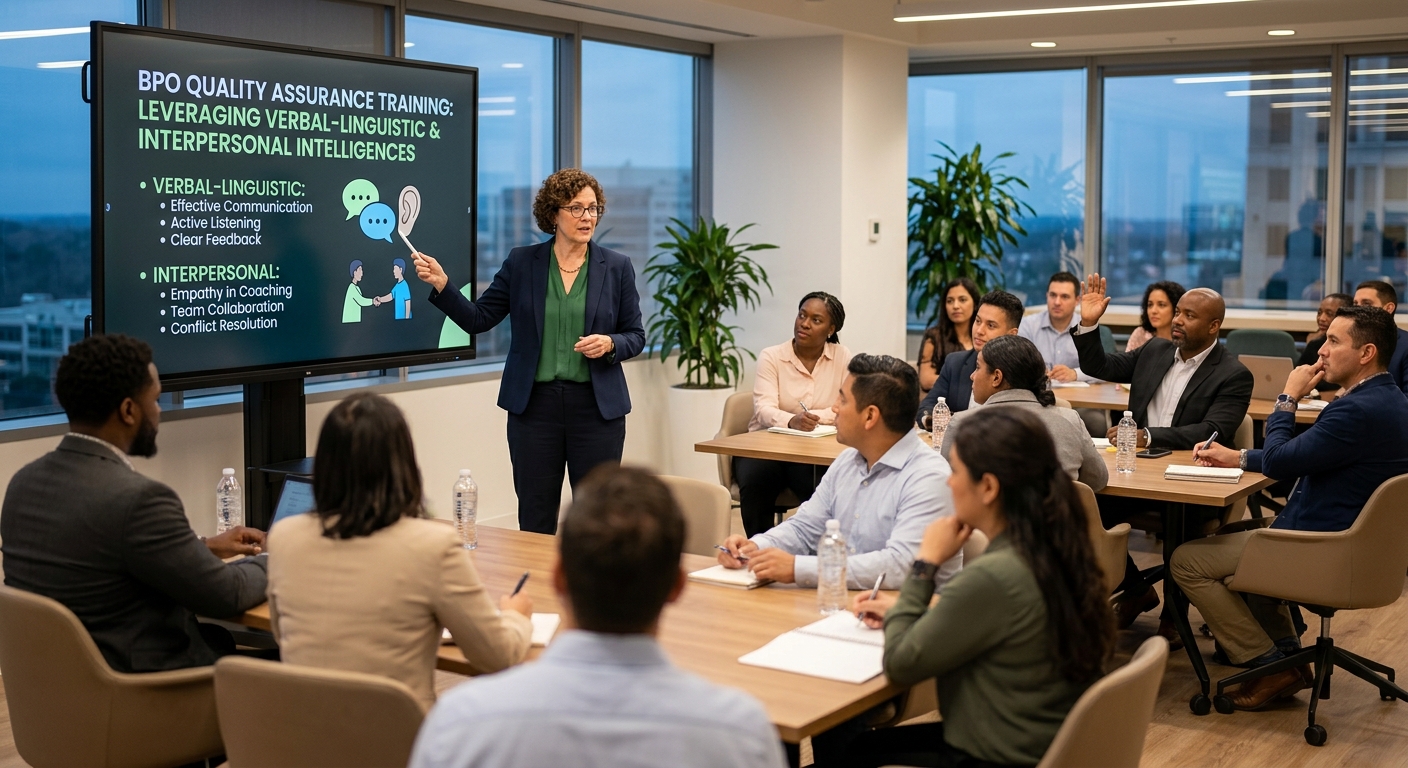
Elevating BPO Quality Assurance: Unleashing Verbal-Linguistic and Interpersonal Intelligences Through Smart Training
In the dynamic landscape of Business Process Outsourcing (BPO), Quality Assurance (QA) isn't merely a checkbox; it's the bedrock of client satisfaction, operational efficiency, and sustained growth. For L&D Vice Presidents, Directors, and Managers, the challenge lies in cultivating QA teams that not only identify issues but also communicate them effectively and foster continuous improvement. This requires moving beyond traditional rote learning to strategic development that taps into core human intelligences. Specifically, by leveraging Verbal-Linguistic and Interpersonal Intelligences, organizations can transform their BPO QA training into a powerful engine for excellence across compliance, sales, banking, finance, insurance, retail, pharma, healthcare, hospitality, oil and gas, and mining sectors.
The Critical Role of Verbal-Linguistic Intelligence in BPO QA
Verbal-Linguistic Intelligence, as defined by Howard Gardner's theory of multiple intelligences, is the ability to think in words and to use language to express meaning. In the context of BPO QA, this intelligence is paramount:
- Clear Communication of Standards: QA professionals must articulate quality metrics, service level agreements (SLAs), and compliance requirements with absolute clarity. Ambiguity here can lead to widespread errors.
- Effective Feedback Delivery: Providing constructive feedback to agents requires not just identifying issues but explaining them in a way that is easily understood, non-confrontational, and actionable. This involves choosing the right words, tone, and structure.
- Precise Documentation: Detailed and accurate documentation of audit findings, root causes, and corrective actions is crucial. This ensures traceability, supports dispute resolution, and informs future training needs.
- Policy Interpretation: QA teams often interpret complex policies and regulations. Strong verbal-linguistic skills enable them to break down intricate legal or procedural language into digestible insights for operational teams.
Strategies for Enhancing Verbal-Linguistic Intelligence in QA Training:
- Structured Communication Drills: Incorporate exercises focused on active listening, summarizing, paraphrasing, and practicing different feedback delivery styles (e.g., STAR method).
- Scenario-Based Role-Playing: Simulate challenging QA audit scenarios where trainees must verbally articulate findings, justify decisions, and provide feedback to a peer playing an agent.
- Written Communication Workshops: Focus on clarity, conciseness, and precision in written reports, email communications, and documentation. Utilizing an AI Powered Authoring Tool can help create targeted writing exercises and provide immediate feedback on style and grammar.
- Vocabulary and Jargon Mastery: Develop modules specifically designed to ensure all QA personnel understand and use industry-specific terminology correctly, especially critical in sectors like finance and healthcare.
Unlocking Interpersonal Intelligence for Superior QA Outcomes
Interpersonal Intelligence is the ability to understand and interact effectively with others. For BPO QA, this translates into fostering collaboration, empathy, and effective conflict resolution:
- Collaborative Problem Solving: QA isn't just about finding faults; it's about partnering with operations to find solutions. Interpersonally intelligent QA professionals can build bridges, not walls.
- Empathetic Coaching: Understanding the challenges faced by agents and delivery teams allows QA to provide feedback that is perceived as supportive rather than punitive, leading to greater buy-in and faster improvement.
- Conflict Resolution: Disagreements over audit findings or performance metrics are inevitable. QA professionals with strong interpersonal skills can de-escalate tensions, mediate discussions, and guide parties towards mutually agreeable outcomes.
- Team Building and Motivation: An interpersonally strong QA leader can inspire their own team, foster a positive culture, and motivate agents to strive for quality, viewing QA as a partner in success.
Training Approaches for Cultivating Interpersonal Intelligence:
- Empathy Mapping Exercises: Train QA professionals to put themselves in the shoes of agents and clients to understand their perspectives and challenges.
- Conflict Management Simulations: Provide structured scenarios for resolving disputes over quality scores, agent performance, or compliance breaches.
- Active Listening and Questioning Techniques: Teach methods for truly hearing concerns, asking probing questions, and demonstrating understanding before responding.
- Feedback Workshops with Peer Coaching: Encourage trainees to practice giving and receiving feedback amongst themselves, fostering a safe environment for skill development. A Gamified LMS can make these interactive sessions more engaging and competitive.
The Powerful Synergy: Combining Verbal-Linguistic and Interpersonal Intelligences
The true power emerges when these two intelligences are developed in tandem. A QA professional who can articulate complex issues clearly (Verbal-Linguistic) AND do so with empathy and an understanding of human dynamics (Interpersonal) becomes an invaluable asset. They can:
- Deliver difficult news in a way that is accepted and acted upon.
- Negotiate changes to processes smoothly and collaboratively.
- Build trust and credibility with both agents and senior management.
- Transform audit findings into actionable, organization-wide learning opportunities.
Modern learning solutions, such as an advanced Microlearning LMS, are ideal for facilitating this integrated development. These platforms allow for bite-sized, focused training modules that can combine communication theory with practical interpersonal skill-building exercises. An Adaptive Learning approach within such a system ensures that each QA professional's training path is tailored to their specific needs, addressing gaps in either intelligence more effectively.
Transforming BPO QA Training with Modern eLearning Solutions
For L&D leaders looking to revolutionize their BPO QA training, embracing a sophisticated LMS is non-negotiable. A robust learning management system, like MaxLearn LMS, provides the infrastructure to deliver targeted, effective training programs.
- Microlearning for Skill Reinforcement: Short, focused modules delivered via a Microlearning LMS are perfect for reinforcing verbal-linguistic nuances or interpersonal communication tactics without overwhelming learners.
- Gamification for Engagement: Incorporating elements of Gamified LMS training, such as points, badges, and leaderboards, can motivate QA teams to engage with practice scenarios and master soft skills.
- Adaptive Paths: An Adaptive Learning approach personalizes the learning journey, ensuring that individuals receive training where they need it most, whether it's on giving direct feedback or managing cross-cultural communication.
- AI-Powered Content Creation: An AI Powered Authoring Tool can rapidly generate relevant content, simulate conversations, and even analyze learner responses to provide tailored feedback, accelerating skill development.
- Risk-Focused Training: Particularly relevant for industries like banking, finance, insurance, and healthcare, Risk-focused Training modules can be developed to hone verbal-linguistic precision when dealing with compliance issues and interpersonal skills for managing sensitive situations.
Implementing an advanced learning content management system transforms the way your organization approaches BPO QA. This kind of learning management software isn't just about housing content; it's about delivering impactful learning management solutions that drive real behavioral change. With a cloud based learning management system, your enterprise learning management initiatives can scale globally, ensuring consistent quality and compliance across all BPO operations. An integrated LCMS within your overall learning management system strategy ensures that content is always current and relevant.
Insights for L&D Leaders: Enhancing BPO QA with Smart Learning
Question for L&D Leaders: How can our organization ensure consistent quality across diverse BPO teams using cutting-edge training?
By implementing a unified learning management system that supports Adaptive Learning and Microlearning LMS modules, organizations can deliver consistent, high-quality training across all BPO centers. Leveraging an AI Powered Authoring Tool enables rapid content creation and localization, ensuring relevance for different teams and markets. This approach fosters a standardized understanding of quality metrics and communication protocols, regardless of geographical location, thereby elevating overall BPO performance.
Global Perspective: What localized considerations should L&D factor into BPO QA training?
L&D must consider cultural communication styles, regional compliance variations, and linguistic nuances when designing BPO QA training for global teams. An effective learning management software should allow for content localization, including translation and culturally relevant scenarios. For instance, Risk-focused Training related to data privacy in Europe might differ significantly from that in Asia. A flexible LMS helps to deploy region-specific modules, addressing local regulations and communication preferences, thus enhancing the interpersonal effectiveness of QA professionals across diverse geographies.
Innovating with Technology: How does advanced machine learning enhance BPO quality assurance training?
Advanced machine learning, integrated into a learning management system, significantly enhances BPO QA training by personalizing learning paths, simulating real-world interactions, and providing data-driven insights. It can analyze learner performance within a Gamified LMS environment, identify specific skill gaps in verbal communication or interpersonal responses, and then recommend targeted Adaptive Learning modules. Furthermore, an AI Powered Authoring Tool can generate complex role-playing scenarios, allowing QA professionals to practice their verbal-linguistic and interpersonal skills in a safe, simulated environment, complete with automated feedback based on their responses. This dynamic approach ensures training is always relevant, engaging, and highly effective.
Conclusion
In the relentless pursuit of BPO excellence, the strategic development of Verbal-Linguistic and Interpersonal Intelligences in QA teams is a competitive differentiator. By investing in modern learning management solutions and a sophisticated LMS, L&D leaders can empower their QA professionals to communicate with precision, collaborate with empathy, and drive continuous improvement across all critical business processes. This holistic approach to skill development not only elevates quality standards but also fosters a culture of understanding and sustained success in an increasingly complex global environment.


