

Can Gardner's Theory Solve the "Forgetfulness Curve" in Corporate Onboarding?
The exhilaration of welcoming new talent often collides with a stark reality: the "forgetfulness curve." In the dynamic world of corporate onboarding, especially across complex sectors like Compliance, Sales, Banking, Finance, Insurance, Retail, Pharma, Health care, Hospitality, Oil and Gas, and Mining, new hires are inundated with information. Policies, procedures, product knowledge, company culture – it's a deluge. Within days or weeks, a significant portion of this crucial knowledge can be lost, impacting productivity, compliance, and ultimately, the bottom line. This isn't just a minor inconvenience; it's a critical challenge for every Vice President, Director, and Manager of Learning & Development.
Traditional onboarding often relies heavily on a one-size-fits-all approach, predominantly catering to linear, logical thinking. But what if we could tailor the learning experience to resonate with each individual's unique cognitive strengths? This is where Howard Gardner's groundbreaking Theory of Multiple Intelligences offers a profound opportunity to revolutionize how we approach corporate onboarding, potentially bending and even breaking the forgetfulness curve.
The "Forgetfulness Curve" in Onboarding: A Persistent Problem
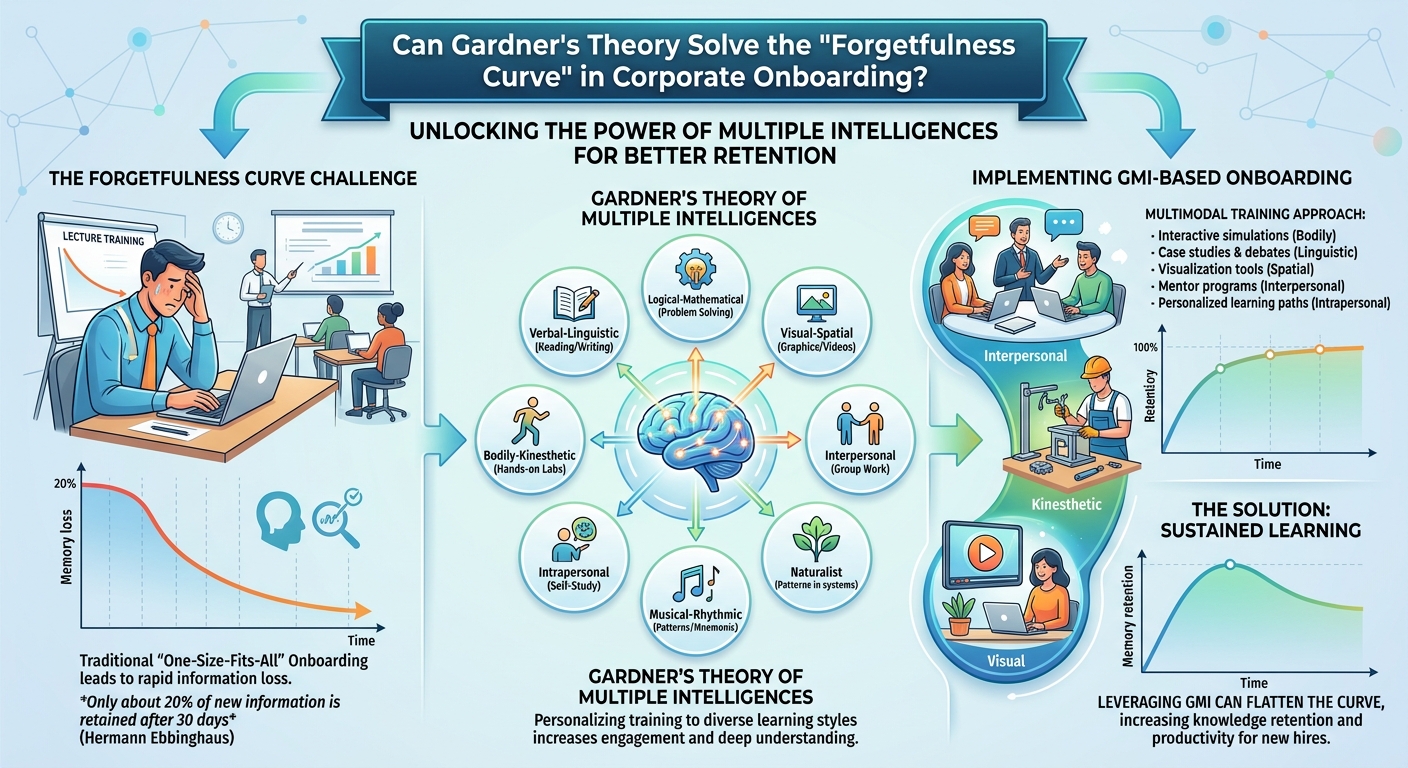
The concept of the "forgetting curve," first described by Hermann Ebbinghaus in the late 19th century, illustrates how information retention declines over time if not actively reinforced. In a corporate context, this phenomenon translates into:
- Reduced efficiency as new hires struggle to recall essential information.
- Increased errors, particularly in compliance-heavy industries.
- Higher training costs due to the need for repeated instruction.
- Diminished employee confidence and engagement.
- Slower time to full productivity for critical roles in Sales, Banking, and Pharma.
For organizations investing heavily in talent acquisition, this knowledge decay represents a significant drain on resources and potential.
Gardner's Theory of Multiple Intelligences: A Paradigm Shift
Howard Gardner's theory posits that intelligence is not a single, monolithic entity, but rather a collection of distinct "intelligences" that individuals possess to varying degrees. While he initially identified seven, the theory typically includes:
- Linguistic Intelligence: Proficient with words, language, reading, and writing.
- Logical-Mathematical Intelligence: Strong in reasoning, numbers, problem-solving, and abstract thinking.
- Spatial Intelligence: Excellent at visualizing, thinking in images, and understanding maps/diagrams.
- Bodily-Kinesthetic Intelligence: Skilled in physical movement, hands-on tasks, and coordination.
- Musical Intelligence: Sensitive to rhythm, pitch, and tone; learns through auditory patterns.
- Interpersonal Intelligence: Adept at understanding and interacting with others.
- Intrapersonal Intelligence: Strong self-awareness, understanding one's own feelings and motivations.
- Naturalistic Intelligence: Ability to recognize and categorize patterns in nature and the environment.
- Existential Intelligence: Capacity to ponder deep questions about life and existence.
Traditional corporate training, often dominated by manuals, presentations, and lectures, primarily caters to linguistic and logical-mathematical intelligences. This leaves a significant portion of the workforce underserved, making it harder for them to absorb and retain information effectively.
Applying Gardner to Combat Forgetfulness in Corporate Onboarding
Imagine an onboarding experience that doesn't just inform, but truly engages every aspect of a new hire's intelligence. By diversifying our teaching methods, we can reinforce learning in multiple ways, dramatically improving retention and minimizing the forgetfulness curve:
- Linguistic & Logical-Mathematical: These remain foundational. Provide clear, concise digital documents via your Microlearning LMS, offer case studies, problem-solving scenarios, and data analysis exercises. A robust Gamified LMS can incorporate quizzes and challenges that test these skills.
- Spatial: Use interactive infographics, virtual reality tours of facilities or product demos, process flowcharts, and mind maps. For industries like Oil and Gas or Healthcare, 3D simulations of equipment or surgical procedures can be invaluable.
- Bodily-Kinesthetic: Incorporate role-playing for sales pitches, customer service scenarios, or compliance procedures. Provide interactive simulations, hands-on workshops (e.g., operating specific machinery in Manufacturing or Retail), or even gamified tasks within a Gamified LMS that require physical responses (e.g., drag-and-drop, timed actions).
- Musical: While less common, mnemonic jingles for recalling complex policies or process steps, or background music during focused learning sessions, could be explored.
- Interpersonal: Facilitate group projects, peer mentoring programs, collaborative problem-solving, and team-based simulations. This is crucial for fostering team cohesion and knowledge sharing in any industry.
- Intrapersonal: Offer opportunities for self-reflection through journaling prompts, personalized learning paths, and self-assessment tools. Adaptive Learning platforms excel here, adjusting content based on individual progress and preferences, allowing new hires to learn at their own pace and focus on areas they find challenging.
- Naturalistic: For industries like Pharma or Oil & Gas, this could involve modules on environmental impact, sustainable practices, or understanding natural processes relevant to their work.
The Role of Modern eLearning Technologies
Implementing a multi-intelligent onboarding approach isn't feasible with traditional methods alone. This is where advanced eLearning solutions, especially a sophisticated Microlearning LMS, become indispensable. A comprehensive `learning management system` (LMS) or `LCMS` acts as the central hub for delivering and managing diverse content types.
- A Microlearning LMS allows you to break down complex information into bite-sized, digestible modules, perfectly suited for reinforcing learning across different intelligences without overwhelming the learner. This is critical for high-stakes Risk-focused Training in Banking or Healthcare.
- A Gamified LMS elevates engagement by transforming learning into an interactive, rewarding experience. Leaderboards, badges, points, and challenges appeal to competitive spirits and make learning enjoyable, enhancing retention for all intelligence types.
- Adaptive Learning tailors the content delivery to each individual's pace and style, aligning perfectly with Intrapersonal intelligence and ensuring that every learner receives the support they need. This personalized approach is a game-changer for combating the forgetfulness curve.
- An AI Powered Authoring Tool empowers L&D teams to rapidly create and deploy rich, interactive content designed for multiple intelligences. From videos and simulations to quizzes and branching scenarios, these tools make it easier to cater to diverse learning styles without extensive development resources.
Utilizing a cutting-edge `LMS`, such as the `MaxLearn LMS`, offers an enterprise-grade `cloud based learning management system` that serves as a powerful `learning content management system`. This `learning management software` provides the `learning management solutions` necessary to create an optimal `lms learning management system` for modern onboarding.
AI-Driven Solutions for Tailored Onboarding: Questions & Insights for L&D Leaders
What are the most effective strategies for preventing knowledge decay in new hires across diverse industries?
The most impactful strategies involve a blended learning approach that leverages multiple intelligences. This includes interactive modules, real-world case studies, simulations, and social learning components to foster deeper understanding and application. Spaced repetition, delivered through short, engaging microlearning bursts via a robust `learning management system`, also plays a crucial role in reinforcing knowledge over time, ensuring new hires in Compliance, Sales, or Pharma retain critical information.
How can organizations in highly regulated sectors like banking or healthcare ensure consistent onboarding excellence globally?
Consistency is key for global compliance. Centralized, cloud-based `enterprise learning management` platforms are essential, allowing for standardized content delivery while offering localization options for cultural nuances and regional regulations. Analytics within these platforms provide insights into engagement and comprehension across different regions, enabling L&D leaders to identify and address inconsistencies promptly. This ensures that a `MaxLearn LMS` can deliver uniform `risk-focused training` worldwide.
How does cutting-edge technology personalize the onboarding journey for each new employee?
Advanced `learning management software` uses algorithms to analyze a new hire's learning patterns, prior knowledge, and performance. Based on this data, the system recommends specific modules, adjusts the difficulty of content, and provides tailored feedback. This personalized pathway ensures that each employee focuses on areas where they need the most support, accelerates their learning, and significantly boosts their confidence and mastery from day one. This proactive adaptation is the hallmark of truly effective `adaptive learning` and a top-tier `LCMS`.
Benefits of a Multi-Intelligent Onboarding Approach
Adopting Gardner's theory in conjunction with modern eLearning solutions yields substantial benefits:
- Higher Knowledge Retention: By appealing to multiple intelligences, information is encoded and stored in various ways, making it easier to recall.
- Faster Time to Proficiency: New hires become productive members of the team more quickly, reducing operational costs.
- Increased Engagement & Job Satisfaction: When learning aligns with an individual's natural strengths, they are more motivated, engaged, and satisfied with their onboarding experience.
- Improved Compliance & Reduced Risk: Especially vital for Risk-focused Training, a deeper understanding of policies and procedures minimizes errors and ensures regulatory adherence.
- Stronger Company Culture: A thoughtful, inclusive onboarding process signals that the company values its employees' diverse talents.
Conclusion
The "forgetfulness curve" doesn't have to be an inevitable hurdle in corporate onboarding. By embracing Howard Gardner's Theory of Multiple Intelligences and harnessing the power of modern eLearning technologies – a robust Microlearning LMS, a dynamic Gamified LMS, intelligent Adaptive Learning, and an AI Powered Authoring Tool – L&D leaders can craft onboarding experiences that are not only comprehensive but also deeply engaging and inherently sticky. This holistic approach doesn't just impart knowledge; it cultivates true understanding, empowering new hires across all industries, from Banking to Hospitality, to thrive from day one and beyond.
.jpg)


