

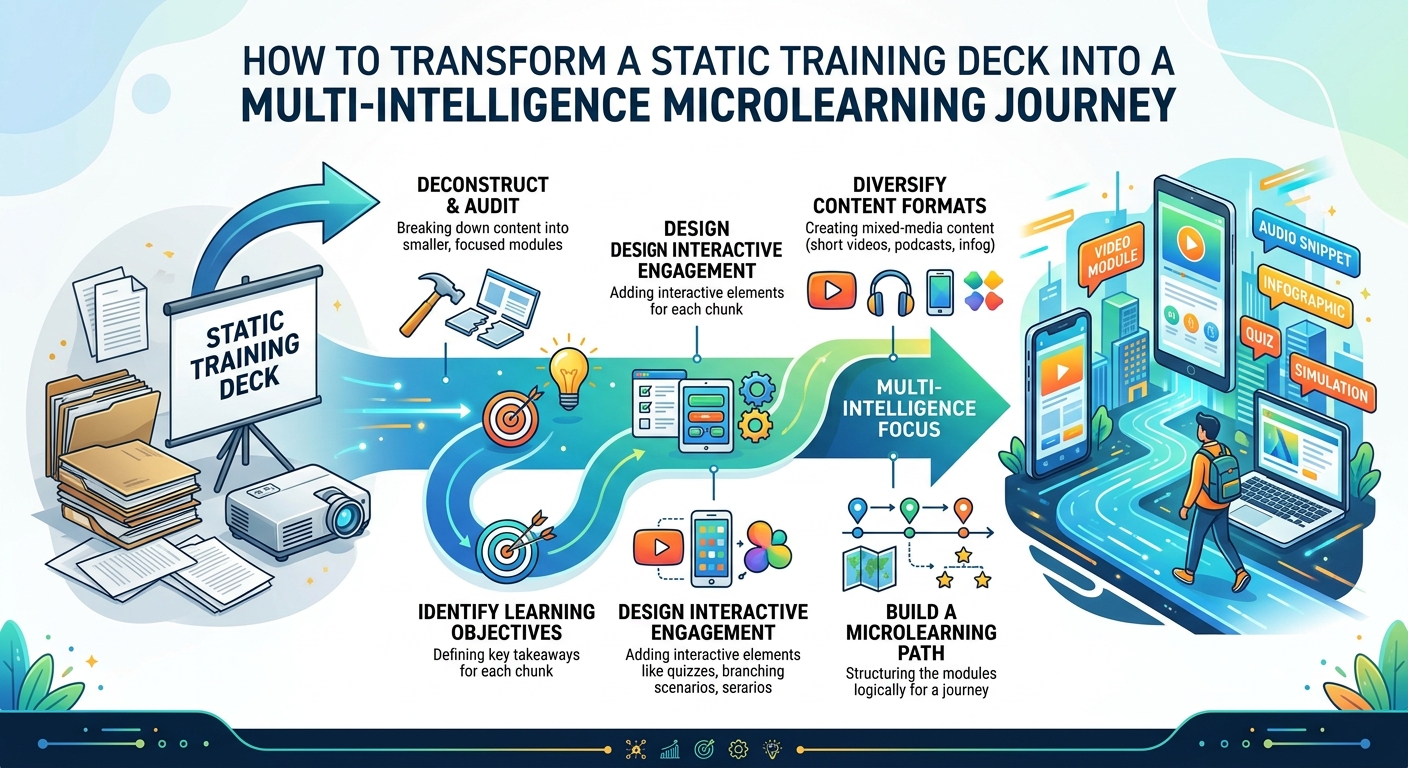
Transforming Static Training Decks into a Multi-Intelligence Microlearning Journey
For Vice Presidents, Directors, and Senior Managers in Learning & Development, the challenge is ever-present: how do you ensure training truly sticks, engages, and drives performance in a fast-paced, multi-faceted business environment? Often, the answer lies buried within static, lengthy training decks that, while content-rich, fail to capture the modern learner's attention or cater to diverse learning styles. In industries spanning Compliance, Sales, Banking, Finance, Insurance, Retail, Pharma, Healthcare, Hospitality, Oil and Gas, and Mining, the stakes are too high for ineffective training.
The solution isn't to abandon your valuable content but to revolutionize its delivery. This article explores how to transform those inert presentations into a dynamic, multi-intelligence microlearning journey, leveraging the power of an advanced Microlearning LMS and cutting-edge methodologies to empower your workforce and achieve tangible business outcomes.
The Static Deck Dilemma: Why Traditional Training Falls Short
Traditional training decks, often brimming with text and bullet points, suffer from inherent limitations in today's digital-first world. While they serve as foundational repositories of information, their passive nature struggles to meet the demands of modern learners who expect engaging, personalized, and on-demand content. The consequences are significant:
- Low Engagement: Long-form content can overwhelm and disinterest learners, leading to mind-numbing experiences.
- Poor Retention: Without active participation and varied reinforcement, information is quickly forgotten, especially in critical areas like Risk-focused Training within finance or compliance.
- Lack of Application: Learners struggle to connect abstract concepts from decks to real-world scenarios and on-the-job application.
- Inefficient Updates: Maintaining and distributing updated static decks across a large organization is a cumbersome and slow process for any enterprise learning management system.
In sectors like Pharma, where product knowledge is constantly evolving, or Sales, where techniques need continuous refinement, relying solely on static materials is a recipe for stagnation. A more agile, adaptable approach is urgently needed.
The Promise of Multi-Intelligence Microlearning
The theory of multiple intelligences, proposed by Howard Gardner, suggests that individuals possess different strengths in various cognitive areas (e.g., visual-spatial, bodily-kinesthetic, linguistic, logical-mathematical, interpersonal, intrapersonal, musical, naturalistic). Traditional training often caters predominantly to linguistic and logical-mathematical intelligences.
Microlearning, characterized by its short, focused bursts of content (typically 3-7 minutes), perfectly complements this. When combined, multi-intelligence microlearning means delivering knowledge in diverse formats that resonate with various learning preferences, ensuring greater comprehension, retention, and immediate applicability.
Imagine a compliance training module that isn't just a document, but a series of short, interactive scenarios (kinesthetic), brief animated explainers (visual), and quick audio summaries (auditory), all accessible on a sophisticated learning content management system. This holistic approach ensures that every learner finds a pathway to understanding and mastery.
Deconstructing the Transformation: From Static to Dynamic
Step 1: Content Chunking and Reimagination
The first critical step is to dissect your existing training decks. Break down lengthy topics into bite-sized, independent learning objectives. Each "chunk" should address a single concept or skill. Ask: "What is the core takeaway from this slide or section?" This foundational step is crucial for any successful microlearning strategy.
Step 2: Embracing Diverse Learning Modalities
Once content is chunked, reimagine its presentation. Instead of simply porting text, convert it into formats that appeal to different intelligences:
- Visual-Spatial: Short animated videos, infographics, interactive diagrams, simulations for operational training in Oil and Gas.
- Linguistic: Concise articles, narrated explainer videos, flashcards, short quizzes.
- Logical-Mathematical: Interactive case studies, problem-solving challenges, branching scenarios for financial decision-making.
- Bodily-Kinesthetic: Drag-and-drop exercises, role-play simulations (e.g., for sales calls or customer service in Retail/Hospitality), virtual reality (VR) snippets for hands-on equipment training.
- Interpersonal: Peer-to-peer challenges, discussion forums, collaborative problem-solving within the Microlearning LMS.
Step 3: Integrating Adaptive Learning Paths
Not every learner needs the same journey. An Adaptive Learning approach personalizes the experience based on pre-assessment results, ongoing performance, and individual preferences. If a learner demonstrates mastery of a topic, they can skip ahead. If they struggle, the system offers remedial content or different modalities to reinforce understanding. This ensures efficient learning and keeps motivation high within the cloud based learning management system.
Step 4: Leveraging Gamification and Interactivity
To combat disengagement, embed game-like elements. Points, badges, leaderboards, and progress tracking can transform mundane tasks into engaging challenges. A Gamified LMS fosters healthy competition and intrinsic motivation, crucial for sustaining long-term learning journeys, especially in Sales or Banking where performance metrics are key.
Step 5: The Role of an Advanced Learning Management System
The entire transformation hinges on a robust learning management system. A modern Microlearning LMS acts as the central hub, providing authoring tools, content delivery, progress tracking, and analytics. It should be a learning management software capable of hosting diverse media, supporting interactive elements, and providing comprehensive reporting on learner engagement and performance. MaxLearn LMS offers comprehensive learning management solutions tailored for this journey.
AI-Powered Augmentation: The Future is Now
Artificial intelligence is no longer a futuristic concept; it's a powerful ally for L&D professionals looking to optimize their training efforts. An AI Powered Authoring Tool can dramatically accelerate the transformation process.
Question: How can artificial intelligence enhance the conversion of traditional training materials into interactive microlearning content?
AI can analyze existing static decks to identify key concepts, automatically chunk content, and even suggest appropriate multimedia formats. It can personalize content delivery by recommending specific modules based on a learner's past performance and role. Furthermore, AI can generate adaptive quizzes and assessments, providing immediate feedback and guiding learners toward areas requiring more focus. This greatly reduces manual effort and speeds up the development cycle, allowing L&D teams to focus on strategic initiatives rather than mundane content conversion.
Question: For global organizations, what geographic considerations should L&D leaders factor in when deploying multi-intelligence microlearning programs?
When rolling out global programs, cultural relevance and linguistic localization are paramount. An effective Microlearning LMS must support multiple languages and allow for content adaptation to local customs and regulations (e.g., specific compliance standards in different regions). Accessibility across varying bandwidths and device types is also crucial, as is adherence to diverse data privacy regulations across countries. AI can assist in content translation and cultural adaptation, ensuring that learning experiences resonate with employees worldwide, whether they're in a bustling city or a remote mining site.
Question: Beyond mere content delivery, how does a multi-intelligence microlearning approach foster a culture of continuous organizational improvement and innovation?
By making learning accessible, engaging, and directly applicable, multi-intelligence microlearning empowers employees to take ownership of their professional development. The constant exposure to new, relevant information in varied formats encourages curiosity and critical thinking. This leads to faster skill acquisition, quicker adaptation to market changes, and an environment where knowledge is continually shared and applied. For industries like Healthcare or Finance, where continuous updates to regulations and best practices are constant, this dynamic learning culture is not just beneficial, but essential for competitive advantage and ensuring proper Risk-focused Training.
Realizing the ROI: Benefits for L&D Leaders
Embracing a multi-intelligence microlearning journey delivers significant returns for L&D leaders and their organizations:
- Increased Engagement and Completion Rates: Learners are more likely to start and finish modules that are short, relevant, and engaging.
- Enhanced Knowledge Retention and Application: Diverse modalities and active learning ensure information is absorbed deeply and applied effectively.
- Faster Time to Competency: Employees acquire necessary skills more quickly, impacting productivity and performance.
- Measurable Impact on Business Outcomes: Improved training directly translates to better compliance adherence, higher sales figures, reduced safety incidents, and enhanced customer satisfaction.
- Future-Proofing Training Efforts: An agile, data-driven approach allows L&D to respond rapidly to evolving business needs and market shifts.
Conclusion
The days of static, one-size-fits-all training are behind us. For L&D leaders aiming to future-proof their workforce and drive strategic business growth, transforming inert training decks into vibrant, multi-intelligence microlearning journeys is not merely an option, but a necessity. By leveraging advanced learning management software, embracing diverse modalities, and integrating AI-powered solutions, your organization can foster a culture of continuous learning, empower employees, and achieve unparalleled operational excellence. It's time to move beyond passively presenting information and start actively cultivating intelligence across your entire enterprise.


