

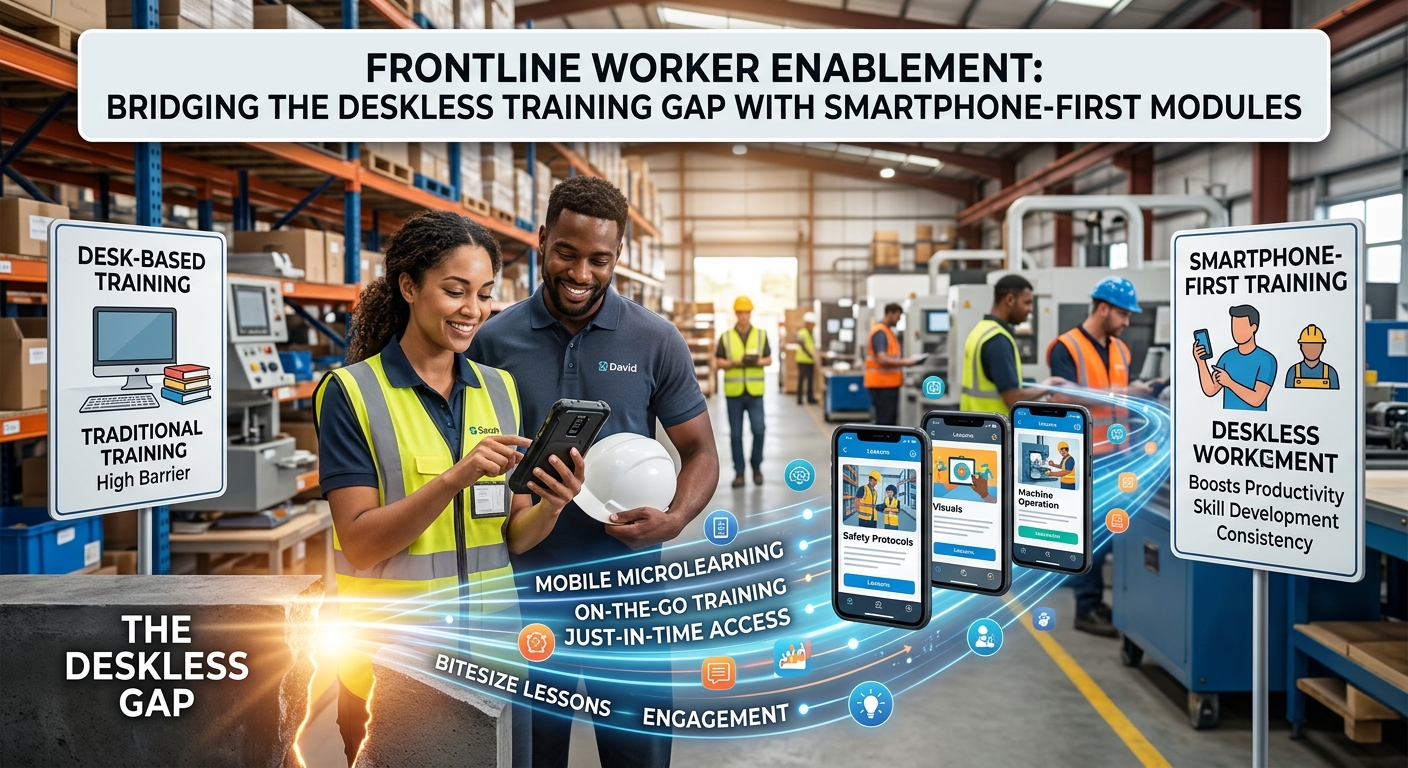
Frontline Worker Enablement: Bridging the Deskless Training Gap with Smartphone-First Modules
In today's dynamic business landscape, frontline workers are the backbone of operations across countless industries – from the retail floor and hospital wards to oil rigs and financial institutions. They are the direct touchpoints for customers, the hands-on implementers of strategy, and often the first to identify operational challenges. Yet, traditional training models frequently fail to adequately serve this critical deskless workforce, leaving a significant gap in their enablement and overall organizational performance.
For Vice Presidents, Directors, and Senior Managers in Learning & Development, the challenge is clear: how do we deliver timely, relevant, and engaging training to employees who are constantly on the move, often without access to desktop computers or dedicated training rooms? The answer lies in embracing a smartphone-first approach, leveraging the ubiquitous device in every worker's pocket to transform training delivery. This strategy isn't just about convenience; it's about optimizing learning outcomes, boosting productivity, and ensuring compliance through highly accessible, impactful modules.
The Deskless Dilemma: Challenges in Training Frontline Workers
Frontline workers operate in environments where time is a premium, and interruptions are common. Traditional eLearning courses, often lengthy and desktop-dependent, are simply not practical. Key challenges include:
- Time Constraints: Busy schedules make it difficult to allocate dedicated hours for training.
- Dispersed Workforce: Geographically scattered teams complicate centralized training efforts.
- Access Barriers: Many frontline roles don't involve daily computer use, making desktop-only learning inaccessible.
- Relevance and Context: Generic training often lacks the immediate applicability needed for on-the-job scenarios.
- Engagement Issues: Long, passive content fails to capture and maintain attention in high-paced environments.
Overcoming these hurdles requires a paradigm shift, moving away from conventional methods towards solutions tailored for the deskless reality. This is where a specialized Microlearning LMS becomes indispensable, offering bite-sized content designed for mobile consumption.
The Power of Smartphone-First: Why Mobile is Key
The smartphone is more than just a communication device; it's a powerful personal computer in every worker's pocket. A smartphone-first training strategy capitalizes on this ubiquity and familiarity, offering a host of benefits:
- Ubiquity & Accessibility: Almost every frontline worker owns a smartphone, providing instant access to learning content anytime, anywhere.
- Convenience & Flexibility: Learners can access modules during short breaks, commutes, or even between tasks, fitting learning into their workflow rather than disrupting it.
- Familiarity & Intuition: Workers are adept at navigating smartphone interfaces, reducing the learning curve for the training platform itself.
- On-Demand Support: Immediate access to critical information or procedure guides for real-time problem-solving.
- Enhanced Engagement: Mobile-optimized content, often in smaller chunks, can be more interactive and less daunting.
By making learning truly accessible and immediate, organizations can foster a culture of continuous development and empower their frontline teams with the knowledge they need precisely when they need it.
Designing Engaging Smartphone-First Training Modules
Effective smartphone-first training goes beyond simply shrinking desktop content. It demands a thoughtful design approach centered on the principles of Microlearning LMS. Modules should be:
- Bite-sized: Short, focused units (3-7 minutes) that address a single learning objective. This prevents cognitive overload and fits into small pockets of time.
- Interactive: Incorporate quizzes, polls, drag-and-drop exercises, and decision-making scenarios suitable for touchscreens.
- Multimedia-Rich: Utilize short videos, infographics, audio clips, and images to convey information quickly and effectively.
- Scenario-Based: Present real-world situations and ask learners to apply their knowledge, enhancing relevance and retention.
- Gamified: Introduce points, badges, leaderboards, and challenges to motivate learners and foster healthy competition. A robust Gamified LMS can significantly boost participation and completion rates.
Leveraging an intuitive learning content management system (LCMS) is crucial for creating and managing such dynamic content efficiently.
Leveraging Intelligence for Optimal Performance
The true power of smartphone-first training is magnified when coupled with intelligent capabilities. Imagine a learning experience that understands each worker's unique needs, adapting content to their strengths and weaknesses. This is the promise of Adaptive Learning.
By analyzing learner performance data, progress, and even preferred learning styles, an advanced learning management software can personalize the learning path. This ensures that a new retail associate receives targeted training on POS systems, while an experienced nurse gets refreshers on critical compliance updates, rather than irrelevant modules. Such tailored experiences lead to faster skill acquisition and more efficient training expenditure.
Furthermore, an enterprise learning management platform can use data to identify broader skill gaps across teams or departments, providing L&D leaders with strategic insights to inform future training initiatives. This shift from reactive to proactive training ensures resources are allocated where they will have the greatest impact.
Addressing Specific Industry Needs: Compliance, Sales, and Beyond
The versatility of smartphone-first learning modules makes them ideal for a wide array of industries and specific training requirements:
- Compliance (Banking, Finance, Healthcare, Pharma): Delivering mandatory Risk-focused Training and regulatory updates in digestible, trackable formats. For example, a financial advisor can complete a new AML module during a lull between client meetings.
- Sales (Retail, Pharma, Insurance): Equipping sales teams with product knowledge, objection handling techniques, and upselling strategies on-the-go. An AI Powered Authoring Tool can rapidly create scenario-based modules for new product launches.
- Hospitality & Retail: Training on customer service standards, new procedures, or seasonal promotions, ensuring consistency across all locations.
- Oil & Gas, Mining: Delivering critical safety protocols, equipment operation guides, and emergency procedures directly to workers in remote or hazardous environments.
The ability to update and deploy content instantly across a cloud based learning management system ensures that all frontline workers always have access to the most current and accurate information, regardless of their location.
Intelligent Queries for Enhanced Learning Strategy
For L&D leaders considering a smartphone-first training strategy, here are some critical questions and insights to guide your approach:
How can organizations ensure their frontline training content is highly discoverable and immediately relevant to a worker's specific task or query?
To maximize discoverability, implement a robust LMS with advanced search capabilities, comprehensive tagging, and intuitive categorization. Content should be structured with clear learning objectives and keyword-rich descriptions. Furthermore, integrating contextual learning, where relevant modules are suggested based on a worker's role, location, or even specific tasks they are performing via other digital tools, can provide just-in-time support and enhance immediate relevance. This ensures that when a worker needs to know "how to handle a specific customer complaint," the exact module is a few taps away.
In a globally distributed organization, how can we deliver consistent, high-quality training that accounts for local nuances and language differences?
For global reach, a cloud based learning management system with robust localization features is paramount. This allows for centralized content creation through a single LCMS, which can then be easily translated, culturally adapted, and deployed to various regions. The system should support multiple languages, allow local administrators to tailor content where necessary (e.g., adding region-specific compliance details), and ensure a consistent user experience regardless of geographic location. This approach balances global standards with local applicability, crucial for sectors like banking or healthcare with varied regulatory landscapes.
What advanced capabilities can transform raw training data into actionable insights for continuous improvement and talent development?
Beyond basic completion rates, an advanced learning management system should offer sophisticated analytics. Look for platforms that provide granular data on learner engagement patterns, areas of struggle, time spent per module, and performance trends. Predictive analytics can identify employees at risk of skill gaps or those with high potential. An enterprise learning management platform can aggregate this data across departments to reveal systemic training needs, inform curriculum development, and enable personalized career pathing. This data-driven approach moves beyond mere reporting to offer strategic guidance for ongoing talent development and business growth.
Implementing a Smartphone-First Strategy: Key Considerations
Adopting a smartphone-first approach requires careful planning:
- Choosing the Right Platform: Select a lms learning management system designed for mobile-first delivery, offering intuitive UX and robust analytics. A solution like MaxLearn LMS is purpose-built for this environment.
- Content Strategy: Prioritize critical skills, break down complex topics, and focus on engaging formats.
- Pilot Programs: Roll out initially to a smaller group to gather feedback and refine the approach before a wider launch.
- Support & Promotion: Ensure technical support is available and actively promote the benefits of mobile learning to foster adoption.
- Measuring Impact: Continuously track completion rates, skill attainment, and business KPIs to demonstrate ROI.
Conclusion
Bridging the deskless training gap with smartphone-first modules is no longer a luxury but a strategic imperative for any organization aiming for operational excellence and a competitive edge. By providing accessible, engaging, and relevant training directly into the hands of your frontline workers, L&D leaders can unlock unprecedented levels of enablement, productivity, and job satisfaction.
Embrace the power of mobile learning to transform your organization's training landscape, empower your most critical employees, and drive tangible business results across all segments and industries. The future of frontline enablement is intelligent, adaptive, and fits perfectly in the palm of their hand.
.jpg)


