

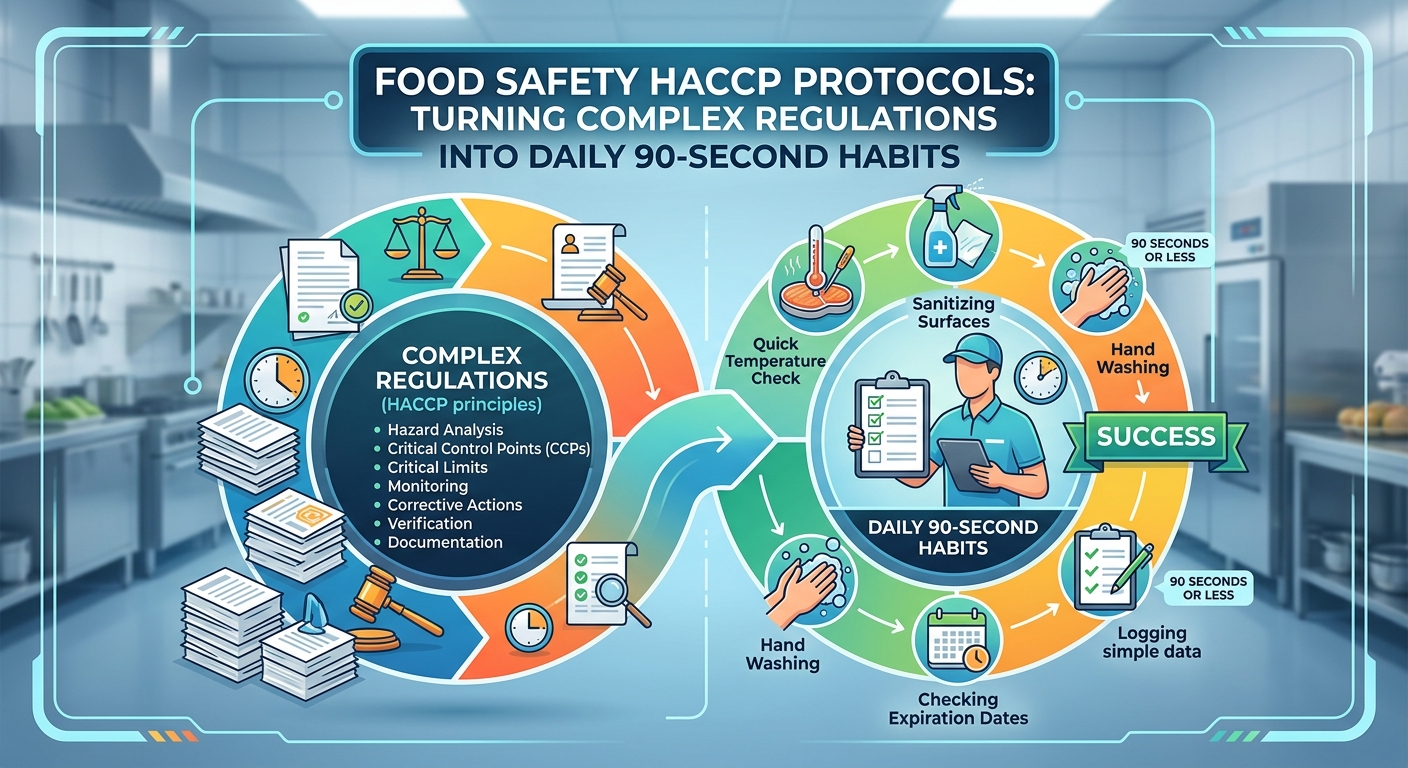
Food Safety HACCP Protocols: Turning Complex Regulations into Daily 90-Second Habits
For leaders in Learning & Development across industries from retail to healthcare, hospitality to oil and gas, ensuring compliance isn't just a regulatory box-ticking exercise; it's a cornerstone of operational integrity, brand reputation, and employee safety. Nowhere is this more critical than in food safety, where the Hazard Analysis and Critical Control Points (HACCP) system stands as a global benchmark. Yet, the sheer volume and complexity of HACCP protocols can overwhelm even the most diligent teams, making consistent adherence a formidable challenge.
The imperative isn't just to understand HACCP; it's to internalize it, to transform intricate guidelines into instinctive, daily actions. This article explores how modern eLearning strategies, particularly microlearning fueled by artificial intelligence, can simplify HACCP training, making it an engaging, accessible, and highly effective part of your organization's daily routine – literally turning complex regulations into 90-second habits.
The Imperative of Food Safety and HACCP
Food safety is non-negotiable. A single lapse can lead to product recalls, legal ramifications, devastating health crises, and irreparable damage to consumer trust. HACCP, a systematic preventive approach to food safety, identifies potential biological, chemical, and physical hazards in food production processes and designs measures to reduce these risks to a safe level. From manufacturing plants and restaurants to catering services and even hospitals, adherence to these protocols is paramount.
The Challenge: Bridging Knowledge Gaps and Compliance
The traditional approach to HACCP training often involves lengthy seminars, dense manuals, and infrequent refreshers. While comprehensive, this method frequently falls short in practical application:
- Information Overload: Employees struggle to retain vast amounts of information presented in a single sitting.
- Lack of Engagement: Static, text-heavy content can disengage learners, leading to passive compliance rather than active understanding.
- Inconsistent Application: Without regular reinforcement and practical context, protocols can be misapplied or forgotten.
- Scalability Issues: Delivering consistent, high-quality training across a large, diverse workforce, potentially in multiple locations, is logistically complex and expensive.
For L&D professionals, the goal is clear: how do we make HACCP not just understood, but habitually practiced, ensuring every employee, from front-line staff to management, acts as a vigilant guardian of food safety?
The Microlearning Revolution: Simplifying HACCP Training
Enter microlearning – a methodology that delivers bite-sized, focused learning content designed for quick consumption and immediate application. Instead of hours-long courses, microlearning modules typically last 3-5 minutes, sometimes even as short as 90 seconds, perfectly suited for busy schedules and on-the-job reinforcement.
Imagine HACCP training broken down into modules like:
- "90-second check: Calibrating your thermometer."
- "Critical control point review: Proper handwashing technique."
- "Hazard identification: Spotting cross-contamination risks."
This approach transforms overwhelming regulations into digestible, actionable insights. By using an effective Microlearning LMS, organizations can deliver these short, impactful lessons directly to employees' mobile devices, at the point of need, just before or during critical tasks. This just-in-time training significantly boosts retention and practical application, ensuring that food safety protocols become ingrained daily habits rather than remembered facts.
Leveraging AI for Smarter, Faster HACCP Adherence
The true power of microlearning for HACCP is amplified when combined with artificial intelligence. AI can revolutionize how training content is delivered, personalized, and assessed:
- Personalized Learning Paths: AI can analyze an employee's role, performance data, and past learning history to deliver customized microlearning modules. This means a kitchen staff member receives specific content on cooking temperatures, while a delivery driver focuses on transport safety, making the training highly relevant and efficient. This focus on individual needs is key to effective Adaptive Learning.
- Predictive Analytics for Risk: AI can identify potential weak points in training or areas where employees consistently struggle, allowing L&D to proactively deploy targeted micro-interventions. This proactive, Risk-focused Training minimizes compliance gaps before they become critical issues.
- Intelligent Content Curation: An AI Powered Authoring Tool can help L&D teams rapidly create and update microlearning content, ensuring it remains current with evolving HACCP regulations and industry best practices.
- Enhanced Engagement through Gamified LMS: AI can power dynamic quizzes, simulations, and interactive scenarios within microlearning modules, turning HACCP compliance into an engaging experience.
Practical Implementation: From Policy to Practice
For L&D leaders, implementing an AI-powered microlearning approach to HACCP involves a strategic shift:
- Audit Existing Protocols: Break down each HACCP principle and critical control point into its smallest, most actionable components.
- Design Bite-Sized Content: Create engaging, visual, and interactive microlearning modules for each component, focusing on a single learning objective per module. Use video, infographics, and short quizzes.
- Choose the Right Platform: Invest in a robust LMS (Learning Management System) or LCMS (Learning Content Management System) that supports microlearning, mobile delivery, and AI capabilities. A modern cloud based learning management system can provide this flexibility and scalability.
- Implement a Reinforcement Schedule: Use the learning management software to schedule regular, brief refreshers and knowledge checks. Spaced repetition, managed by the enterprise learning management system, is crucial for long-term retention.
- Integrate with Operations: Make these 90-second habits part of the daily workflow. For example, a quick microlearning module could be part of the daily shift briefing or accessible via a QR code at a specific workstation.
AI-Enhanced Insights: Your Questions Answered
As L&D professionals consider adopting advanced learning solutions, common queries arise about their practical applications and benefits:
Q: How can learning platforms customize content for different roles within a large organization?
A: Modern learning management solutions leverage machine learning to analyze user profiles, job roles, and past performance. This allows the lms learning management system to dynamically deliver content tailored specifically to an individual's responsibilities. For instance, a supervisor might receive modules on auditing HACCP records, while a processing line worker gets content on specific equipment sanitation procedures. This ensures relevancy and minimizes wasted learning time.
Q: How can global enterprises ensure consistent food safety training across diverse regions with varying regulations?
A: Advanced learning management system platforms are designed for global scalability. They can host localized content, support multiple languages, and track compliance against region-specific regulatory frameworks. Artificial intelligence can even help identify discrepancies between local practices and global standards, suggesting localized microlearning updates to ensure uniform understanding and adherence, regardless of geographical location. A robust MaxLearn LMS is equipped for this global reach.
Q: What kind of learning solution best ensures employees retain critical food safety information and apply it consistently?
A: The most effective solution combines microlearning with adaptive, AI-driven pathways and gamification. By breaking down complex information into short, engaging modules, delivered precisely when needed, retention dramatically improves. The learning management system can use AI to assess comprehension, identify knowledge gaps, and automatically provide targeted refreshers. Gamified elements further motivate employees to interact frequently with the content, embedding crucial food safety habits through repeated, positive engagement.
The Future of Food Safety Training: Smart, Seamless, Secure
For Vice Presidents, Directors, and Managers of L&D, the path to superior food safety compliance no longer lies in traditional, cumbersome training methods. It's about harnessing the power of technology to make learning efficient, engaging, and genuinely habitual. By adopting an AI-powered microlearning approach, organizations can transform complex HACCP regulations into daily, 90-second habits, fostering a culture of continuous safety, protecting consumers, and safeguarding their brand. The investment in such a forward-thinking LMS is an investment in unparalleled operational excellence and unwavering trust.
.jpg)


