

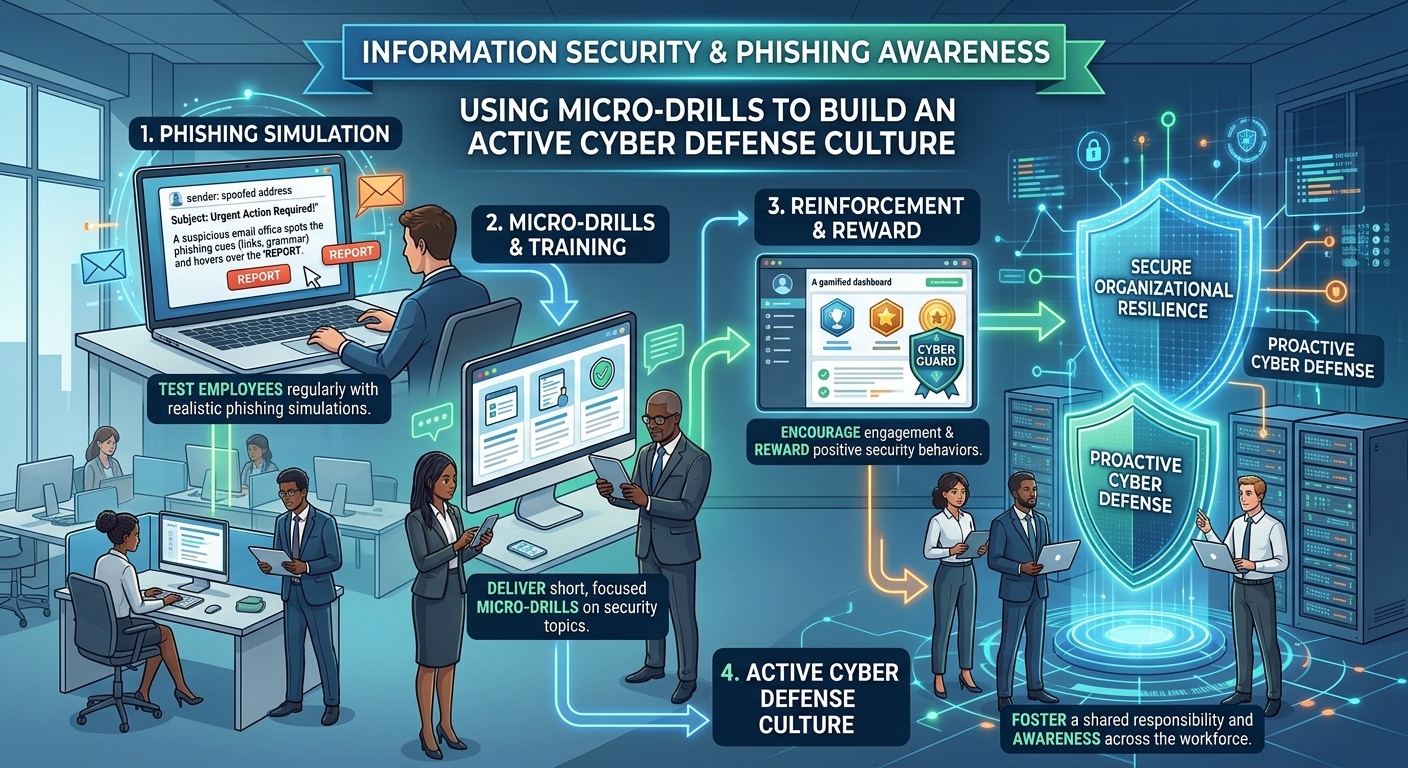
Information Security & Phishing Awareness: Using Micro-Drills to Build an Active Cyber Defense Culture
In an era where digital threats evolve at lightning speed, the human element remains the most significant vulnerability in an organization's cyber defense strategy. Phishing attacks, ransomware, and social engineering schemes are becoming increasingly sophisticated, making robust information security awareness not just a compliance checkbox, but a strategic imperative for Vice Presidents, Directors, and Managers of Learning & Development. Traditional annual training sessions, while foundational, often fall short of building the agile, active cyber defense culture required today. The answer lies in transforming passive learning into proactive engagement: through micro-drills.
The Escalating Threat Landscape and Human Vulnerability
Every day, organizations across all segments—from Banking and Finance to Retail, Pharma, Healthcare, and Oil and Gas—face a relentless barrage of cyber threats. These threats are not merely technological; they expertly target human psychology. A single misstep, a hasty click on a malicious link, or an unwitting disclosure of sensitive information can lead to devastating consequences: data breaches, financial losses, reputational damage, and operational disruption. The sheer volume and complexity of these attacks underscore the urgent need for continuous, practical, and highly engaging employee training.
The problem isn't that employees don't care about security; it's often that their awareness isn't consistently reinforced or made relevant to their daily workflows. Static, lengthy training modules struggle to compete with the dynamic nature of real-world threats. They fail to build the muscle memory and critical thinking skills necessary to identify and resist sophisticated social engineering tactics.
Beyond Annual Training: Why Traditional Methods Fall Short
For too long, information security awareness has been treated as a one-off event. Employees sit through a generic course, click through slides, and take a quiz. While these efforts satisfy compliance requirements, their effectiveness in fostering a truly secure environment is limited. The "forgetting curve" dictates that much of what's learned is rapidly lost without regular reinforcement. Furthermore, generic content rarely resonates with the specific risks and roles of individual employees.
This outdated approach creates a reactive defense posture, rather than an active one. Organizations need a methodology that integrates security awareness into the fabric of daily operations, making it a continuous, engaging, and personalized journey. This is where the power of micro-drills comes into play, creating a fundamental shift from passive reception to active participation.
Introducing Micro-Drills: A Paradigm Shift in Awareness Training
Micro-drills are short, focused, and frequent learning interventions designed to reinforce specific security concepts and behaviors. They simulate real-world scenarios in a controlled environment, allowing employees to practice identifying and responding to threats without fear of real consequences. Imagine your entire workforce engaging in bite-sized, practical exercises that sharpen their cyber instincts, much like fire drills prepare staff for an emergency.
This approach leverages principles of Microlearning LMS, delivering knowledge in digestible chunks that are easy to consume and retain. By breaking down complex topics into manageable parts, micro-drills combat cognitive overload and enhance learning retention, making security awareness an ongoing habit rather than an annual chore.
How Micro-Drills Work in Practice
Micro-drills can take various forms, all designed to be quick, relevant, and impactful:
- Simulated Phishing Emails: Periodically send realistic, harmless phishing emails to employees. Those who click on suspicious links or provide credentials can then receive immediate, targeted feedback and remedial training.
- "Spot the Imposter" Quizzes: Present employees with examples of legitimate vs. fraudulent emails, websites, or messages, asking them to identify the fakes.
- Interactive Scenarios: Short, narrative-driven exercises that put employees in decision-making roles regarding security incidents, with instant feedback on their choices.
- Short Video Explanations: Quick, animated videos explaining a specific threat (e.g., "what is smishing?" or "how to spot a spoofed website") followed by a single question.
- Password Strength Challenges: Mini-games or quizzes that teach employees about creating strong, unique passwords and the risks of reusing them.
The key is consistency and variety. By regularly exposing employees to different types of simulated threats, organizations can build resilience and adaptability.
Building an Active Cyber Defense Culture with Micro-Drills
Transforming security awareness from a compliance mandate into an active cultural norm requires more than just deploying micro-drills; it demands a strategic framework:
Frequency and Consistency
Unlike annual training, micro-drills should be deployed frequently – perhaps weekly or bi-weekly. This continuous reinforcement keeps security top-of-mind and builds 'cyber muscle memory.' Regular exposure to simulated threats helps employees instinctively recognize and report real ones.
Personalization and Relevance
One size does not fit all. Micro-drills should be tailored to different departments, roles, and risk profiles. A finance manager might receive drills focused on invoice fraud, while an HR professional might focus on data privacy phishing attempts. This contextual relevance significantly boosts engagement and effectiveness, allowing for truly Adaptive Learning experiences.
Feedback and Reinforcement
Immediate, constructive feedback is crucial. If an employee falls for a simulated phish, the system should instantly provide information on what went wrong and how to identify such threats in the future. This transforms errors into valuable learning opportunities.
Positive Reinforcement, Not Punishment
The goal is to educate and empower, not to shame. A positive, supportive environment encourages employees to report suspicious activities without fear of repercussions, fostering a culture of shared responsibility for security.
Leveraging an Advanced Learning Platform for Micro-Drills
To effectively manage, deliver, and track a comprehensive micro-drill program, a robust learning platform is indispensable. A modern learning management system (LMS) can automate the deployment of drills, collect valuable data, and provide insights into employee readiness. Such a platform acts as a central learning content management system (LCMS) for all your security training needs.
Consider a cloud based learning management system that offers a suite of features:
- Automated Scheduling and Delivery: Streamline the deployment of micro-drills to target groups.
- Performance Analytics: Track participation rates, success rates, and identify areas of weakness across the organization. This helps in understanding what advanced metrics and analytical approaches can help us truly understand and improve employee readiness against sophisticated cyber threats.
- Gamified LMS Elements: Incorporate points, leaderboards, and badges to boost engagement and create a healthy competitive spirit.
- Content Authoring Tools: Utilize an AI Powered Authoring Tool to quickly create and customize micro-drills, ensuring they remain fresh and relevant. This answers the question: how can artificial intelligence tools enhance our cybersecurity training programs to make them more effective and efficient?
- Scalability: An enterprise learning management solution ensures that training can be scaled seamlessly across a diverse, geographically dispersed workforce, addressing what are the best practices for scaling information security awareness across a diverse, geographically dispersed workforce using digital platforms.
By using a comprehensive learning management software, organizations can implement Risk-focused Training, directing resources to where they are most needed and achieving optimal impact. This proactive approach with an advanced lms learning management system empowers L&D leaders to demonstrate tangible improvements in their organization's cyber resilience.
Conclusion: Empowering Your Workforce as the First Line of Defense
In the relentless battle against cyber threats, your employees are your most critical asset. Investing in a dynamic, continuous information security awareness program driven by micro-drills is no longer optional; it's a fundamental pillar of modern organizational resilience. By embracing platforms like MaxLearn LMS and adopting innovative learning management solutions, L&D leaders can transform passive learners into active cyber defenders, significantly reducing your organization's risk profile. It's time to build a proactive, engaged, and resilient cyber defense culture—one micro-drill at a time.
.jpg)


