

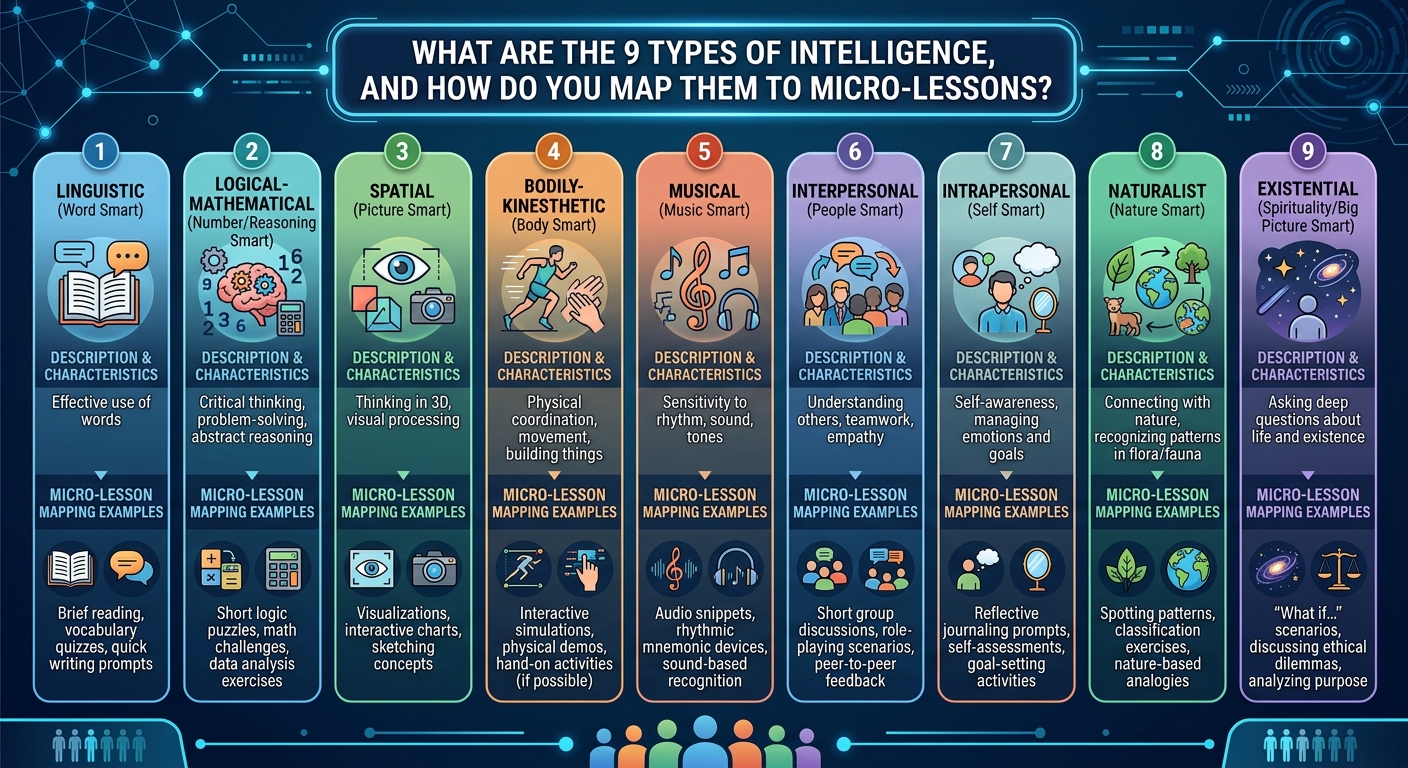
Unlocking Potential: Mapping the 9 Intelligences to Micro-Lessons for Modern L&D
In today's fast-paced corporate environment, the demand for effective and engaging learning and development (L&D) programs has never been higher. Vice Presidents, Directors, and Senior Managers in L&D across industries like Compliance, Sales, Banking, Finance, Insurance, Retail, Pharma, Health care, Hospitality, Oil and Gas, and Mining face the constant challenge of upskilling their workforce efficiently. The traditional one-size-fits-all training approach often falls short, failing to cater to the diverse ways individuals learn and process information. This is where understanding the nine types of intelligence and strategically mapping them to micro-lessons becomes a game-changer.
Imagine a learning ecosystem where every employee, regardless of their dominant intelligence, feels understood, engaged, and empowered to absorb complex information. This article explores how embracing a multi-intelligent approach, powered by micro-lessons, can transform your enterprise learning management strategy, fostering deeper engagement and measurable skill development.
Understanding the 9 Types of Intelligence
Pioneering research into human cognition revealed that intelligence is not a single, monolithic entity but rather a spectrum of distinct abilities. Recognizing these diverse intelligences is the first step toward crafting truly impactful corporate training.
- Linguistic Intelligence: The ability to use words effectively, both orally and in writing. Think writers, speakers, lawyers, and educators who excel at language nuances.
- Logical-Mathematical Intelligence: The capacity to use reason, logic, and numbers to solve problems and understand abstract concepts. Essential for scientists, mathematicians, and engineers.
- Spatial Intelligence: The ability to perceive the visual-spatial world accurately and to perform transformations upon those perceptions. Architects, artists, and navigators often exhibit high spatial intelligence.
- Bodily-Kinesthetic Intelligence: Expertise in using one’s whole body to express ideas and feelings, and facility in using one’s hands to produce or transform things. Dancers, athletes, surgeons, and craftspeople exemplify this.
- Musical Intelligence: The capacity to perceive, discriminate, transform, and express musical forms. Composers, musicians, and sensitive listeners possess this aptitude.
- Interpersonal Intelligence: The ability to understand and interact effectively with others. Leaders, counselors, sales professionals, and teachers often have strong interpersonal skills.
- Intrapersonal Intelligence: The capacity to understand oneself, including one’s own emotions, motivations, and goals. This intelligence is crucial for self-awareness and personal growth.
- Naturalistic Intelligence: The ability to recognize and categorize elements of the natural world, such as flora, fauna, and environmental patterns. Biologists, farmers, and outdoor enthusiasts often exhibit this.
- Existential Intelligence: The inclination to ponder fundamental questions about life, death, and existence. Philosophers, spiritual leaders, and those who reflect on deeper meanings typically possess this.
The Power of Micro-Lessons in L&D
Micro-lessons, characterized by short, focused bursts of learning content, are ideally suited to address the varied learning styles stemming from these intelligences. Unlike lengthy courses, micro-lessons deliver specific learning objectives in easily digestible formats, typically ranging from 2-10 minutes. This approach is particularly effective for busy professionals, ensuring higher completion rates, better retention, and immediate applicability.
Implementing a Microlearning LMS allows organizations to manage, deliver, and track these concise learning modules with unparalleled efficiency. The flexibility of a modern learning management system means content can be accessed anytime, anywhere, catering to the dynamic schedules of employees across diverse industries, from field operations in Oil and Gas to fast-paced retail environments.
Mapping Intelligences to Micro-Lessons: A Strategic Approach
By understanding each intelligence type, L&D professionals can design micro-lessons that resonate deeply with different learners, creating a more inclusive and effective training experience.
For Linguistic Intelligence:
Micro-lessons can include concise policy briefs, summary videos with clear narration, interactive legal document analyses, or short case study summaries. For Sales training, this might involve quick tips on objection handling scripts or effective communication phrases. In Banking, it could be a brief video explaining complex financial terms.
For Logical-Mathematical Intelligence:
Design micro-lessons around quick quizzes, problem-solving simulations, data interpretation challenges, or interactive flowcharts for compliance procedures. For Pharma, this could involve a short module on drug dosage calculations or statistical analysis of trial results. Finance professionals benefit from quick exercises on risk assessment algorithms or budget forecasting.
For Spatial Intelligence:
Leverage infographics, interactive diagrams, visual checklists, virtual walkthroughs of facilities (e.g., a hospital layout for healthcare staff, a factory floor for safety training in Manufacturing), or "spot the error" visual exercises. Retail staff could learn product placement strategies through visual guides, while Mining employees might use interactive maps for site safety.
For Bodily-Kinesthetic Intelligence:
Incorporate interactive simulations, role-playing scenarios, practical demonstration videos (e.g., how to operate new machinery in Oil and Gas, a new customer service protocol in Hospitality), or gamified tasks. A Gamified LMS is perfect for this, turning learning into an active, engaging experience, from practicing a sales pitch to simulating a medical emergency.
For Musical Intelligence:
While less conventional for corporate training, musical cues, jingles for memorizing key facts (e.g., safety protocols), or background music designed to enhance focus during a micro-lesson can be subtle yet effective. Imagine a short jingle to remember compliance regulations in Banking.
For Interpersonal Intelligence:
Focus on scenario-based dialogues, short modules on conflict resolution, peer-to-peer learning prompts, or customer service simulations. For Insurance, this could be a micro-lesson on empathetic client communication. Healthcare professionals benefit from modules on improving team collaboration.
For Intrapersonal Intelligence:
Provide self-reflection prompts, short journaling exercises, goal-setting templates, or modules on stress management and ethical decision-making. These help employees in any sector, especially those in high-pressure roles, develop self-awareness and resilience.
For Naturalistic Intelligence:
Micro-lessons can explore environmental impact assessments, sustainability training, or pattern recognition in market trends or geological data. For Oil and Gas or Mining, this might include identifying environmental risks or understanding resource extraction impacts.
For Existential Intelligence:
Develop micro-lessons on corporate ethics, corporate social responsibility (CSR) initiatives, leadership philosophy, or the societal impact of the company's operations. Risk-focused Training often touches upon ethical dilemmas and the broader implications of business decisions.
Advanced Algorithms for Personalized Learning Paths
The synergy between diverse intelligences and micro-lessons truly blossoms with the integration of intelligent systems. Advanced algorithms are revolutionizing how L&D content is delivered, ensuring maximum impact for every learner.
How can advanced algorithms tailor content delivery for optimal engagement? By analyzing a learner's interactions, progress, and even preferred formats, intelligent systems can dynamically adjust the learning path. This means a linguistic learner might receive more text-based micro-lessons, while a spatial learner is presented with interactive diagrams and videos. This adaptive delivery ensures that each employee receives the most effective content for their specific needs, leading to higher knowledge retention and skill mastery. This approach is at the heart of Adaptive Learning.
What are the considerations for deploying a universal learning platform across diverse global operations? When managing a global workforce, an intelligent learning content management system must account for cultural nuances, language differences, and regional compliance requirements. Algorithms can help localize content, track regional performance metrics, and ensure equitable access to learning resources, regardless of geographical location. This enables consistent quality training across all segments, from a Compliance team in New York to a Health care facility in Dubai.
How do intelligent learning systems empower individuals to achieve specific performance goals? By providing real-time feedback, identifying knowledge gaps, and recommending targeted micro-lessons, these systems act as personalized coaches. For instance, in Sales training, if an employee struggles with closing techniques, the system can automatically suggest a series of micro-lessons focused on that specific skill, perhaps even delivered via an AI Powered Authoring Tool. This data-driven, individualized approach ensures that training directly translates into improved performance and tangible business outcomes, addressing the critical needs of enterprise learning management.
Implementing a Multi-Intelligent Microlearning Strategy
To successfully integrate this strategy, L&D leaders should:
- Assess Learner Profiles: Utilize pre-assessments or surveys to understand the dominant intelligence types within your workforce.
- Diversify Content: Create a rich repository of micro-lessons using various media types – videos, infographics, interactive quizzes, audio clips, and text.
- Leverage Technology: Invest in a robust LMS or LCMS that supports diverse content formats, adaptive learning paths, and detailed analytics. A cloud based learning management system offers the scalability and accessibility needed for modern corporate training.
- Measure and Iterate: Continuously gather feedback and analyze data to refine your micro-lesson content and delivery methods.
Conclusion
Moving beyond generic training, L&D professionals now have the tools and insights to create profoundly personal and effective learning experiences. By understanding the nine types of intelligence and strategically mapping them to micro-lessons, supported by intelligent learning management solutions, organizations can unlock the full potential of their workforce. This approach not only boosts engagement and retention but also ensures that critical skills development, from Compliance to Sales, is tailored, impactful, and directly contributes to business growth. Embrace this multi-intelligent microlearning strategy and empower your employees to thrive in an ever-evolving corporate landscape.
.jpg)


