

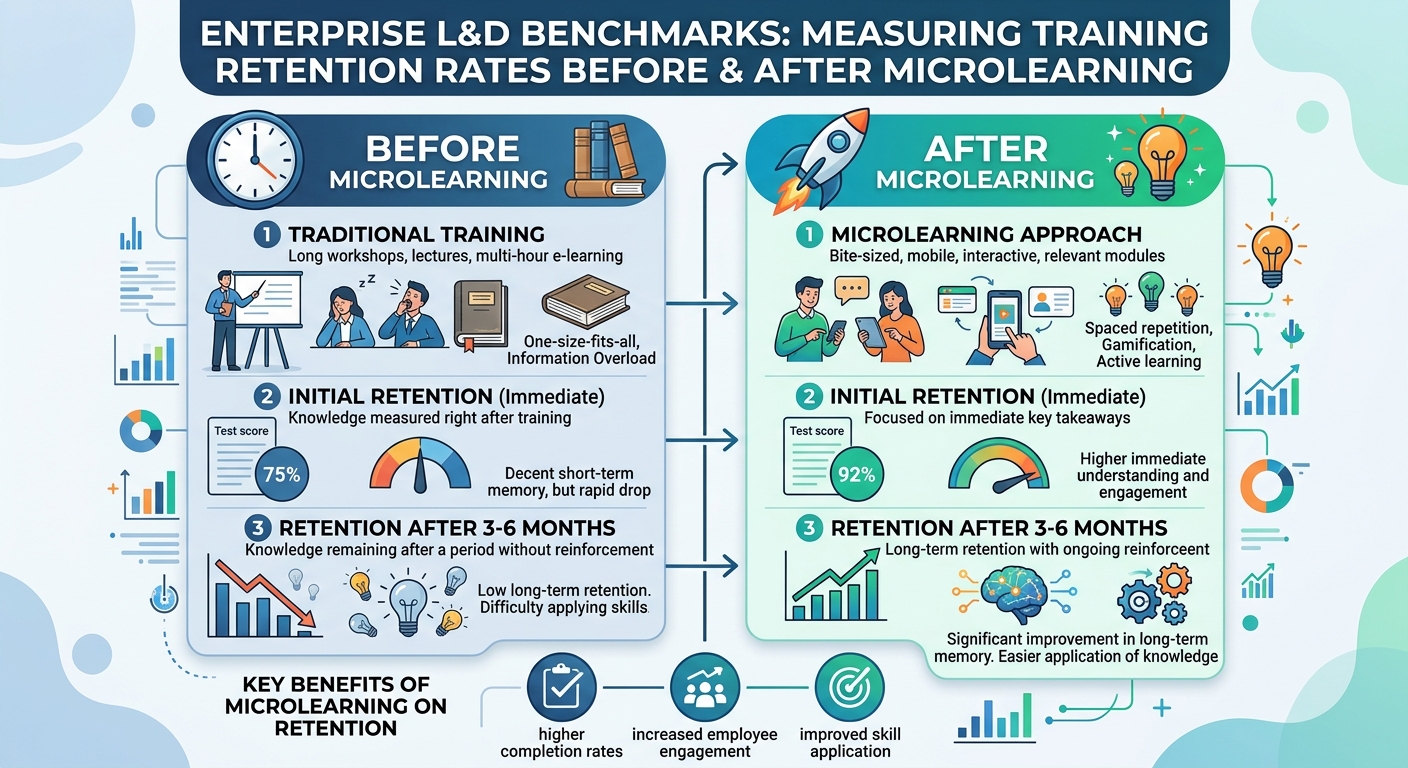
Enterprise L&D Benchmarks: Measuring Training Retention Rates Before and After Microlearning
In today's fast-paced corporate environment, enterprise-level Learning & Development (L&D) leaders face the perennial challenge of ensuring that training investments translate into tangible, lasting knowledge and skill retention. For Vice Presidents, Directors, and Senior Managers of L&D across industries like Compliance, Sales, Banking, Finance, Insurance, Retail, Pharma, Health care, Hospitality, Oil and Gas, and Mining, the effectiveness of training isn't just about completion rates; it's about measurable impact on performance, compliance, and ultimately, the bottom line. This article delves into how to benchmark training retention rates, critically examining the 'before' and 'after' scenarios when introducing microlearning methodologies.
The Imperative of Measuring Training Retention
Effective training is the bedrock of a competent, compliant, and competitive workforce. Yet, without robust measurement, L&D initiatives risk becoming costly exercises with unclear returns. The 'forgetting curve' is a stark reality, indicating that learners can lose up to 70% of new information within 24 hours if not reinforced. This challenge is amplified in complex enterprise settings where a single compliance error or a missed sales opportunity can have significant repercussions.
How can we accurately gauge the effectiveness of our current corporate training programs?
Measuring retention provides concrete data on how much knowledge or skill learners truly absorb and, more importantly, retain over time. This insight allows L&D leaders to:
- Optimize Training Spend: Identify which programs yield the best retention, justifying further investment or prompting redesign for underperforming ones.
- Ensure Compliance: In regulated industries, high retention of compliance knowledge is non-negotiable, mitigating risks and avoiding penalties.
- Boost Performance: Retained skills directly translate to improved employee performance, productivity, and innovation.
- Validate L&D's Strategic Value: Provide quantifiable evidence of L&D's contribution to organizational goals.
Establishing Your Baseline: Training Retention Before Microlearning
Before implementing any new methodology, it's crucial to understand your current state. This involves collecting baseline data on knowledge and skill retention from your existing, traditional training programs. Your existing LMS or learning management system should ideally facilitate some of this data collection.
What data points are most critical for L&D leaders assessing skill acquisition?
Consider the following methods to establish a pre-microlearning benchmark:
- Post-Training Assessments: Administer quizzes or exams immediately after training and again at delayed intervals (e.g., 30, 60, 90 days later). Compare scores to identify retention decay.
- Performance Reviews & KPIs: Analyze employee performance metrics relevant to the training content before and after the traditional program. Look for sustained improvements or a decline over time.
- Manager & Peer Feedback: Gather qualitative insights from supervisors and colleagues on observed application of learned skills in the workplace.
- Simulation & Role-Playing: For skill-based training (e.g., sales techniques, customer service scripts), observe performance in simulated scenarios at different time points.
- Audits & Compliance Checks: In regulated environments, review audit results related to compliance training adherence over time.
This initial data provides a critical reference point against which the impact of microlearning can be meaningfully measured. A robust cloud based learning management system with strong reporting capabilities can greatly assist in this phase.
The Microlearning Advantage: Enhancing Retention
Microlearning breaks down complex subjects into bite-sized, focused modules, typically 3-10 minutes long. This approach aligns perfectly with modern learning habits, catering to short attention spans and busy schedules. Its core principles – conciseness, relevance, and accessibility – directly combat the forgetting curve.
Where do the most significant knowledge gaps persist within our workforce after traditional training?
Microlearning addresses these gaps by:
- Improved Engagement: Shorter, more engaging modules prevent cognitive overload and encourage higher completion rates. Consider a Gamified LMS to further boost engagement.
- Just-in-Time Learning: Learners can access relevant information precisely when they need it, reinforcing knowledge at the point of application.
- Spaced Repetition: Microlearning is ideal for delivering spaced repetition, providing timely refreshers that solidify knowledge over time.
- Flexibility & Accessibility: Accessible on any device, microlearning empowers employees to learn at their own pace and convenience, integrating learning into their workflow.
Measuring Retention After Implementing Microlearning
Once microlearning initiatives are in place, the next step is to rigorously measure their impact on retention, comparing it against your established baseline. This is where an advanced enterprise learning management system truly shines.
What impact does engagement have on long-term knowledge retention?
Leverage your learning content management system or LCMS to track specific metrics:
- Micro-Assessments: Embed short quizzes within or immediately after microlearning modules, and then follow up with spaced quizzes at later intervals.
- Application-Based Scenarios: Use short, practical scenarios or simulations to assess how well learners apply concepts from microlearning in realistic situations.
- Performance Data Comparison: Continuously monitor KPIs and performance metrics that directly correlate with the skills taught via microlearning. Look for sustained improvements beyond what was achieved with traditional methods.
- Qualitative Feedback: Collect feedback from employees and managers on the perceived usefulness and retention of microlearning content.
- Usage Analytics: Analyze engagement metrics within your MaxLearn LMS, such as completion rates, time spent, and repeat access to specific modules. High engagement often correlates with better retention.
Leveraging Technology for Unprecedented Retention Insights
Modern learning management software offers powerful features to not only deliver microlearning but also to meticulously track its impact on retention. An integrated lms learning management system is indispensable here.
How can technology transform our approach to employee development and learning?
- Microlearning LMS: Specifically designed platforms facilitate the creation, delivery, and tracking of micro-content, offering detailed analytics on learner progress and retention.
- Gamified LMS: Integrating game-like elements (points, badges, leaderboards) significantly boosts engagement and motivation, directly impacting sustained interaction with content and thus, retention.
- Adaptive Learning: These systems personalize learning paths based on individual performance and knowledge gaps. By focusing on areas where a learner struggles, adaptive learning ensures more efficient and effective retention.
- AI Powered Authoring Tool: Streamlines the creation of microlearning content, allowing L&D teams to rapidly develop and update modules, keeping content fresh and relevant. This also helps in addressing emerging knowledge gaps swiftly.
- Data Analytics & Reporting: Advanced learning management solutions provide comprehensive dashboards, enabling L&D managers to visualize retention trends, identify struggling learners, and pinpoint areas for content improvement.
Industry-Specific Applications and the ROI of Retention
The benefits of improved retention through microlearning are universal but manifest uniquely across sectors:
- Compliance: In Banking, Finance, Insurance, and Pharma, Risk-focused Training delivered via microlearning ensures critical regulatory knowledge is retained, significantly reducing legal and financial exposure.
- Sales: Retail and B2B Sales teams benefit from just-in-time product knowledge and sales technique refreshers, leading to higher close rates and improved customer satisfaction. An enterprise learning management approach here is key.
- Healthcare: Doctors and nurses can quickly access updated protocols or drug information, enhancing patient safety and care quality.
- Hospitality: Staff can master service standards and operational procedures more effectively, leading to superior guest experiences.
- Oil & Gas/Mining: Safety procedures and equipment operation guidelines, crucial for preventing incidents, are reinforced consistently through microlearning.
What are the tangible returns on investment for an optimized learning strategy?
By effectively measuring and improving training retention with microlearning, enterprises can expect:
- Reduced retraining costs.
- Lower compliance violations and associated fines.
- Increased employee productivity and job satisfaction.
- Faster skill acquisition and deployment.
- A demonstrable return on investment (ROI) for L&D initiatives.
Conclusion
For L&D leaders navigating the complexities of enterprise training, moving beyond mere training completion to truly measuring and enhancing knowledge retention is paramount. By establishing clear benchmarks before microlearning implementation and meticulously tracking the 'after' effects, organizations can unlock the full potential of their L&D investments. Embracing modern LMS platforms like MaxLearn LMS, which offer specialized Microlearning LMS capabilities, Gamified LMS features, and Adaptive Learning paths, is not just an upgrade – it's a strategic imperative for fostering a highly skilled, compliant, and continuously evolving workforce. The future of enterprise L&D lies in smart, measurable, and retention-focused learning strategies.


