

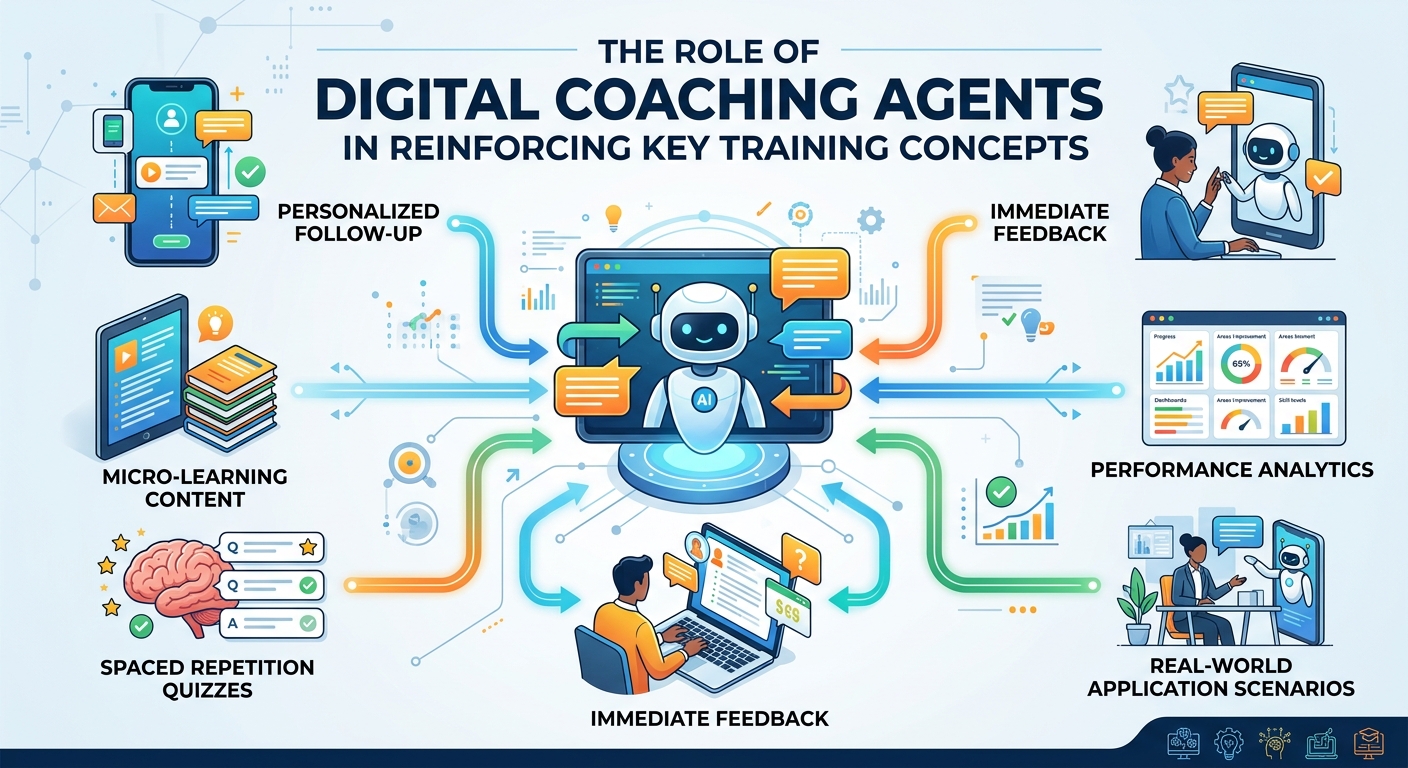
The Role of Digital Coaching Agents in Reinforcing Key Training Concepts
In today's fast-paced corporate environment, where knowledge is power and continuous learning is paramount, organizations invest heavily in training their workforce. From complex compliance protocols in the banking and healthcare sectors to nuanced sales techniques in retail and insurance, effective training is the bedrock of success. However, a persistent challenge for L&D leaders—Vice Presidents, Directors, and Senior Managers alike—is ensuring that crucial training concepts don't just 'stick' during the initial session but are truly absorbed, reinforced, and applied long-term. This is where the innovative power of digital coaching agents emerges as a transformative solution.
The "forgetting curve" is a well-documented enemy of traditional training. Learners often forget a significant portion of what they've learned within days or weeks without reinforcement. How can L&D departments move beyond one-off training events to create a culture of sustained learning and application across diverse industries like Pharma, Hospitality, Oil and Gas, and Mining? Digital coaching agents, powered by artificial intelligence, offer a dynamic and scalable answer, providing personalized, on-demand support that embeds learning deeper and drives measurable performance improvements.
What Are Digital Coaching Agents?
Digital coaching agents are AI-driven virtual assistants designed to interact with learners, provide guidance, answer questions, and facilitate practice, all within the context of specific training objectives. Unlike static e-learning modules or traditional classroom settings, these agents offer personalized, adaptive, and immediate support. They act as a perpetual mentor, available 24/7, continuously reinforcing key concepts and guiding employees toward mastery, whether they are navigating new financial regulations, mastering a complex sales pitch, or understanding critical safety protocols.
The Challenge of Training Reinforcement
For L&D professionals, a primary concern is how to combat the natural tendency for employees to forget training material. Why do employees often struggle to retain the information gained from training programs? Traditional methods, while foundational, often lack the continuous, personalized follow-up required for true mastery. Classroom sessions end, e-learning modules are completed, and then employees are expected to apply knowledge that might only have been briefly absorbed. This gap between learning and application is where critical knowledge erodes, impacting everything from compliance adherence to sales effectiveness.
The need for ongoing support is particularly acute in industries dealing with high-stakes information. In compliance-heavy sectors like banking, finance, and healthcare, a lapse in understanding can lead to significant penalties or operational failures. For sales teams, forgetting product features or objection handling techniques directly impacts revenue. How can organizations move beyond sporadic refreshers to a system that embeds learning into the daily workflow?
How Digital Coaching Agents Bridge the Gap
Digital coaching agents provide a versatile and scalable mechanism for continuous reinforcement, addressing the limitations of conventional training approaches. They make learning a dynamic, ongoing process rather than a static event.
Personalized, On-Demand Support
One critical challenge for L&D leaders is how to effectively combat the "forgetting curve" and ensure that learning sticks over time. Digital coaching agents excel at delivering highly personalized content. Based on a learner's past performance, interactions, and specific role, the agent can tailor its guidance, offering relevant reminders, targeted quizzes, or deeper explanations exactly when and where they are needed. This adaptive approach ensures that every employee, from a new hire in retail to a seasoned manager in oil and gas, receives the most effective reinforcement for their individual learning journey. How can training be made more relevant to individual needs? By leveraging data to customize the learning pathway, digital coaching agents ensure that reinforcement is never generic, but always pertinent to the individual.
Contextual Feedback and Practice
The ability to practice new skills and receive immediate feedback is crucial for skill development. What's the best way to get real-time feedback on skills application? Digital coaching agents facilitate this by creating simulated scenarios, asking follow-up questions, or prompting users to apply concepts in their real-world tasks. For a sales professional, an agent might offer tips on handling a specific customer objection before a call. For a healthcare worker, it could provide a quick reference for a rare medical procedure. This immediate, contextual feedback allows learners to correct misunderstandings on the spot, solidifying correct practices and preventing the entrenchment of errors.
Spaced Repetition and Recall
To truly embed learning, concepts must be revisited strategically over time. Digital coaching agents automate the principle of spaced repetition, delivering short, impactful bursts of information or questions at optimal intervals. This Microlearning LMS approach is highly effective in combating the forgetting curve. Instead of overwhelming learners with information, the agent provides concise, digestible content that reinforces specific points, enhancing long-term recall. How can learning retention be improved over time? By intelligently scheduling reinforcement activities, digital coaching agents ensure that key information is recalled and re-engaged with before it fades from memory, making learning stick effectively.
Engagement Through Interactive Elements
Maintaining learner engagement is vital for successful training reinforcement. Digital coaching agents often incorporate Gamified LMS elements such as points, badges, and leaderboards, transforming reinforcement into an enjoyable and competitive experience. Furthermore, their inherent interactivity, simulating conversations and providing instant responses, makes learning dynamic. Coupled with Adaptive Learning capabilities, these agents can adjust the difficulty and type of interactions based on learner performance, keeping them challenged but not overwhelmed. What strategies increase learner engagement? Through intelligent conversation, interactive quizzes, and adaptive pathways, digital coaching agents keep learners motivated and actively participating in their own development.
Benefits Across Key Industries
The application of digital coaching agents offers significant advantages across various sectors, directly addressing specific industry challenges.
Compliance & Risk Management
In highly regulated industries like Banking, Finance, Insurance, Pharma, Healthcare, Oil & Gas, and Mining, compliance is non-negotiable. How do organizations ensure adherence to complex regulations and reduce potential risks? Digital coaching agents can continuously reinforce compliance procedures, ethical guidelines, and safety protocols. They can quiz employees on regulatory updates, provide instant answers to policy questions, and flag potential non-compliance risks, significantly bolstering Risk-focused Training and mitigating costly errors. An effective learning management system (LMS) integrated with these agents ensures that all critical updates are propagated instantly.
Sales & Customer Service
For sectors like Retail, Hospitality, and parts of Banking and Insurance, sales performance and customer experience are paramount. Can digital tools improve sales performance and customer interactions? Absolutely. Agents can coach sales teams on new product features, refine objection-handling techniques, or provide best practices for customer engagement. They can simulate sales calls, offer immediate feedback on pitch delivery, and reinforce brand messaging, leading to improved conversion rates and higher customer satisfaction. This continuous reinforcement provided by the learning content management system transforms how sales training is delivered and absorbed.
Operational Excellence
Across all industries, operational efficiency drives profitability. How can training improve operational efficiency? Digital coaching agents can reinforce standard operating procedures, guide employees through complex equipment usage, or provide step-by-step instructions for troubleshooting common issues. In manufacturing, they might guide technicians through maintenance routines. In hospitality, they can ensure consistent service delivery. This consistent reinforcement by the learning management software leads to fewer errors, faster task completion, and a more skilled, confident workforce. An enterprise learning management solution with digital coaches becomes an invaluable asset for streamlining operations.
Implementing Digital Coaching Agents: What L&D Leaders Need to Know
For L&D leaders considering integrating digital coaching agents, several strategic considerations are crucial.
Choosing the Right Platform
Selecting a robust learning management system (LMS) that can host and integrate these agents is foundational. Look for a comprehensive learning management system that offers not just course delivery but also analytics on learner interactions with the digital coach. A cloud based learning management system provides the flexibility and scalability needed for global enterprises. Ensure your chosen lms learning management system supports seamless integration for a truly holistic learning experience.
Content Development & Integration
The effectiveness of digital coaching agents hinges on the quality and relevance of the content they deliver. Leveraging an AI Powered Authoring Tool can significantly streamline the creation of engaging, interactive content specifically designed for agent interaction. This includes crafting clear FAQs, designing interactive scenarios, and ensuring the knowledge base is comprehensive and up-to-date. The LCMS component within your learning management solutions should facilitate easy content updates.
Measuring Impact
Like any L&D initiative, it's essential to measure the return on investment. Track key metrics such as skill retention rates, performance improvements, compliance adherence, and learner engagement levels. The analytics provided by a modern enterprise learning management system, coupled with feedback from the digital coaching agents, will offer invaluable insights into the program's effectiveness and areas for optimization.
The Future of Learning with Digital Coaching Agents
As organizations continue to navigate increasingly complex landscapes, the need for agile, effective, and continuous learning will only grow. Digital coaching agents represent a significant leap forward in addressing the persistent challenge of training reinforcement. By offering personalized, on-demand, and interactive support, they empower employees to move beyond mere comprehension to true mastery and application.
The integration of sophisticated AI into the learning management system ecosystem promises a future where learning is not confined to a classroom or a scheduled module, but is an integral, continuous, and dynamic part of every employee's daily experience. Companies leveraging a powerful LMS like MaxLearn LMS with integrated digital coaching agents will undoubtedly gain a competitive edge in developing a highly skilled, adaptable, and compliant workforce, driving business growth and innovation across all industries.
.jpg)


