

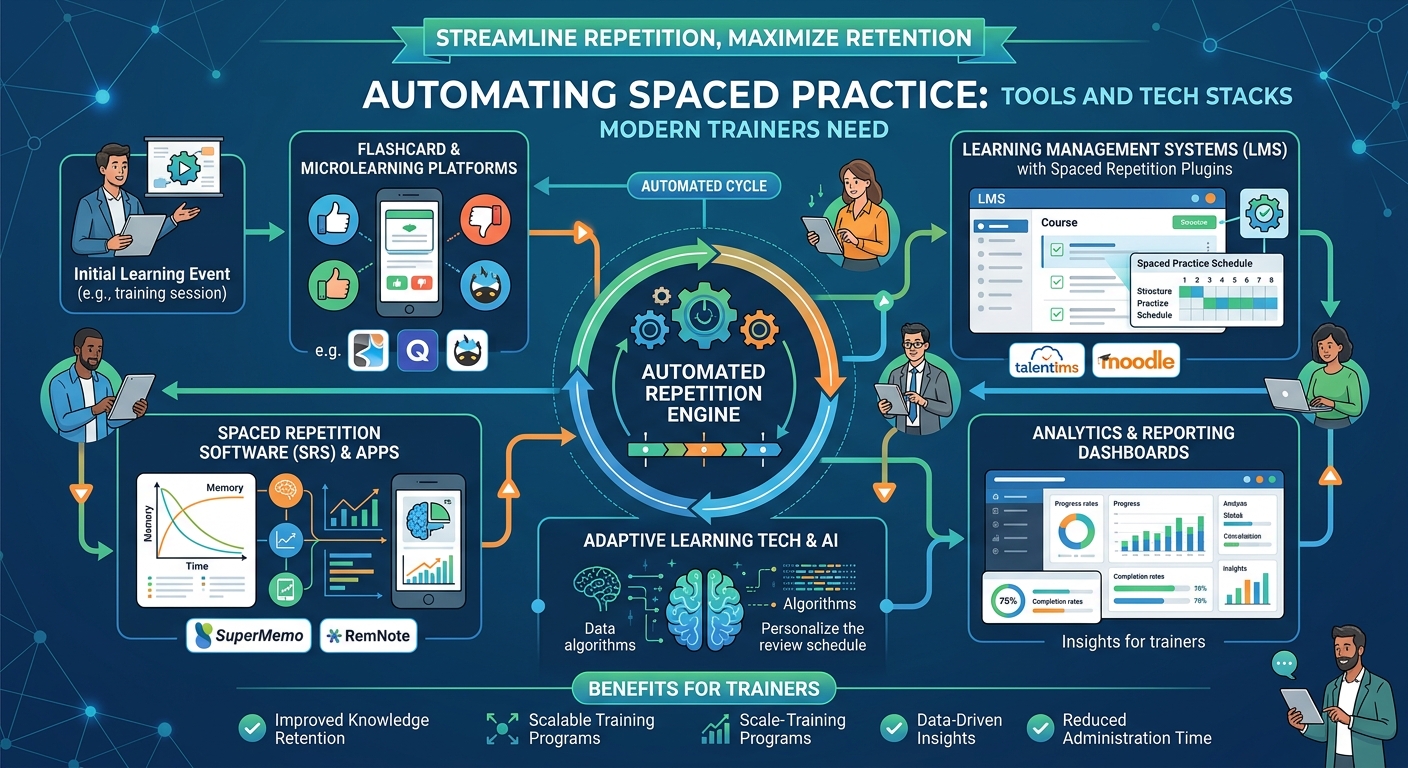
Automating Spaced Practice: Tools and Tech Stacks Modern Trainers Need
In the dynamic landscape of corporate learning and development, the challenge of ensuring knowledge retention is paramount. From critical compliance protocols in banking and finance to evolving sales strategies in retail, and complex operational procedures in oil and gas, employee proficiency is the bedrock of organizational success. Modern L&D leaders—VPs, Directors, and Managers—are constantly seeking innovative solutions to combat the notorious "forgetting curve" and foster enduring expertise across diverse industries like healthcare, pharma, and hospitality. The answer lies in the strategic automation of spaced practice.
Spaced practice, or spaced repetition, is a scientifically-backed learning technique that involves reviewing information at increasing intervals over time. While its efficacy is undisputed, implementing it manually across a large enterprise learning management system can be a logistical nightmare. This article will explore the essential tools and tech stacks required to automate spaced practice, transforming your learning initiatives from a one-time event into a continuous, impactful journey.
The Forgetting Curve and the Power of Spaced Repetition
Hermann Ebbinghaus's research on the forgetting curve highlights a stark reality: without reinforcement, learners rapidly forget newly acquired information. Within days, a significant portion of what was learned is lost. Traditional training methods, often characterized by intensive, one-off sessions, inadvertently contribute to this decline, especially in high-stakes environments like compliance training or Risk-focused Training. The solution isn't to cram more information into initial sessions but to strategically re-expose learners to key concepts over time.
Spaced practice directly counters this curve by scheduling review sessions at optimal intervals, strengthening neural pathways and transferring information from short-term to long-term memory. This approach is vital for any organization where knowledge retention directly impacts performance, safety, and regulatory adherence.
Why Automate Spaced Practice? The L&D Imperative
For L&D professionals managing training across large, geographically dispersed teams in sectors like mining or manufacturing, manual spaced practice is simply not feasible. Automation offers game-changing advantages:
Scalability and Consistency
Automated systems ensure that every learner, regardless of their location or role, receives timely and consistent reinforcement. This is crucial for maintaining uniform standards in areas like product knowledge for sales teams or safety protocols for field workers. A robust LMS is the backbone for this scalability, ensuring a standardized approach to content delivery and review.
Data-Driven Insights and Personalization
Automation enables the collection of rich data on learner performance. This data identifies individual knowledge gaps, informs the timing of subsequent review cycles, and personalizes the content delivered. This intelligent tailoring transforms generic training into highly relevant and effective learning experiences, a hallmark of Adaptive Learning.
Efficiency and Resource Optimization
By automating the scheduling, delivery, and tracking of spaced repetition exercises, L&D teams are freed from tedious administrative tasks. This allows them to focus on strategic initiatives, content development, and continuous improvement of the learning content management system, leading to a higher return on investment for training programs.
Essential Tools and Tech Stacks for Automated Spaced Practice
Building an effective automated spaced practice strategy requires a cohesive tech stack. Here are the core components:
The Core: A Robust Learning Management System (LMS)
At the heart of any modern eLearning strategy is a powerful Microlearning LMS. This central platform manages all aspects of learning, from course delivery and learner enrollment to progress tracking and reporting. For automated spaced practice, the LMS must support:
- Scheduled content delivery for follow-up quizzes and refreshers.
- Personalized learning paths that adapt to individual performance.
- Integration with other learning tools.
An enterprise learning management system or learning management software that functions as a comprehensive learning management solution is critical. Modern cloud based learning management system options offer the flexibility and scalability needed for global organizations. The best LMS serves as your central nervous system for all training, often doubling as an LCMS (learning content management system) to manage content lifecycle effectively.
Intelligent Content Delivery Mechanisms
Microlearning LMS Platforms: For spaced practice to be effective, content must be delivered in bite-sized, digestible chunks. Microlearning platforms excel at this, providing short videos, infographics, or quick quizzes that can be consumed on the go, making learning accessible and less daunting. This is particularly effective for reinforcing key concepts without overwhelming learners.
Gamified LMS Features: To sustain engagement over multiple spaced repetitions, gamification is a powerful ally. Leaderboards, badges, points, and challenges embedded within the LMS transform review sessions from mundane tasks into engaging experiences, boosting motivation and competition. This is incredibly effective in sales training and compliance modules.
Adaptive Learning Engines: These sophisticated algorithms analyze a learner's performance, strengths, and weaknesses to dynamically adjust the spaced repetition schedule and content. If a learner masters a concept quickly, the review interval extends; if they struggle, reviews become more frequent and targeted. This personalization maximizes efficiency and ensures learners focus on areas where they need the most reinforcement.
Authoring Tools and Content Libraries
Creating and managing the vast array of content required for spaced practice necessitates efficient authoring tools. Tools that allow for rapid content creation, version control, and easy integration with your learning management system are invaluable. An AI Powered Authoring Tool can significantly streamline this process, enabling L&D teams to generate new content, quizzes, and scenarios quickly, keeping pace with evolving industry demands and internal policies.
Analytics and Reporting Dashboards
Automating spaced practice is only half the battle; understanding its impact is the other. Comprehensive analytics and reporting dashboards within your LMS are essential. These tools provide L&D leaders with actionable insights into:
- Individual and team-level knowledge retention rates.
- Engagement with spaced repetition activities.
- Identification of common knowledge gaps across the organization.
- Correlation between spaced practice and real-world performance metrics.
Such data is invaluable for refining training programs, demonstrating ROI, and making informed decisions, particularly for Risk-focused Training where precise understanding of knowledge gaps can prevent costly errors.
The MaxLearn Advantage: A Holistic Solution
For L&D leaders seeking a comprehensive, integrated solution, MaxLearn LMS offers a powerful platform that seamlessly combines microlearning capabilities, gamification, adaptive learning pathways, and robust analytics. It's designed to empower modern trainers to implement highly effective, automated spaced practice strategies, ensuring superior knowledge retention and measurable business impact across all industries and segments.
Forward-Thinking L&D: AI and the Future of Spaced Practice
Artificial intelligence is rapidly reshaping the future of eLearning, offering unprecedented opportunities for refining and optimizing spaced practice. L&D leaders should be asking critical questions about how AI can further enhance their automated training strategies.
Frequently Asked Questions on AI in Automated Spaced Practice
How can training be dynamically adjusted for a global workforce without human intervention?
AI-driven content engines can assess an individual's context and past performance, then intelligently deliver the most relevant practice questions or content, optimizing for their specific learning journey. This ensures content relevance and engagement regardless of location.
How do we gain deep insights into learner engagement and retention patterns across different training modules?
Intelligent analytics leverage machine learning to identify complex patterns in learner behavior, predicting potential knowledge gaps and suggesting proactive interventions. This level of optimization provides unprecedented visibility into training effectiveness.
What’s the best way to ensure content is always fresh and optimized for maximum impact?
AI-powered content generation and curation tools can analyze industry trends, learner feedback, and performance data to suggest updates, create new practice questions, or even generate entire modules. This ensures continuous content optimization for superior learning outcomes.
Conclusion: Elevating L&D with Automated Spaced Practice
The transition from traditional, event-based training to a continuous, reinforced learning model is no longer optional for organizations striving for excellence. Automating spaced practice with the right tools and tech stack is a strategic imperative for L&D leaders aiming to improve knowledge retention, enhance skill application, and drive measurable business outcomes. By investing in an advanced learning management system that incorporates Microlearning LMS principles, Gamified LMS features, Adaptive Learning, and AI Powered Authoring Tool capabilities, you can build a resilient, future-ready workforce.
Explore these technologies and transform your L&D strategy from reactive to proactive, ensuring your employees not only learn but truly remember and apply critical knowledge.
.jpg)


