

How Just-in-Time Knowledge Retrieval Complements Long-Term Retention: A Strategic Imperative for L&D Leaders
In today's rapidly evolving business landscape, the demands on organizational learning and development (L&D) are more intense than ever. Vice Presidents, Directors, and Senior Managers of L&D face the dual challenge of ensuring employees retain foundational knowledge crucial for strategic thinking while also providing immediate access to information needed for tasks at hand. This isn't just about training; it's about optimizing performance, fostering innovation, and mitigating risks across industries from Compliance and Sales to Banking, Finance, Insurance, Retail, Pharma, Health care, Hospitality, Oil and Gas, and Mining.
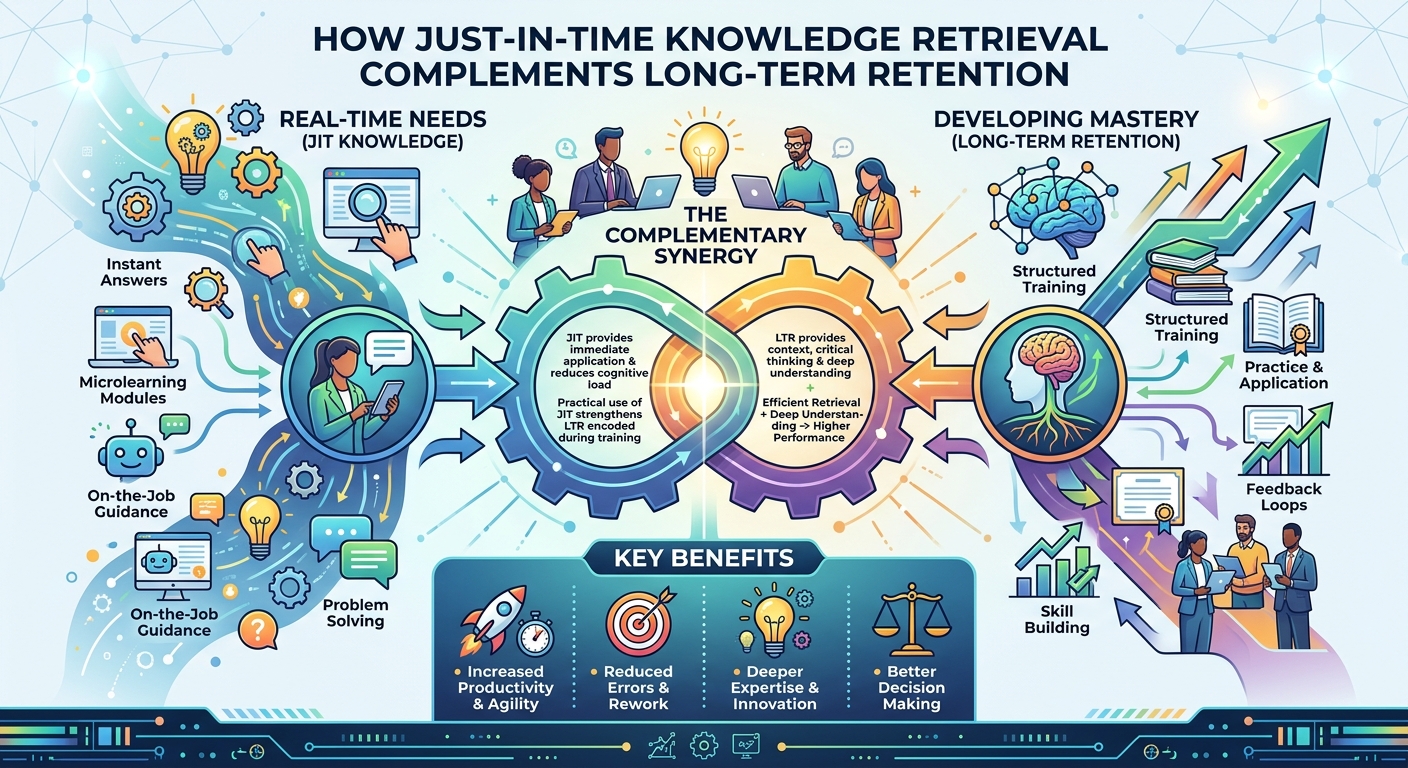
The traditional view often pitted long-term retention against immediate access, as if they were mutually exclusive. However, modern L&D strategies understand that Just-in-Time (JIT) knowledge retrieval and robust long-term retention are not adversaries but powerful complements. When effectively integrated through sophisticated Microlearning LMS solutions and intelligent platforms, they create a learning ecosystem that drives sustained performance and empowers a knowledgeable workforce.
The Urgency of Just-in-Time Knowledge Retrieval
Just-in-Time knowledge retrieval is precisely what it sounds like: providing learners with the exact information they need, at the moment they need it, to complete a specific task or solve an immediate problem. This approach is invaluable in high-pressure, fast-paced environments where delays can lead to errors, inefficiencies, or missed opportunities. Imagine a sales professional needing a quick refresher on a product feature during a client call, or a healthcare worker verifying a protocol in an emergency—JIT knowledge is their lifeline.
The benefits are clear:
- Enhanced Performance: Employees can apply knowledge immediately, reducing the learning curve and improving task execution.
- Reduced Errors: Access to accurate, up-to-date information at the point of need minimizes mistakes, especially critical in sectors like Compliance, Banking, and Pharma.
- Increased Efficiency: Less time spent searching for answers means more time spent on productive work, a significant win for enterprise learning management.
- Improved Confidence: Employees feel more capable and empowered knowing help is readily available.
- Agility: Organizations can quickly adapt to new regulations, product updates, or market changes by deploying instant support.
Modern learning management system (LMS) platforms, particularly those designed for agility, are central to delivering effective JIT solutions. A cloud based learning management system ensures this vital information is accessible from anywhere, on any device, making it a critical component of any comprehensive learning management software strategy.
The Enduring Power of Long-Term Retention
While JIT addresses immediate needs, long-term retention is the bedrock of true expertise and strategic capability. It's about embedding foundational understanding, critical thinking skills, and complex concepts deep into an employee's cognitive framework. This type of retention is crucial for:
- Strategic Decision-Making: Leaders in Finance and Oil & Gas rely on deeply retained knowledge to analyze complex situations and make informed decisions.
- Problem-Solving: Beyond simple task completion, long-term retention enables employees to tackle novel problems and innovate.
- Adaptability: A strong foundation of knowledge allows individuals to more easily assimilate new information and adapt to change.
- Compliance and Ethics: Deep understanding of regulatory frameworks and ethical guidelines is non-negotiable in sectors like Banking, Insurance, and Health care. Risk-focused Training relies heavily on this deep retention.
- Mentorship and Leadership: Experienced employees can guide others more effectively when they possess a comprehensive and deeply understood body of knowledge.
Achieving long-term retention often involves strategies like spaced repetition, active recall, scenario-based learning, and reflective practice. A robust learning content management system (LCMS) is essential for organizing and delivering content designed for this deep, lasting impact.
The Synergy: Where Just-in-Time Meets Long-Term
The magic happens when these two approaches are not only present but also seamlessly integrated. Just-in-Time knowledge retrieval doesn't replace long-term retention; it reinforces it. Consider these powerful interactions:
- Reinforcement Loop: When an employee retrieves a piece of JIT information, they are actively recalling it. This act of recall, especially when repeated, strengthens the neural pathways associated with that knowledge, aiding long-term memory.
- Contextual Application: JIT retrieval provides immediate, real-world context for previously learned concepts. Applying knowledge in a practical scenario helps solidify understanding far more effectively than passive learning alone.
- Bridging the Forgetting Curve: Microlearning modules delivered JIT can act as perfectly timed refreshers, countering the natural tendency to forget information over time. This targeted intervention helps maintain high levels of long-term retention.
- Building Confidence for Deeper Learning: By providing immediate support for immediate tasks, JIT solutions reduce cognitive load and frustration, freeing up mental capacity for learners to engage in more complex, foundational learning that builds long-term retention.
An effective Gamified LMS can further enhance this synergy by making both retrieval and deeper learning engaging and rewarding, fostering a continuous learning culture.
Leveraging Technology for an Integrated Approach
Modern learning management solutions are designed to facilitate this powerful complementary relationship. L&D leaders should look for platforms that offer a blend of features to support both immediate access and deep learning.
Question: How can sophisticated learning platforms personalize the development of crucial skills for our diverse workforce, from sales teams to compliance officers?
Insight: Advanced platforms use data to create tailored learning paths, ensuring that individuals receive relevant content for both immediate task support and long-term career growth. This involves understanding an employee's role, performance data, and existing knowledge base to deliver highly personalized Adaptive Learning experiences. For a sales team in Retail, this might mean instant access to pricing updates, while a compliance officer in Finance receives curated modules on new regulatory changes, all aligned with their personal learning journey.
Question: What data-driven insights can advanced analytical tools provide to pinpoint systemic knowledge gaps across our geographically dispersed operational units in banking or manufacturing?
Insight: By analyzing usage patterns, assessment results, and performance metrics across different locations or departments, intelligent systems can identify common areas of weakness. This allows L&D teams to proactively deploy targeted JIT resources or design more robust long-term training programs to address widespread challenges, preventing potential issues in global operations or distributed workforces.
Question: In high-stakes environments like healthcare or oil & gas, how can intelligent systems ensure immediate access to critical information during unforeseen operational challenges?
Insight: AI-powered tools integrated into a learning management system can act as intelligent assistants, providing context-aware information directly within workflows or through conversational interfaces. This means an employee facing a novel situation, perhaps an unusual equipment malfunction in Mining or an unexpected patient symptom in Health care, can get instant, precise guidance, minimizing risk and optimizing response times.
An AI Powered Authoring Tool further streamlines the process of creating content for both JIT and long-term needs, allowing L&D teams to quickly develop and deploy engaging modules without extensive manual effort. This is crucial for maintaining an agile and responsive learning environment.
Real-World Applications Across Industries
- Compliance: Instant access to policy documents and deep understanding of regulations prevent fines.
- Sales: JIT product knowledge for client calls, combined with long-term sales methodology training.
- Banking & Finance: Quick lookup for new financial products, supported by foundational economic principles.
- Insurance: Immediate claims processing guidelines, bolstered by comprehensive understanding of actuarial science.
- Retail: Real-time inventory checks and customer service scripts, alongside extensive product knowledge.
- Pharma & Health care: Drug interaction lookups and critical procedure refreshers, built on years of medical education.
- Hospitality: Instant answers to guest queries, combined with deep training in service excellence.
- Oil and Gas & Mining: On-demand safety protocols for specific equipment, underpinned by robust engineering principles.
Choosing the Right Learning Management System for Your Organization
For L&D leaders, the strategic choice of an LMS or a complete learning management solution is paramount. Look for a platform that:
- Supports diverse content formats for both microlearning and comprehensive courses.
- Offers robust search and retrieval capabilities for JIT access.
- Integrates features like gamification, social learning, and adaptive pathways for long-term engagement.
- Provides powerful analytics to track learning effectiveness and identify knowledge gaps.
- Is a scalable, cloud based learning management system suitable for enterprise learning management.
- Leverages AI for content creation, personalization, and intelligent assistance.
A comprehensive MaxLearn LMS, as an example of a leading learning management system, understands this dual necessity, offering tools that bridge the gap between immediate performance needs and strategic knowledge development.
Conclusion
The L&D landscape demands a nuanced approach that transcends the false dichotomy between Just-in-Time knowledge retrieval and long-term retention. Forward-thinking leaders recognize these as synergistic forces, each amplifying the other to cultivate a highly skilled, adaptable, and resilient workforce. By strategically implementing advanced learning management software that leverages microlearning, adaptive paths, gamification, and AI-powered tools, organizations can ensure their employees not only have the answers when they need them but also possess the deep understanding required to navigate complexity and drive sustained success in any industry. This integrated strategy is not just beneficial; it's a strategic imperative for competitive advantage and growth.
.jpg)


