

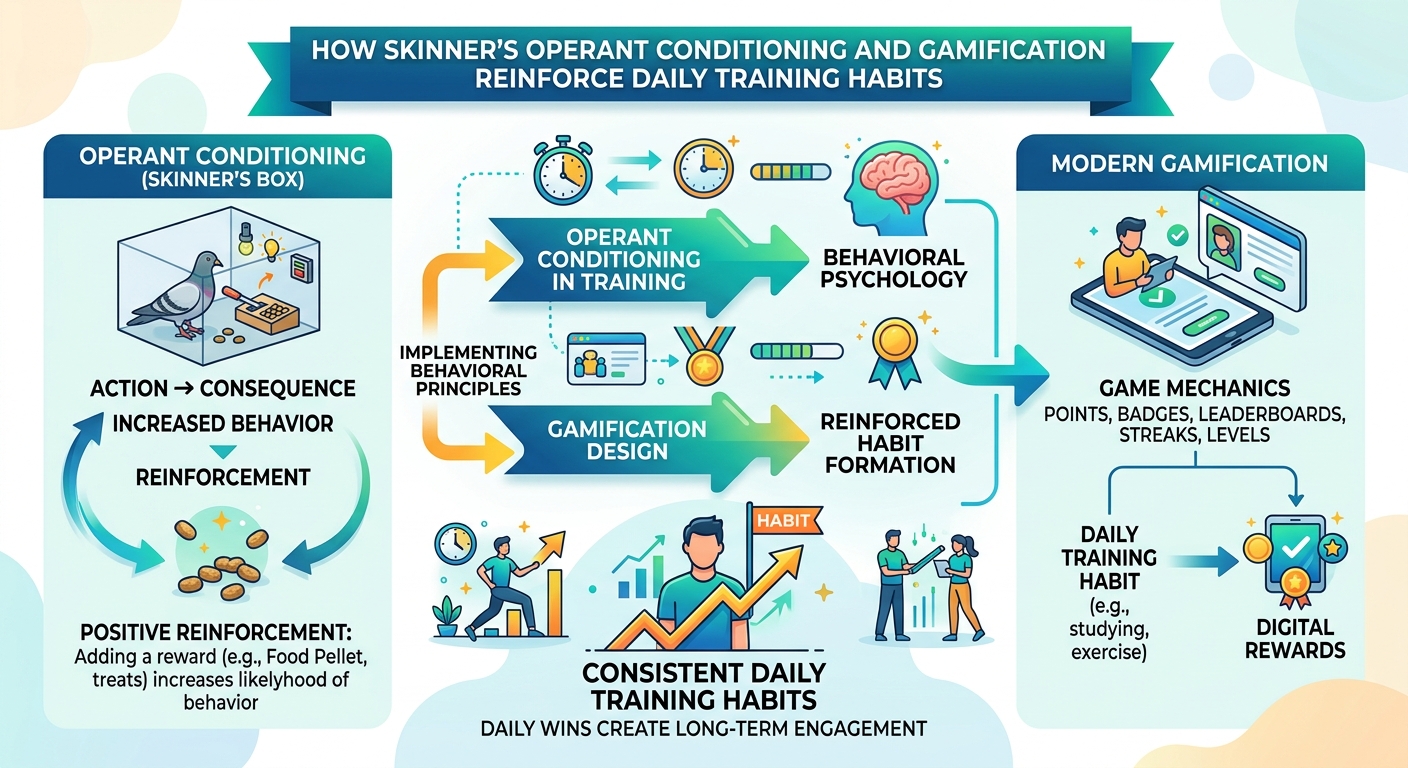
How Skinner’s Operant Conditioning and Gamification Reinforce Daily Training Habits
In the dynamic landscape of corporate learning and development, fostering consistent daily training habits is paramount for skill acquisition, compliance adherence, and overall organizational success. As L&D leaders, you’re constantly seeking innovative strategies to move beyond mere information delivery towards sustained behavioral change and knowledge retention. The answer often lies in understanding fundamental psychological principles and applying modern technological solutions.
This article delves into the powerful synergy between B.F. Skinner's operant conditioning and the strategic implementation of gamification. We'll explore how these two forces, when combined with advanced eLearning platforms, can revolutionize how your workforce engages with and internalizes essential training, building habits that drive performance across diverse industries from Compliance and Sales to Banking, Pharma, and Oil & Gas.
Skinner's Operant Conditioning: The Foundation of Habit Formation
B.F. Skinner, a pioneer in behavioral psychology, introduced the concept of operant conditioning, which posits that behaviors are learned through their consequences. Simply put, actions followed by desirable outcomes are more likely to be repeated, while those followed by undesirable outcomes are less likely. This framework provides a scientific basis for understanding how habits are formed and sustained.
- Positive Reinforcement: Adding something desirable to increase a behavior (e.g., praise for completing a module, a bonus for achieving a sales target).
- Negative Reinforcement: Removing something undesirable to increase a behavior (e.g., a manager stops nagging when a report is submitted on time).
- Positive Punishment: Adding something undesirable to decrease a behavior (e.g., a penalty for missing a deadline).
- Negative Punishment: Removing something desirable to decrease a behavior (e.g., loss of privileges for poor performance).
For L&D professionals, the key takeaway is the immense power of positive reinforcement. By designing training environments where desired learning behaviors (completing modules, applying skills, achieving milestones) are consistently rewarded, organizations can significantly increase engagement and retention. This isn't about manipulation; it's about structuring learning pathways to make the desired actions intrinsically and extrinsically rewarding, leading to robust habit formation.
Gamification: Modernizing Reinforcement
Gamification is the application of game-design elements and game principles in non-game contexts. It’s a powerful strategy that naturally aligns with the principles of operant conditioning. By introducing elements like points, badges, leaderboards, levels, and challenges into learning, organizations create an environment ripe for positive reinforcement and sustained engagement.
Consider how traditional training often lacks immediate, tangible rewards for completion or mastery. Gamification fills this void by providing instant feedback and symbolic rewards. Completing a difficult LMS module might earn a learner points and a virtual badge, which acts as positive reinforcement, encouraging them to tackle the next challenge. Ascending a leaderboard provides social recognition, a powerful motivator that reinforces consistent participation and performance.
This approach transforms mundane tasks into engaging experiences. For instance, a compliance training module that might typically be seen as a chore becomes a quest to unlock new levels and earn recognition, making the daily habit of logging in and learning much more appealing.
The Synergy: Operant Conditioning Meets Gamification in L&D
The true magic happens when operant conditioning and gamification are intentionally combined within a well-designed learning management system. This synergy creates a reinforcing loop:
- Points & Rewards (Positive Reinforcement): Every correct answer, module completion, or skill demonstration earns points, virtual currency, or unlockable content, directly reinforcing the desired learning behavior.
- Badges & Certificates (Symbolic Reinforcement): Digital badges awarded for mastering specific topics or completing training pathways provide visible recognition and a sense of achievement, further motivating learners.
- Leaderboards & Competition (Social Reinforcement): Public recognition for top performers encourages healthy competition and sustained effort, driven by the desire for status and peer acknowledgment.
- Progress Bars & Levels (Shaping Behavior): Breaking down complex training into smaller, manageable levels with clear progress indicators helps learners see their advancement, reinforcing their commitment to continue. This is particularly effective with Microlearning LMS strategies.
- Challenges & Quests (Engagement & Persistence): Framing training as challenges or quests enhances engagement and encourages learners to persist through difficulties, reinforcing problem-solving and critical thinking.
This integrated approach is invaluable for building daily training habits. When employees know their efforts will be immediately recognized and rewarded, they are far more likely to consistently engage with learning content. This is crucial for industries requiring continuous updates, such as in Healthcare for new medical protocols or in Banking for evolving financial regulations.
Leveraging Advanced Technology for Enhanced Reinforcement
Modern eLearning technology significantly amplifies the impact of operant conditioning and gamification. Platforms like a sophisticated Gamified LMS are built to integrate these principles seamlessly.
Through features such as microlearning, training content is delivered in bite-sized, digestible modules, making daily engagement less daunting and more achievable. This short-burst learning fits perfectly with the immediate feedback loops of gamification, providing frequent opportunities for positive reinforcement.
Adaptive Learning tailors content delivery based on individual learner performance, ensuring that reinforcement is personalized and relevant. If a learner struggles with a concept, the system can provide additional resources or practice, reinforcing persistence. Conversely, if a learner masters a topic quickly, they can progress efficiently, reinforcing their competence.
Furthermore, an AI Powered Authoring Tool can dramatically enhance the creation of engaging and reinforcing content. AI can analyze learner data to suggest optimal gamification elements, personalize feedback, and even automate the creation of challenge scenarios that align with operant conditioning principles.
Addressing Advanced Technology Questions:
How can artificial intelligence personalize and optimize reinforcement strategies for individual learners?
Intelligent algorithms within a learning content management system can analyze individual performance data, learning styles, and engagement patterns to dynamically adjust the type and frequency of reinforcement. For instance, a learner motivated by social recognition might receive more leaderboard visibility, while another might benefit from personalized virtual rewards or bespoke challenges tailored to their specific skill gaps. This ensures that reinforcement is always relevant and maximally effective for each user, fostering continuous engagement.
What benefits does advanced technology bring to reinforcing daily training habits across a globally distributed workforce?
For large, multinational enterprises, a robust cloud based learning management system powered by advanced technology enables consistent and scalable reinforcement. It can standardize rewards and recognition globally while allowing for localized content and culturally appropriate gamification elements. This ensures equitable access to engaging training and fosters a unified learning culture, transcending geographical boundaries and time zones, critical for industries like Oil and Gas or global retail.
How can intelligent systems ensure consistent engagement and knowledge retention over the long term?
Intelligent systems employ predictive analytics to identify potential drop-off points or knowledge decay. By analyzing engagement data, the system can proactively trigger reminders, suggest relevant refresher microlearning modules, or initiate new gamified challenges to re-engage learners. This continuous monitoring and proactive intervention, coupled with spaced repetition techniques, create a self-sustaining learning ecosystem that reinforces daily habits and embeds knowledge deep into long-term memory.
Real-World Impact Across Industries
The application of Skinner’s principles and gamification, powered by an advanced enterprise learning management system, yields significant benefits across various sectors:
- Compliance: In Banking, Finance, and Pharma, where regulatory training is mandatory but often dry, gamified Risk-focused Training transforms compliance modules into interactive challenges, ensuring higher completion rates and better understanding of critical policies.
- Sales: Sales teams benefit from leaderboards and performance-based rewards tied to product knowledge assessments and sales process mastery, directly translating learning into revenue.
- Healthcare: For new medical procedures or patient care protocols, scenario-based gamified training reinforces correct actions, reducing errors and improving patient outcomes.
- Retail & Hospitality: Staff training on customer service, product knowledge, or operational procedures can be made engaging through gamified challenges, leading to improved service quality and employee retention.
Implementing a Robust System
To harness the full potential of operant conditioning and gamification, organizations need a powerful and flexible learning management software. A comprehensive LCMS like MaxLearn LMS offers the functionalities required to design, deliver, and manage engaging learning experiences that leverage these psychological principles. From robust content creation tools to advanced analytics that track learner progress and engagement, a state-of-the-art lms learning management system provides the infrastructure for building a culture of continuous learning and habit formation.
Conclusion
The principles of B.F. Skinner's operant conditioning, when intelligently integrated with gamification strategies and cutting-edge eLearning technology, offer a scientifically proven pathway to reinforce daily training habits within your organization. By providing immediate feedback, tangible rewards, and a sense of achievement, L&D leaders can transform passive learners into active participants, driving sustained engagement and measurable performance improvements. Investing in a powerful learning management solutions that supports these methodologies is not just an expenditure; it's a strategic investment in the future capabilities and resilience of your workforce.
.jpg)


