

Retrieval Practice vs. Passive Review: Which Delivers Measurable Workplace Behavioral Change?
In the dynamic world of corporate learning and development, the quest for training methods that yield demonstrable, lasting behavioral change is relentless. As L&D Vice Presidents, Directors, and Senior Managers, you face the constant challenge of ensuring that significant investments in training translate into tangible improvements in performance, compliance, and overall business outcomes. Two prominent methodologies often stand in contrast: passive review and retrieval practice. But which one truly moves the needle from knowledge acquisition to measurable workplace transformation?
The core of effective learning isn't just about what information is consumed, but how it's processed, retained, and applied. While passive review has long been a staple in corporate training, modern cognitive science and innovative LMS solutions are increasingly pointing towards the transformative power of retrieval practice.
The Illusion of Learning: Understanding Passive Review
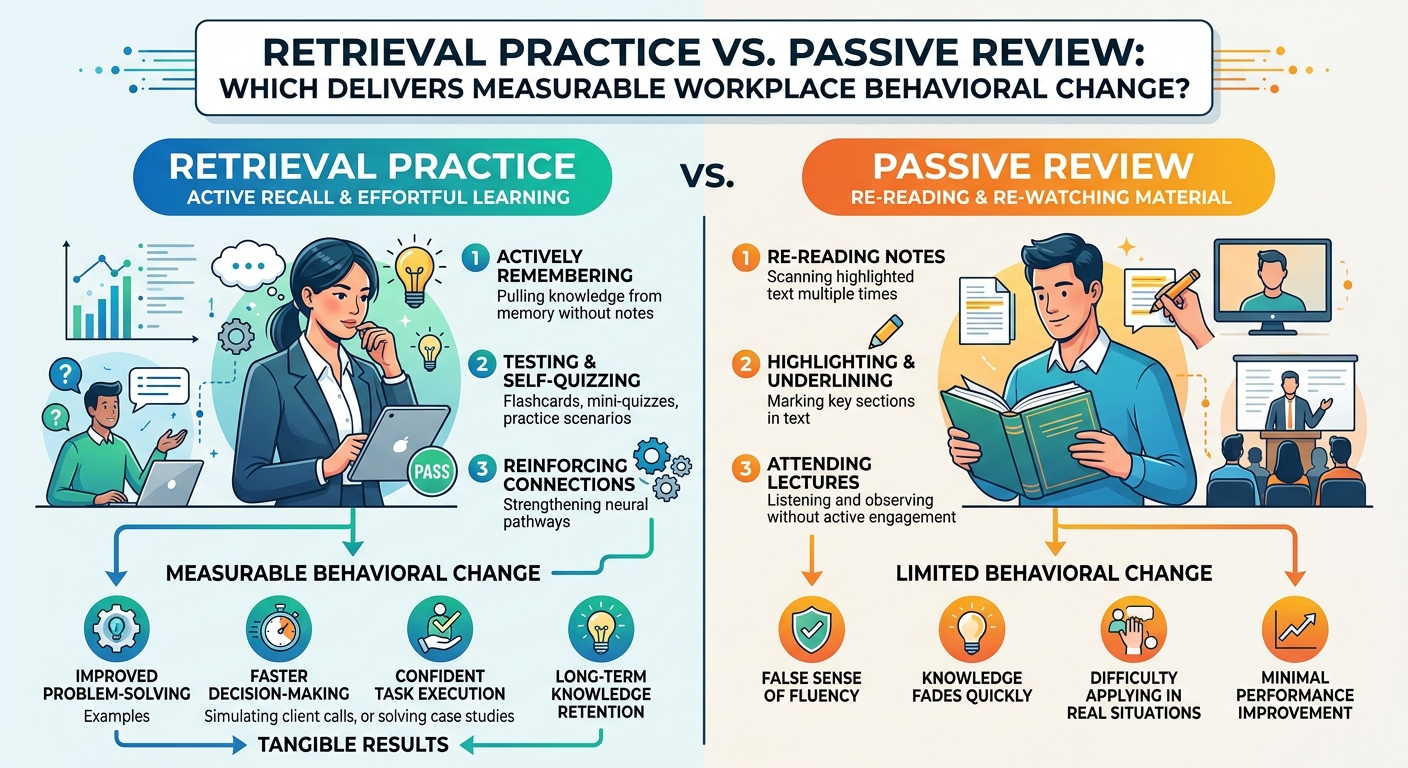
Passive review, as the name suggests, involves learners re-exposing themselves to information without actively manipulating it. This includes activities such as:
- Rereading training manuals or slides
- Watching video lectures or demonstrations
- Listening to presentations
- Highlighting text
This approach is prevalent across industries from Banking to Healthcare, Compliance to Sales, often facilitated by traditional learning management software or a basic learning content management system. It feels comfortable and often gives learners a false sense of familiarity, leading them to believe they understand the material. However, the ease of passive review masks a critical limitation: it often fails to build strong, retrievable memory traces. Learners might recognize information when they see it, but struggle to recall or apply it when needed on the job. This "recognition without recall" phenomenon is a significant barrier to achieving genuine behavioral change.
Unlocking Performance: The Power of Retrieval Practice
Retrieval practice, on the other hand, is an active learning strategy that involves deliberately recalling information from memory. Instead of passively re-reading, learners are challenged to pull facts, concepts, or procedures from their minds, often through:
- Quizzing themselves
- Answering open-ended questions
- Explaining concepts in their own words
- Solving problems or case studies without referring to notes
- Using flashcards or interactive scenarios
This "testing effect" is one of the most robust findings in cognitive psychology. Each act of successful retrieval strengthens the memory trace, making it easier to recall that information again in the future. For organizations utilizing a modern Microlearning LMS or a Gamified LMS, integrating retrieval practice becomes seamless, transforming mundane learning into engaging, high-impact experiences that genuinely foster behavioral shifts in areas like Pharma, Retail, and Oil and Gas.
The Science Behind the Change
The cognitive mechanisms underpinning retrieval practice are what drive its superior efficacy in producing measurable workplace behavioral change. When an employee actively recalls information, they are not just accessing a memory; they are strengthening the neural pathways associated with that memory. This process, often referred to as "desirable difficulties," makes learning feel harder in the short term but leads to much stronger, more flexible, and more durable retention.
- Enhanced Retention: Repeated retrieval sessions over time (spaced repetition) dramatically improve long-term memory, ensuring that critical compliance protocols, sales techniques, or patient care procedures are not forgotten.
- Improved Application: The act of retrieving information simulates the actual performance context, preparing employees to apply their knowledge effectively when faced with real-world scenarios. This is crucial for Risk-focused Training across all industries.
- Metacognition and Self-Correction: Retrieval practice helps learners identify what they truly know and what they don't, guiding them to focus their study efforts more efficiently. This self-awareness is vital for continuous improvement in complex fields like Finance and Mining.
Ultimately, by forcing the brain to work, retrieval practice moves beyond mere knowledge exposure to embed understanding deeply, making it readily available for on-the-job application and leading directly to observable changes in behavior.
Measuring the Impact: From Learning to Doing
For L&D professionals, the ultimate goal is not just to deliver training, but to demonstrate its ROI through measurable behavioral change. Here's how retrieval practice, particularly when integrated with a sophisticated learning management solutions, facilitates this:
- Performance Metrics: In Sales, this could mean tracking conversion rates, average deal size, or product knowledge scores. In Healthcare, it might be adherence to new patient protocols or reduction in medical errors.
- Compliance Rates: For industries like Banking and Insurance, retrieval practice in compliance training directly correlates with higher understanding and adherence to regulatory requirements, reducing the incidence of non-compliance.
- Error Reduction: In manufacturing or technical roles (e.g., Oil and Gas, Mining), regular retrieval practice through simulations and quizzes can significantly reduce operational errors and improve safety records.
- Skill Proficiency: Through ongoing assessments and practical application exercises, an enterprise learning management system can track proficiency levels, showing improvement over time.
Modern learning management systems, such as a cloud based learning management system, offer robust analytics dashboards that can correlate retrieval practice completion rates and scores with actual performance data, providing clear evidence of behavioral change. An effective lms learning management system is key to gathering and interpreting this data.
The Role of Technology in Driving Active Learning
Implementing retrieval practice at scale across diverse organizations, from Hospitality to Pharma, is made significantly easier and more effective with advanced eLearning platforms. A comprehensive learning management system (LCMS) is no longer just a content repository; it's an intelligent engine for active learning.
Consider the transformative potential of artificial intelligence in this domain:
How can advanced algorithms personalize the learning experience for diverse workforces, ensuring that retrieval challenges are tailored to individual knowledge gaps and learning paces?
What capabilities do intelligent platforms offer for deploying and managing learning across international teams, adapting content and practice opportunities to local contexts and linguistic nuances?
Beyond simple tracking, how do sophisticated learning systems identify knowledge gaps and recommend targeted interventions to optimize skill development, turning data into actionable insights for continuous improvement?
These capabilities are at the forefront of modern L&D. Features like Adaptive Learning automatically adjust the difficulty and frequency of retrieval questions based on learner performance, ensuring optimal challenge and engagement. An AI Powered Authoring Tool can even assist in creating dynamic, scenario-based quizzes and interactive simulations that mimic real-world workplace challenges, greatly enhancing the effectiveness of retrieval practice. For example, a MaxLearn LMS empowers L&D teams to leverage these technological advancements for superior training outcomes.
Implementing Retrieval Practice in Your Organization
Transitioning from a passive review culture to one that embraces retrieval practice requires strategic planning and the right tools. Here are practical steps:
- Integrate Frequent, Low-Stakes Quizzes: Embed short quizzes at regular intervals within your learning modules, rather than just at the end.
- Leverage Spaced Repetition: Design your training programs to revisit key concepts periodically, challenging learners to recall information over increasing time intervals.
- Incorporate Scenario-Based Questions: Create realistic workplace scenarios where employees must apply their knowledge to solve problems, rather than just select a multiple-choice answer.
- Encourage Peer Teaching and Explanations: Foster environments where employees teach concepts to each other, reinforcing their own understanding through active recall.
- Utilize Interactive Tools: Employ the interactive capabilities of your enterprise learning management system for flashcards, drag-and-drop exercises, and simulations.
Conclusion
While passive review has its place for initial exposure, it falls short when the objective is lasting behavioral change and measurable impact in the workplace. Retrieval practice, grounded in robust cognitive science and amplified by cutting-edge eLearning technology, is the undisputed champion for transforming how employees learn, retain, and apply critical skills and knowledge. By shifting your L&D strategy to prioritize active recall, facilitated by an intelligent learning management system, you can ensure your training investments deliver not just knowledge, but tangible, measurable improvements in performance, compliance, and overall business success across every industry.
.jpg)


