

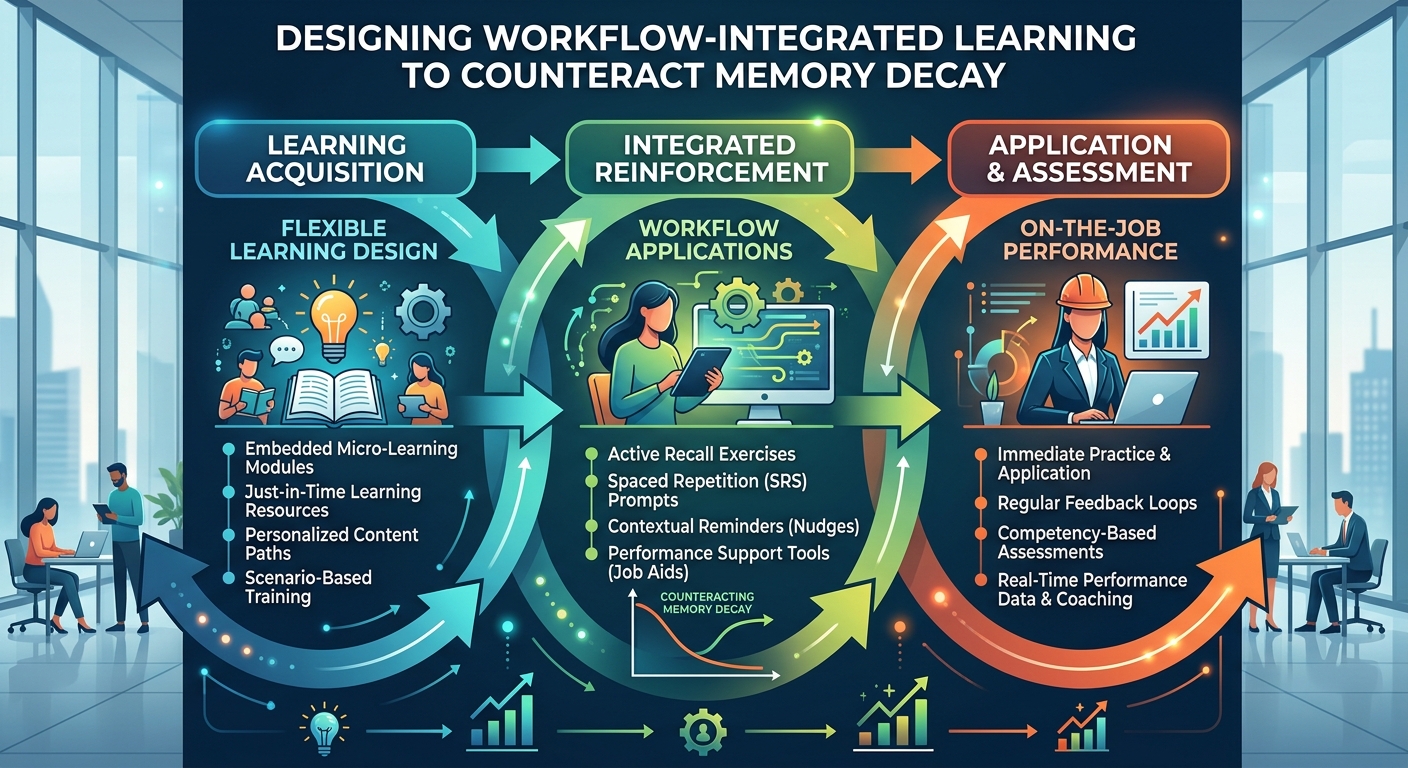
Designing Workflow-Integrated Learning to Counteract Memory Decay
In the fast-paced world of modern business, continuous learning isn't just a buzzword; it's a strategic imperative. Yet, despite significant investments in training programs, a persistent challenge looms large for L&D leaders: the insidious impact of memory decay. Within days, or even hours, much of what was learned in a traditional setting can dissipate, leaving a significant gap between knowledge acquisition and practical application. This phenomenon, often dubbed the 'forgetting curve,' costs organizations invaluable resources and hinders performance across every sector, from Risk-focused Training in banking to complex sales processes.
The solution isn't to train harder, but smarter. It lies in designing learning experiences that are seamlessly integrated into the daily workflow, turning moments of need into opportunities for lasting knowledge retention. For Vice Presidents, Directors, and Managers of L&D, understanding and implementing workflow-integrated learning is no longer an option, but a necessity for building a truly agile and competent workforce.
The Forgetting Curve Revisited: Why Traditional Training Fails
Hermann Ebbinghaus’s research on the forgetting curve, dating back to the late 19th century, remains chillingly relevant today. It demonstrates that without reinforcement, a significant portion of newly acquired information is lost rapidly. In a corporate context, this translates to:
- Reduced ROI: Training costs not translating into sustained performance improvements.
- Skill Gaps: Employees struggling to recall critical information when facing real-world scenarios.
- Increased Risk: Especially in compliance, healthcare, or finance, where forgotten procedures can lead to serious consequences.
- Disengagement: Learners feeling frustrated when classroom knowledge doesn't translate easily to their job.
Traditional, event-based training — whether a multi-day workshop or a lengthy e-learning course — often pulls employees away from their work, delivering information out of context. The disconnect between learning and immediate application is a primary driver of memory decay, making the quest for effective learning management software critical.
What is Workflow-Integrated Learning?
Workflow-integrated learning is a paradigm shift. Instead of treating learning as a separate event, it embeds knowledge, resources, and support directly into the daily tasks and processes of an employee. It's learning at the point of need, in the flow of work, contextualized by immediate challenges and opportunities. This approach transforms every task into a potential learning moment, bolstering retention and enhancing performance in real-time.
Imagine a sales professional needing to quickly reference a new product feature during a client call, or a nurse confirming a dosage for a less common medication. Workflow-integrated learning provides the answer precisely when and where it's required, making the information stick because it's immediately relevant and applicable. This methodology is vastly different from a stand-alone learning content management system that simply houses courses.
The Power of Integration: How it Fights Decay
By merging learning with work, organizations can directly counteract the forgetting curve through several powerful mechanisms:
- Contextual Relevance: Information is presented when it has immediate meaning, making it easier to encode into long-term memory.
- Spaced Repetition in Action: Workflow cues can trigger brief, relevant learning interventions, naturally building in spaced repetition without dedicated study time.
- Active Recall & Application: Instead of passively receiving information, learners actively retrieve and apply it to solve real problems, strengthening neural pathways.
- Performance Support: Access to job aids, checklists, and Microlearning LMS modules directly within operational systems provides just-in-time assistance.
Key Principles for Designing Effective Workflow-Integrated Learning
To successfully implement this strategy, L&D teams must adopt a strategic approach:
- Identify Critical Workflow Junctions: Pinpoint the moments in an employee's day where a lack of knowledge or skill most impacts performance or introduces risk. These are the prime candidates for learning integration.
- Break Down Content into Micro-Modules: Large, monolithic courses are antithetical to workflow learning. Content must be atomized into easily digestible, search-friendly Microlearning LMS units that can be accessed quickly.
- Leverage Technology for Seamless Delivery: A robust learning management system (LMS) is foundational. It should act as an enterprise learning management hub, providing LMS capabilities that integrate with existing business tools and provide immediate access to learning resources. A cloud based learning management system offers the flexibility needed for this.
- Incorporate Gamification and Adaptive Paths: To enhance engagement and retention, leverage features like a Gamified LMS for quick challenges and Adaptive Learning paths that tailor content based on individual performance and needs.
AI's Role in Revolutionizing Workflow-Integrated Learning
Artificial intelligence is not just a trend; it's a transformative force for L&D, especially in the context of learning management solutions and fighting memory decay.
How can intelligent systems personalize learning experiences within workflows?
Advanced intelligent systems can analyze an employee's performance data, identify specific skill gaps, and instantly recommend highly relevant, in-the-moment learning content. This could be a Microlearning LMS module triggered by a specific customer service query in a CRM, or a quick tutorial on a new software feature in a project management tool. AI-driven personalization ensures that learners only receive content that addresses their unique needs at that precise moment, maximizing relevance and impact. Tools like an AI Powered Authoring Tool further streamline the creation of such targeted content.
What specific challenges does intelligent automation help address in learning retention for diverse industries?
Intelligent automation brings unprecedented consistency and scalability to learning reinforcement. In industries like banking and finance, where regulatory compliance is paramount, AI can ensure that critical policy updates are not just delivered, but actively reinforced through automated reminders, quizzes, and scenario-based training that pops up during relevant tasks. For healthcare professionals, AI can deliver Risk-focused Training by highlighting protocol updates during patient care workflows. This automated, consistent reinforcement is vital in high-stakes environments, drastically reducing the chances of critical information being forgotten.
How can advanced analytics from machine learning inform continuous improvement of workflow learning programs?
Machine learning algorithms excel at processing vast amounts of data to uncover patterns. In workflow learning, this means analyzing engagement rates, completion times, performance improvements tied to learning interventions, and knowledge retention scores. An LMS powered by these analytics can identify which learning modules are most effective, which topics require more reinforcement, and which delivery methods resonate best with different employee groups. This data-driven insight allows L&D teams to continuously refine and optimize their learning management system strategies, ensuring maximum effectiveness and a strong return on investment for their learning management software.
Implementing Workflow-Integrated Learning Across Industries
The principles of workflow-integrated learning are universally applicable and particularly impactful across the diverse industries L&D serves:
- Compliance & Banking/Finance: Real-time access to updated regulations, quick modules on new financial products, or fraud prevention guidelines embedded directly into transaction processing systems.
- Sales & Retail: Product knowledge refreshers, objection handling tips, or customer service best practices available within CRM systems or point-of-sale terminals.
- Healthcare & Pharma: Updated clinical protocols, new drug information, or medical device operation guides accessible during patient rounds or surgical preparations.
- Hospitality: Training on new booking systems, guest service standards, or health and safety procedures available during daily operations.
- Oil and Gas & Mining: Safety procedure refreshers, equipment maintenance guides, or operational best practices integrated into control room interfaces or field service applications.
A robust lms learning management system is essential for delivering these contextualized learning experiences. The right learning management solutions ensure that content is not only accessible but also tracked, personalized, and integrated into existing business tools.
Choosing the Right Technology Partner
The success of workflow-integrated learning hinges on the underlying technology. Organizations need a powerful learning management system (LMS) that can support microlearning, adaptive paths, gamification, and deep integration with enterprise systems. This means looking beyond basic functionalities to an enterprise learning management solution like MaxLearn LMS, which offers a comprehensive suite of features designed to combat memory decay and foster a culture of continuous, relevant learning. A sophisticated LCMS (Learning Content Management System) is pivotal for managing and deploying content effectively within this model.
Conclusion
Memory decay is an undeniable reality in adult learning, but it doesn't have to be a barrier to organizational effectiveness. By embracing workflow-integrated learning, L&D leaders can transform how their teams acquire, retain, and apply critical knowledge. Leveraging the power of microlearning, adaptive methodologies, and cutting-edge AI, organizations can create dynamic learning ecosystems that not only counteract the forgetting curve but also empower employees to perform at their peak, consistently and confidently. This strategic shift from episodic training to continuous, contextualized learning is the key to unlocking true workforce potential and driving sustainable business growth.
.jpg)


