

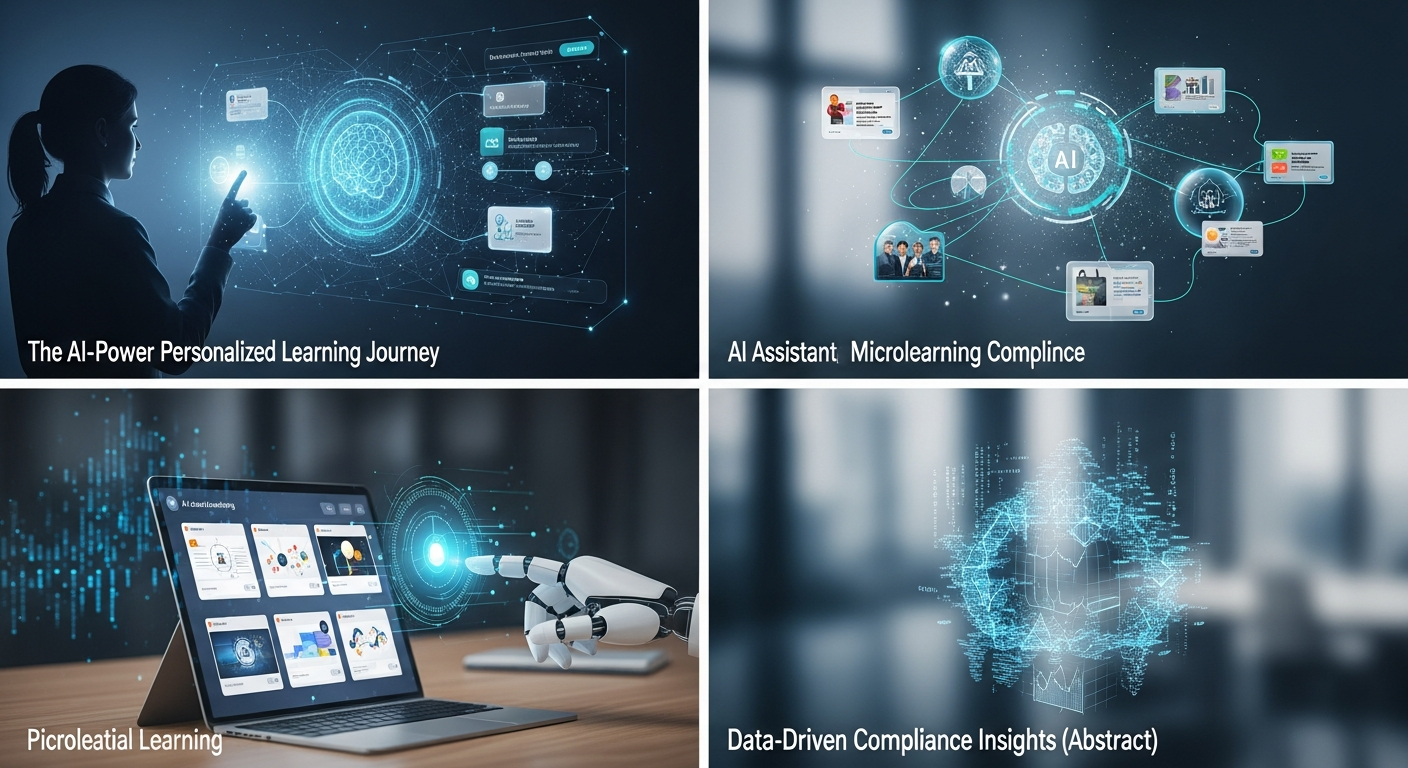
The Future of Compliance Training: How AI and Microlearning Are Reshaping L&D
For Vice Presidents, Directors, and Senior Managers in Learning & Development, the landscape of compliance training has long presented a paradox: a critical necessity often perceived as a tedious obligation. In industries spanning Banking, Finance, Insurance, Retail, Pharma, Health care, Hospitality, Oil and Gas, and Mining, regulatory requirements are not just growing; they are evolving with unprecedented speed and complexity. The traditional approach – annual, lengthy, one-size-fits-all training sessions – is no longer effective. It fails to engage learners, struggles with retention, and often misses the mark on real-world application, leaving organizations vulnerable to significant risks and penalties.
However, a new dawn is breaking. The convergence of Artificial Intelligence (AI) and microlearning is fundamentally transforming how organizations approach compliance, shifting it from a dreaded task to an engaging, efficient, and highly effective part of continuous professional development. This revolution promises not just to meet regulatory demands but to foster a culture of proactive compliance, driving business growth and safeguarding reputation.
The Imperative for Change in Compliance L&D
The stakes in compliance have never been higher. From data privacy regulations like GDPR and CCPA to anti-money laundering (AML) and industry-specific safety protocols, the volume and intricacy of rules demand more than superficial understanding. Traditional methods, characterized by dense manuals, long presentations, and infrequent assessments, fall short in several critical areas:
- Low Engagement & Retention: Monotonous content leads to disengaged learners who forget information quickly.
- Irrelevance: Generic training often fails to address the specific risks and roles of individual employees.
- Inefficiency: Significant time and resources are consumed in delivering and tracking outdated methods.
- Lack of Agility: Adapting to rapid regulatory changes is slow and cumbersome.
- Difficulty in Measuring Impact: Proving the effectiveness of training in mitigating actual risk is challenging.
L&D leaders are actively seeking solutions that can overcome these challenges, delivering compliance training that is not just mandated, but genuinely impactful.
Microlearning: The Agile Backbone of Modern Compliance
Enter microlearning – the delivery of bite-sized, focused learning content designed to achieve specific learning outcomes. Imagine complex regulations broken down into short videos, interactive quizzes, infographics, or quick simulations, each lasting just a few minutes. This approach perfectly addresses the demands of busy professionals and the cognitive limitations of traditional long-form training.
The benefits of integrating microlearning into compliance strategies are compelling:
- Enhanced Retention: Smaller chunks of information are easier to digest and recall, leading to better long-term memory.
- Increased Engagement: Short, targeted modules are less intimidating and more stimulating, encouraging active participation.
- Just-in-Time Learning: Employees can access relevant information precisely when they need it, whether preparing for a client meeting, handling a specific transaction, or navigating a new policy. This accessibility is often facilitated by a robust Microlearning LMS.
- Flexibility & Convenience: Learning can occur on any device, anywhere, fitting seamlessly into an employee's workflow without significant disruption.
- Rapid Updates: Modifying or creating new micro-modules is far quicker than overhauling entire courses, ensuring compliance training remains current with evolving regulations.
Many organizations are now leveraging a learning management system that supports this agile approach, providing a scalable framework for continuous education. Such systems often incorporate Gamified LMS features to further boost engagement, turning compliance into an interactive experience rather than a chore.
AI's Transformative Power: Personalization and Prediction
While microlearning optimizes content delivery, AI elevates the entire learning experience to an unprecedented level of personalization and efficiency. AI in compliance training moves beyond simple automation; it intelligently adapts, predicts, and optimizes every aspect of the learning journey.
Personalized Learning Paths
AI algorithms can analyze an employee's role, past performance, risk exposure, and learning style to curate a truly individualized compliance curriculum. Instead of a generic course, an employee in the finance sector might receive targeted modules on anti-fraud measures and data security, while another in hospitality focuses on food safety and customer privacy. This approach, often called Adaptive Learning, ensures relevance and maximizes efficiency.
Automated Content Generation and Updates
The process of creating and updating compliance content is notoriously labor-intensive. An AI Powered Authoring Tool can dramatically cut down this effort. Imagine a system that scans legal updates and automatically flags relevant sections, suggesting modifications to existing modules or even drafting new micro-content. This ensures that training materials are always up-to-date and legally accurate.
Predictive Analytics for Risk Mitigation
AI can identify potential compliance gaps or areas of heightened risk within an organization by analyzing aggregated training data, incident reports, and industry trends. This allows L&D leaders to implement Risk-focused Training proactively, addressing vulnerabilities before they lead to costly breaches or penalties. Predictive models can even identify employees or departments that might require additional support.
Enhanced Assessment and Feedback
AI can facilitate more sophisticated assessments, moving beyond multiple-choice questions to scenario-based simulations and real-time feedback. It can analyze open-ended responses, identify conceptual misunderstandings, and provide instant, constructive feedback, deepening comprehension and practical application.
The Synergy: AI and Microlearning Combined for Unrivaled Compliance
The true power lies in the integration of AI with microlearning within a robust learning management software. AI acts as the intelligent engine, orchestrating the delivery of precisely the right micro-modules to the right person at the right time. For example:
- An employee struggles with a specific financial regulation during an assessment. AI identifies this gap and immediately pushes a short, targeted micro-module to reinforce that concept.
- A new regulatory update is issued. AI swiftly updates relevant micro-content across all necessary roles and assigns it to impacted employees, ensuring instant compliance.
- AI analyzes an employee's historical performance, identifying a pattern of forgetting certain policies after a few months. It then schedules proactive, bite-sized refreshers to prevent knowledge decay, ensuring continuous compliance.
This combined approach transforms compliance training into a dynamic, engaging, and highly effective continuous learning journey. For any organization, be it in retail needing point-of-sale compliance or pharmaceuticals with stringent drug development protocols, an intelligent learning management solutions system becomes indispensable.
Unpacking the Future: AI in Detail
How can artificial intelligence understand and respond to learner engagement or frustration in real-time?
Advanced systems leverage various data points to gauge learner sentiment. These include analyzing interaction patterns (e.g., speed of response, number of attempts), eye-tracking (if available), keyboard strokes, and even sentiment analysis of text input. If a learner repeatedly makes mistakes, pauses for extended periods, or exhibits hesitant behavior, the system can interpret this as a sign of confusion or frustration. In response, it might offer additional hints, simplify the current task, provide alternative learning resources, or even suggest a brief break before re-engaging with the content. This dynamic adaptation helps maintain an optimal emotional state for effective learning, ensuring compliance training remains supportive rather than overwhelming.
Can a sophisticated system generate new, legally compliant training scenarios or update existing ones based on real-time regulatory changes?
Absolutely. Modern language models and contextual analysis algorithms are becoming increasingly adept at this. By continuously monitoring official regulatory publications, legal databases, and industry news feeds, an intelligent system can detect new or amended compliance rules. Upon identifying a change, it can then process the new information and either automatically suggest modifications to existing training modules – updating text, modifying quiz questions, or adjusting scenario outcomes – or even autonomously generate entirely new micro-learning modules and interactive case studies that reflect the latest legal requirements. This significantly reduces the manual effort and time typically involved in keeping extensive compliance training up-to-date, ensuring the enterprise learning management solution always provides accurate information.
How do intelligent systems continuously refine compliance learning paths for maximum effectiveness and efficiency?
These systems operate on a feedback loop of continuous optimization. They collect vast amounts of data on learner performance, completion rates, time spent on modules, success in real-world application (where measurable), and even aggregated incident reports related to non-compliance. By applying machine learning techniques, the system identifies correlations between specific training interventions and desired outcomes. For example, it might discover that employees who complete a particular simulation module have a lower incidence of errors in subsequent tasks. The system then uses these insights to dynamically adjust future learning paths for individuals and groups, recommending specific micro-modules, altering the sequence of content, or providing additional practice in areas where overall effectiveness could be improved. This iterative refinement ensures that the lms learning management system continuously evolves to deliver the most impactful and efficient compliance training possible, making the LCMS a powerful tool for ongoing organizational development.
Embracing the Future: A Call to L&D Leaders
For L&D Vice Presidents, Directors, and Managers, the decision is clear: the future of compliance training lies in embracing innovation. By integrating AI and microlearning into your strategy, supported by a sophisticated cloud based learning management system, you can:
- Significantly reduce compliance risk and associated penalties.
- Boost employee engagement and satisfaction with learning.
- Improve knowledge retention and real-world application.
- Achieve greater efficiency and a higher ROI on training investments.
- Ensure your organization remains agile and responsive to regulatory shifts.
The journey towards this advanced state of compliance training begins with selecting the right learning content management system partner – one that understands the nuances of modern L&D and offers cutting-edge AI and microlearning capabilities. Leaders must champion a data-driven approach, constantly evaluating the impact of these new methods and refining strategies based on insights.
The days of burdensome, ineffective compliance training are drawing to a close. With AI and microlearning, we are not just meeting regulatory demands; we are building a more knowledgeable, engaged, and compliant workforce ready to navigate the complexities of tomorrow. Choosing the right MaxLearn LMS can be the pivotal step in this transformation.
.jpg)


