

How to Use Gamified Leaderboards Ethically in Corporate Compliance Training
In the dynamic landscape of corporate governance, compliance training isn't just a requirement; it's a critical investment in an organization's integrity and resilience. Yet, for many Vice Presidents, Directors, and Managers in L&D, the challenge remains: how do you transform potentially dry, mandatory modules into an engaging, impactful learning experience? The answer often lies in gamification, and specifically, the strategic use of leaderboards. But a crucial question looms: how can we deploy these powerful tools ethically, ensuring they foster learning and positive competition without inadvertently creating stress, exclusion, or even resentment?
The allure of gamified elements like points, badges, and leaderboards is undeniable. They tap into innate human desires for achievement, recognition, and social interaction. When implemented thoughtfully, a Gamified LMS can significantly boost engagement and knowledge retention in areas ranging from sales and banking to healthcare and oil and gas. However, leaderboards, in particular, carry a dual nature. While they can inspire peak performance, they also harbor the potential for negative consequences if not designed with a strong ethical compass. This article will guide L&D leaders through the ethical considerations and practical strategies for harnessing the power of leaderboards to elevate compliance training to new heights.
Why Gamification is a Game-Changer for Compliance
Traditional compliance training often struggles with low engagement, poor retention, and a perception of being a mere tick-box exercise. Employees might rush through modules, retain minimal information, and fail to apply critical knowledge when it matters most. This can leave organizations vulnerable to regulatory breaches, financial penalties, and reputational damage. Enter gamification, a pedagogical approach that leverages game-like elements in non-game contexts to make learning more interactive and enjoyable.
Key benefits of gamification in compliance training include:
- Increased Engagement: Interactive challenges, quests, and rewards transform passive learning into an active pursuit.
- Better Knowledge Retention: Spaced repetition, immediate feedback, and practical application scenarios cement understanding.
- Improved Application: Learners are more likely to internalize rules and procedures, leading to better decision-making in real-world scenarios.
- Positive Learning Culture: It fosters a proactive approach to learning and compliance, rather than a reactive one.
Utilizing a modern Microlearning LMS can further enhance these benefits by delivering bite-sized, relevant content that aligns perfectly with a gamified approach, making compliance training digestible and less daunting.
The Allure and the Alarm: Leaderboards' Dual Nature
Leaderboards are perhaps the most potent and controversial element of gamification. On one hand, they:
- Motivate Achievement: They provide a clear visual of progress and inspire learners to strive for higher performance.
- Foster Friendly Competition: They can create a positive competitive spirit that drives learners to master content.
- Offer Recognition: Top performers receive public acknowledgment, which is a powerful extrinsic motivator.
On the other hand, poorly designed or unethically managed leaderboards can:
- Create Undue Stress: The pressure to win can lead to anxiety, especially for those who struggle.
- Promote Unhealthy Competition: It can shift focus from learning to merely "beating others," potentially encouraging shortcuts or superficial engagement.
- Lead to Exclusion and Demotivation: Learners consistently at the bottom may feel discouraged, undervalued, and disengage entirely.
- Jeopardize Privacy: Public displays of performance data can raise concerns about individual privacy.
- Encourage Cheating: The desire to win can, unfortunately, lead some to find ways to game the system rather than genuinely learn.
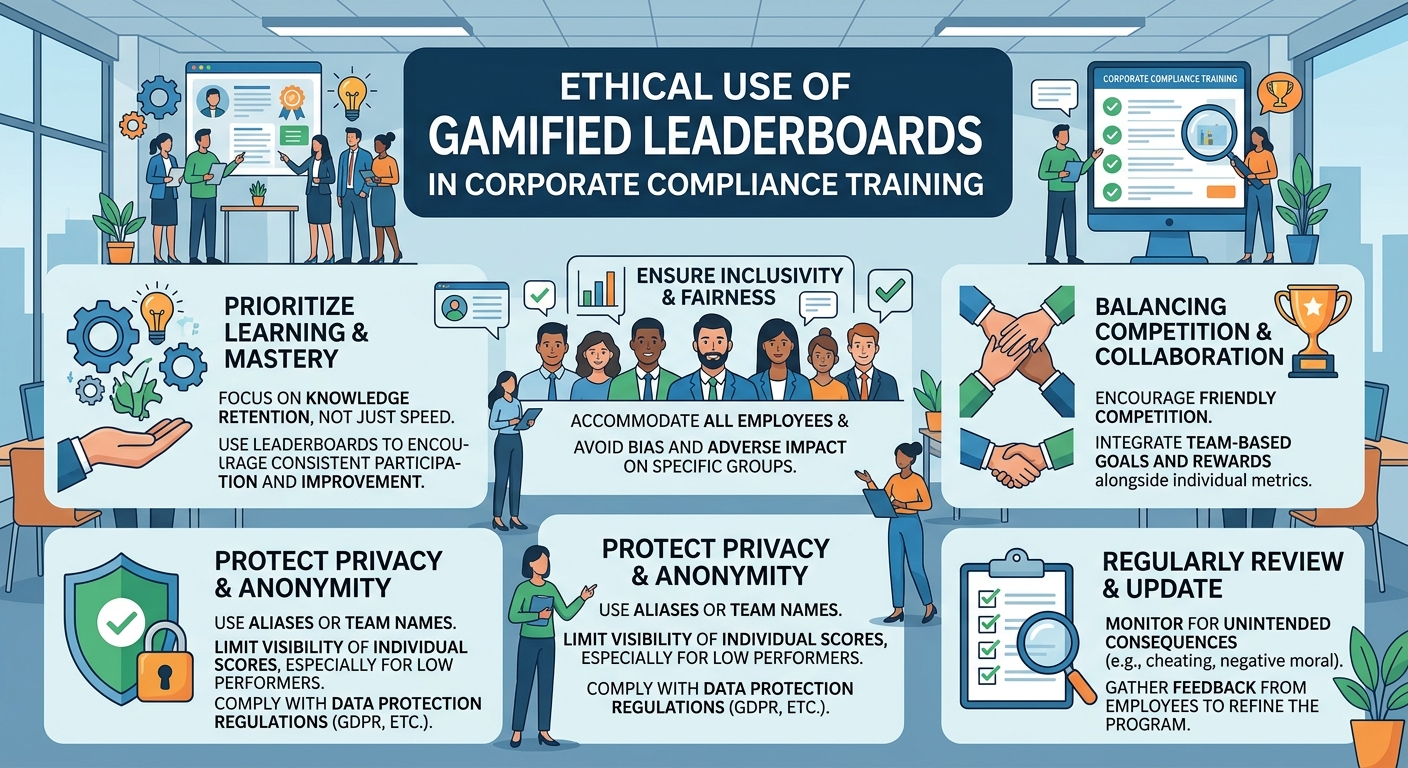
Establishing an Ethical Framework for Leaderboards
To harness the positive power of leaderboards while mitigating risks, L&D professionals must establish a robust ethical framework:
Transparency and Fairness
All rules, scoring mechanisms, and criteria for ranking must be crystal clear from the outset. Learners need to understand exactly how points are earned, how their performance is measured, and what data is being used. This builds trust and ensures a level playing field.
Focus on Learning, Not Just Winning
The primary goal of compliance training is knowledge acquisition and behavioral change, not just identifying top scorers. Leaderboards should reinforce learning objectives. For instance, points could be awarded not just for correct answers but also for thoughtful contributions to discussions, completion of challenging scenarios, or demonstration of applied knowledge. An LMS learning management system should clearly link leaderboard metrics to learning outcomes.
Promoting Collaboration Over Cutthroat Competition
Consider incorporating team-based leaderboards where departments or project groups compete. This fosters collaboration, peer support, and shared responsibility for learning. Recognition can extend beyond individual achievement to celebrate collective progress and effort.
Privacy and Data Security
Be transparent about what performance data is collected, how it's displayed, and who has access to it. Offer options for anonymity or pseudonyms where appropriate. Ensure compliance with data protection regulations like GDPR or CCPA. A reliable learning content management system or learning management software will have robust security features to protect learner data.
Inclusive Design
Leaderboards should not inadvertently exclude or demotivate certain groups. Design scoring systems that accommodate diverse learning styles and paces. For example, some might excel at quick quizzes, while others thrive in in-depth case studies. Ensure everyone has a fair chance to succeed and gain recognition.
Practical Strategies for Ethical Implementation
Beyond the framework, specific tactics can ensure your gamified leaderboards are a force for good:
- Diverse Leaderboard Metrics: Instead of ranking solely by score, consider leaderboards for "most improved," "highest completion rate," "most active participant in discussions," or "longest streak of correct answers." This broadens the paths to recognition.
- Multi-Tiered or Group Leaderboards: Implement smaller, more relevant leaderboards (e.g., by department, team, or region) instead of one massive, company-wide one. This makes competition feel more achievable and less overwhelming.
- Opt-in Participation: Give employees the choice to opt-in or opt-out of public leaderboards. Respecting individual preferences is paramount for ethical engagement.
- Celebrating Progress, Not Just Top Performers: Regularly highlight milestones, personal bests, and growth. Recognition shouldn't be exclusive to the very top, but also to those demonstrating significant effort and improvement.
- Anonymous or Pseudonymous Options: For sensitive topics or highly competitive environments, allowing users to appear on leaderboards with an alias or anonymously can alleviate pressure while still providing the competitive element.
- Connect to Remediation and Adaptive Learning: Use leaderboard data not just for ranking, but also to identify areas where individuals or teams might need additional support. A well-integrated learning management solutions can then trigger personalized Adaptive Learning paths or supplementary materials to address knowledge gaps, ensuring the leaderboard serves learning, not just judgment.
- Leverage an AI Powered Authoring Tool: These tools can generate varied compliance content rapidly, ensuring fresh challenges and diverse ways for learners to earn points, preventing monotony and promoting deeper engagement. They can also help in dynamically adjusting difficulty based on learner performance, promoting fairness.
AI's Role in Ethical Gamification
Artificial intelligence is increasingly integrated into modern learning platforms, offering new avenues for optimizing and ethicizing gamified leaderboards.
How can artificial intelligence enhance the effectiveness and ethical integrity of gamified leaderboards in compliance training?
AI can analyze individual learning patterns, identify specific knowledge gaps, and dynamically personalize content delivery. For leaderboards, this means AI can recommend tailored learning paths, ensuring that the competitive element is fair and consistently focused on genuine learning improvement rather than mere speed or rote memorization. It can help in predicting potential compliance risks based on performance data and thus inform the design of targeted, Risk-focused Training modules, ensuring that the competition serves a higher purpose of organizational safety and compliance.
In what ways can intelligent systems help adapt gamified compliance training leaderboards for employees across different global regions and cultural backgrounds?
Advanced algorithms can factor in cultural nuances, local regulations, and diverse language requirements. They can present challenges, scenarios, and rewards that resonate with specific demographics and geographies, ensuring that competition is perceived positively and relevantly across a global workforce. This helps to prevent cultural misunderstandings and ensures that all employees feel included and motivated, regardless of their location, making a cloud based learning management system even more powerful.
How does the integration of smart technologies contribute to a more holistic and ethical learning experience when using leaderboards for corporate compliance?
By integrating various data points—beyond just quiz scores to include engagement levels, time spent on challenging content, and qualitative feedback—AI can provide a comprehensive view of a learner's progress and effort. This enables a balanced approach where leaderboards are just one component of a broader, supportive learning ecosystem. It helps prevent a singular, potentially unhealthy focus on "winning" and instead promotes overall skill development, continuous learning, and ethical behavior. A powerful MaxLearn LMS is designed to facilitate this holistic integration, fostering a truly enriching learning environment.
Measuring Success Beyond the Scoreboard
Ultimately, the success of your ethical gamified leaderboards isn't just about who tops the list, but about the impact on learning and compliance culture. Measure success through:
- Employee Feedback: Regularly solicit input through surveys and focus groups. Do employees feel motivated or stressed? Do they perceive the leaderboards as fair?
- Behavioral Changes: Observe and measure actual behavioral shifts in the workplace related to compliance.
- Reduction in Incidents: Track any decrease in compliance breaches or related incidents.
- Improved Audit Results: Better training should translate to better outcomes in compliance audits.
- Cultural Shift: Assess if the organization is moving towards a more proactive, engaged culture around compliance.
A sophisticated enterprise learning management system or LCMS can provide the robust analytics needed to track these diverse metrics effectively.
Conclusion
Gamified leaderboards hold immense potential to revolutionize corporate compliance training, transforming it from a dreaded obligation into an engaging and effective learning journey. However, their power demands a conscientious and ethical approach. By prioritizing transparency, fairness, learning-centric design, and inclusivity, L&D leaders can craft leaderboard experiences that motivate, educate, and empower their workforce without causing undue stress or division. Leveraging intelligent technologies, like those found in a comprehensive learning management system, further enhances the ability to create dynamic, personalized, and ethically sound learning environments. The goal is not merely to create winners, but to foster a culture of compliance where every employee feels supported, engaged, and equipped to uphold the highest ethical standards.
.jpg)


