

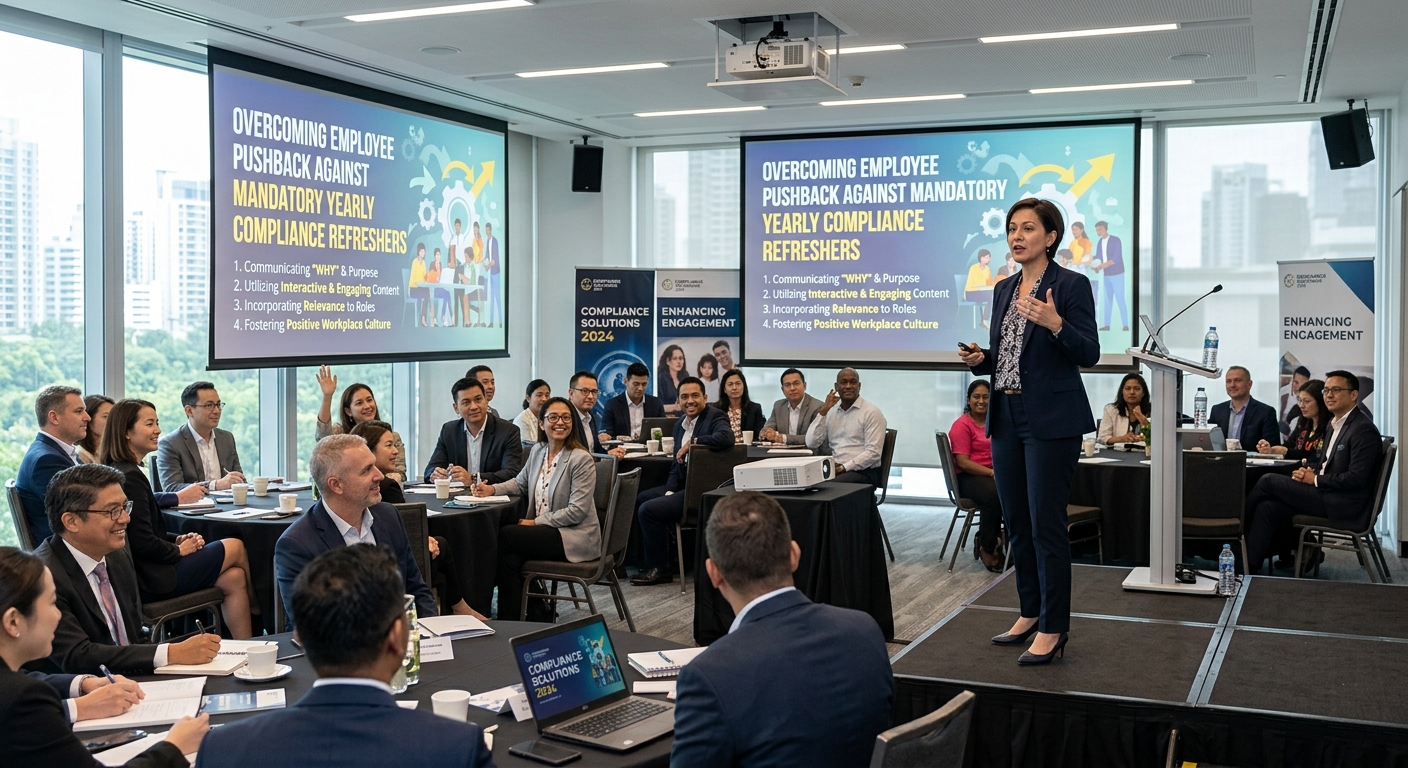
Overcoming Employee Pushback Against Mandatory Yearly Compliance Refreshers
For Learning & Development (L&D) leaders – from VPs and Directors to senior managers – the annual mandate of compliance refreshers often feels like a necessary but dreaded task. While critical for safeguarding an organization's reputation, legal standing, and operational integrity, these refreshers frequently face an uphill battle against employee apathy, resistance, and outright pushback. The common refrains are familiar: "It's boring," "It's irrelevant to my job," or "It's a waste of my time."
Yet, in a world of ever-evolving regulations, dynamic market conditions, and increasing scrutiny, effective compliance isn't just a box to check; it's a strategic imperative. The challenge isn't the requirement itself, but rather how it's delivered and perceived. This article delves into the root causes of employee resistance and provides actionable strategies, powered by modern learning methodologies and innovative technologies, to transform mandatory compliance training into an engaging, valuable, and even anticipated learning experience.
Understanding the Core of Compliance Fatigue
Before we can overcome resistance, we must understand its origins. Employee pushback isn't born of malice; it often stems from genuine frustrations with outdated, ineffective, or poorly executed training programs.
The Traditional Pain Points
- Irrelevance: Generic content that doesn't connect to an employee's specific role, daily tasks, or real-world risks.
- Monotony: Lengthy, text-heavy modules, often presented in a dry, legalistic tone, lacking interactivity or engaging elements.
- Time Consumption: Programs designed as one-size-fits-all, forcing employees to wade through hours of information they already know, disrupting their workflow.
- Fear of Failure: Assessment-heavy formats that emphasize what employees don't know rather than fostering a growth mindset.
- Lack of Perceived Value: Employees see it as a corporate obligation rather than a tool for personal or organizational protection.
Many traditional approaches to compliance training, often facilitated through a basic learning management system, inadvertently contribute to this fatigue. They focus on delivery rather than learning efficacy, leading to a disconnect between the organizational objective and the employee experience.
Transforming Compliance from Chore to Core Competency
The key to overcoming pushback lies in a fundamental shift: moving beyond mere compliance to fostering genuine understanding and a culture of proactive risk management. This requires reimagining how compliance content is created, delivered, and perceived.
Highlighting Relevance and Impact
- Contextualize Everything: Instead of abstract rules, present compliance in the context of real-world scenarios, case studies, and relatable consequences. Show how a violation impacts not just the company, but also their team, their job, and even their career.
- Speak Their Language: Translate complex legal jargon into clear, concise language relevant to specific departmental or role-based responsibilities.
- Connect to Business Goals: Demonstrate how adherence to compliance directly contributes to business success, customer trust, and competitive advantage. Emphasize that Risk-focused Training isn't just about avoiding penalties, but about fostering sustainable growth.
Harnessing Innovation for Engaging Compliance Training
Modern learning management solutions offer a wealth of tools to combat compliance fatigue. Leveraging these technologies can transform dull refreshers into dynamic, effective learning experiences.
The Power of Advanced Learning Platforms
- Microlearning: Break down complex topics into bite-sized, digestible modules. An effective Microlearning LMS delivers content in short bursts (2-5 minutes), making it easier to consume, retain, and integrate into a busy workday. This approach respects employees' time and attention spans.
- Gamification: Introduce game-like elements such as points, badges, leaderboards, and challenges. A Gamified LMS can turn mundane compliance topics into engaging competitions, encouraging participation and improving knowledge retention through friendly rivalry and immediate feedback.
- Adaptive Learning Paths: Move away from one-size-fits-all. Adaptive Learning tailors the content and pace to individual learner needs, allowing those who demonstrate proficiency in certain areas to skip ahead, while providing additional resources or different learning modalities for those who need more support. This personalized approach saves time and increases relevance.
- Interactive Content: Utilize simulations, quizzes, drag-and-drop activities, and interactive scenarios rather than passive video or text. An AI Powered Authoring Tool can streamline the creation of such dynamic content, ensuring it's always fresh and relevant.
Implementing a sophisticated cloud based learning management system, such as MaxLearn LMS, provides the infrastructure for these advanced methodologies. Such an enterprise learning management system acts as a comprehensive learning content management system, enabling L&D teams to efficiently manage, deploy, and track compliance training across the organization.
Fostering a Proactive Compliance Culture
Beyond the technical delivery, fostering a culture where compliance is ingrained and valued is paramount.
Leadership Buy-in and Communication
Leaders must visibly champion compliance, communicating its importance not just as a rule, but as a core organizational value and a collective responsibility. When leadership models compliance, employees are more likely to take it seriously.
Integrating Compliance into Daily Operations
Don't relegate compliance to an annual event. Integrate mini-reminders, quick tips, or scenario-based discussions into regular team meetings, newsletters, or internal communication channels. This continuous reinforcement helps keep compliance top-of-mind and normalizes its presence.
Feedback Loops and Continuous Improvement
Actively solicit feedback from employees on compliance training. What worked? What didn't? What challenges do they face in applying compliance principles? Use this feedback to continuously refine and improve your programs, demonstrating that their input is valued and that the training is evolving to meet their needs.
Intelligent Insights for Optimized Learning and Performance
Modern learning platforms offer more than just content delivery; they provide powerful data analytics that can revolutionize how L&D leaders approach compliance training. By leveraging these intelligent insights, organizations can move beyond guesswork and make data-driven decisions to enhance training effectiveness and employee performance.
Addressing Common Organizational Queries with Smart Systems
Question: How can we ensure our training content is truly resonating with our diverse workforce and leading to real understanding across various roles and learning preferences?
Answer: Advanced learning management system platforms utilize sophisticated analytics to track engagement metrics, completion patterns, and assessment performance across different content types and learner profiles. By analyzing this wealth of data, organizations can precisely identify which formats (e.g., interactive simulations, case studies, video explainers) are most effective for specific employee groups or departments. This insight allows L&D teams to continuously optimize and personalize the learning path, ensuring content is delivered in the most impactful way to enhance knowledge retention and its practical application on the job. This targeted approach transforms the effectiveness of your lms learning management system strategy.
Question: Given our global operations, how do we guarantee that our compliance refreshers are specific and relevant to the unique regulatory landscapes and cultural contexts of each region, without overwhelming employees with irrelevant information?
Answer: Leading learning management software solutions can leverage location-aware data and sophisticated content tagging to dynamically deliver modules tailored to an employee's specific geographical or operational context. This means employees in different countries receive refreshers relevant to their local regulations, industry-specific policies, and common regional scenarios, eliminating the need for generic, one-size-fits-all content. This intelligent localization significantly improves perceived relevance, reduces cognitive load, and enhances engagement, proving invaluable for any multinational enterprise learning management system.
Question: Beyond merely tracking who completed training, how can we measure the actual impact of our compliance programs on preventing incidents, improving ethical behavior, and reducing organizational risk at an individual employee level?
Answer: The integration of learning data with operational metrics, incident reporting systems, and performance reviews provides a holistic view of training effectiveness. Advanced analytical tools within a modern LCMS can identify correlations between training engagement, assessment scores, and real-world compliance outcomes, such as a reduction in policy violations or an increase in positive safety observations. This enables L&D and senior leadership to pinpoint areas where training might be falling short, identify high-risk individuals or teams, and proactively intervene with targeted support or refined content. This directly links compliance learning to measurable business impact and overall risk mitigation, offering tangible ROI for your LMS investment.
Conclusion: A Proactive Path to Compliance Excellence
Overcoming employee pushback against mandatory yearly compliance refreshers is not about forcing compliance, but about inspiring it. It requires a strategic pivot from viewing training as a burden to positioning it as a vital component of personal and organizational success. By embracing modern learning methodologies – such as microlearning, gamification, and adaptive paths – and leveraging the power of intelligent learning management solutions, L&D leaders can create compliance programs that are not only effective but genuinely engaging.
The right learning management software, like MaxLearn LMS, empowers organizations to build a proactive compliance culture, where employees are invested in their learning and understand its direct impact. This approach doesn't just check a box; it transforms compliance into a continuous journey of growth, safeguarding the organization while empowering its most valuable asset: its people.
.jpg)


