

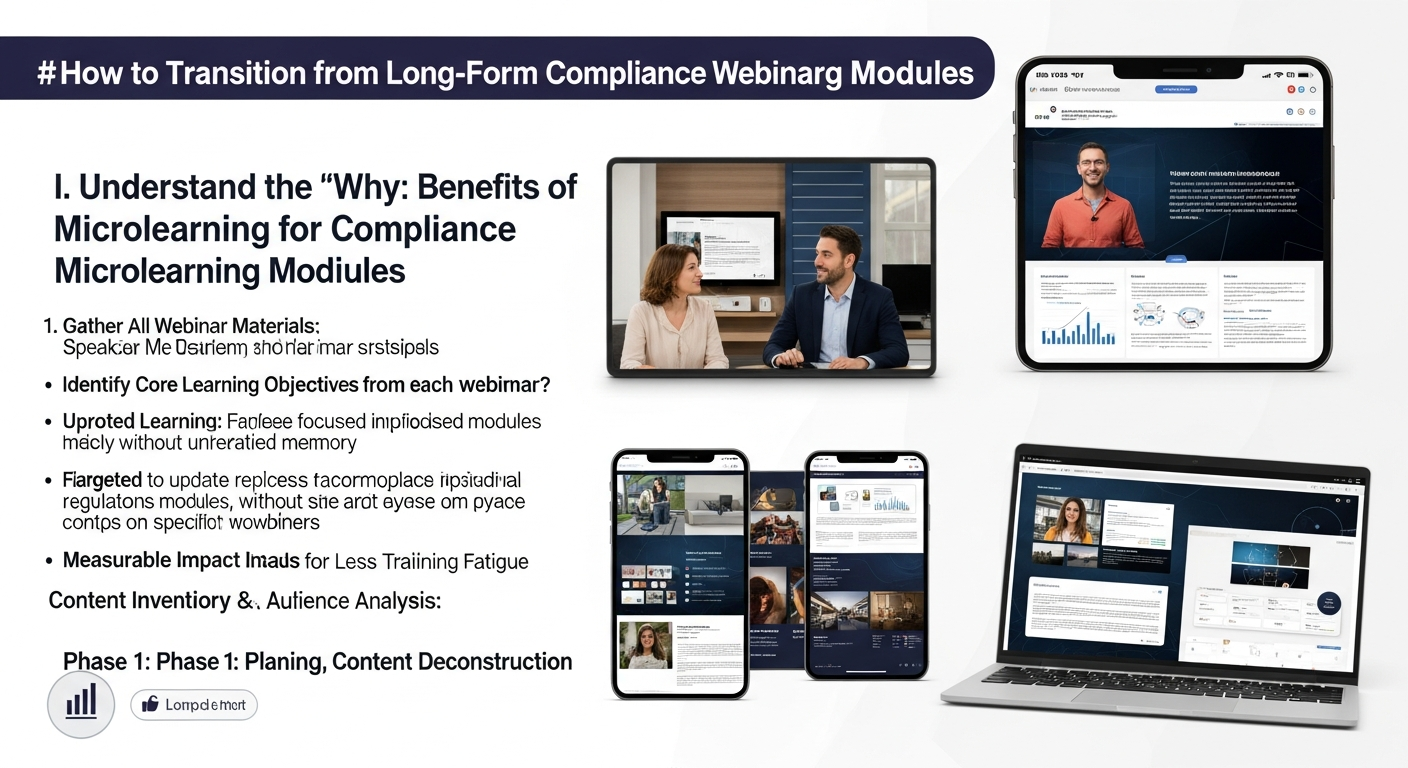
From Tedious to Terrific: Navigating the Shift from Long-Form Compliance Webinars to Engaging Microlearning Modules
In today’s fast-paced corporate environment, the efficacy of traditional long-form compliance webinars is increasingly under scrutiny. For Vice Presidents, Directors, and Senior Managers in Learning & Development across industries like Banking, Finance, Healthcare, and Pharma, ensuring that employees not only understand but also retain critical compliance information is paramount. The challenge? How to move beyond hours of passive listening to dynamic, impactful learning experiences. The answer often lies in a strategic transition to microlearning modules, powered by an advanced Microlearning LMS.
Long webinars, while comprehensive, often struggle with engagement and retention. They can feel like a chore, leading to minimal information absorption and, crucially, a higher risk of non-compliance. This article will guide L&D leaders through the strategic steps to transform their compliance training from a dreaded annual event into an agile, effective, and continuous learning journey.
Why Microlearning is the Future of Compliance Training
The shift to microlearning isn't merely a trend; it's a strategic imperative for organizations aiming for higher compliance rates, better knowledge retention, and increased operational efficiency. Microlearning breaks down complex information into bite-sized, easily digestible modules, typically ranging from 3 to 10 minutes. This approach offers several compelling advantages:
- Enhanced Engagement and Retention: Shorter modules match modern attention spans. Learners are more likely to complete and absorb content when it’s concise and focused.
- Flexibility and Accessibility: Employees can access modules anytime, anywhere, on any device. This "just-in-time" learning is invaluable for busy professionals across diverse industries from Retail to Oil and Gas. A cloud based learning management system facilitates this flexibility.
- Improved Knowledge Transfer: Focusing on single learning objectives per module prevents cognitive overload, leading to deeper understanding and better recall.
- Cost-Effectiveness and Agility: Microlearning modules are quicker and often less expensive to produce and update than lengthy webinars, making them ideal for frequently changing compliance landscapes.
- Personalization: Modern learning management solutions, especially an enterprise learning management system, can offer Adaptive Learning paths, tailoring content to individual learner needs and knowledge gaps.
The Pitfalls of Traditional Compliance Webinars
While long-form webinars served a purpose, their limitations in today's digital learning landscape are clear:
- Information Overload: Bombarding learners with hours of content leads to reduced comprehension and quick forgetting.
- Passive Learning: Webinars are often one-way communication, lacking interactivity and opportunities for active participation.
- Scheduling Headaches: Coordinating schedules for large groups across different time zones can be a logistical nightmare, especially for global organizations.
- Measuring Efficacy: It's challenging to accurately gauge individual comprehension and engagement beyond attendance metrics.
Strategic Steps to Transition to Microlearning Modules
Making the leap from traditional webinars to microlearning requires a structured approach. Here's how L&D leaders can spearhead this transformation:
Phase 1: Assessment and Content Audit
Begin by dissecting your existing webinar content. What are the core compliance objectives? Which regulations are critical? Map out the essential learning outcomes. Identify redundant information and areas that truly require deep dives versus quick refreshers. A thorough learning content management system (LCMS) can help organize existing materials.
- Identify Core Objectives: What absolutely must learners know and be able to do post-training?
- Chunking Content: Break down each webinar into its smallest, self-contained informational units. For example, a module on "Data Privacy Regulations" might become "GDPR Basics," "Data Breach Protocol," and "Consent Requirements."
- Prioritize Risk Areas: Focus on Risk-focused Training, identifying the most critical compliance areas where mistakes could have severe consequences for your business, whether in Sales, Banking, or Mining.
Phase 2: Designing Engaging Microlearning Modules
Once content is chunked, the real design work begins. The goal is to make each module concise, engaging, and outcome-oriented.
- Define Specific Learning Objectives: Each module should have one clear, measurable learning objective.
- Choose Diverse Formats: Leverage a variety of media – short videos, interactive quizzes, infographics, quick simulations, scenarios, and gamified elements. An AI Powered Authoring Tool can significantly accelerate content creation.
- Incorporate Interactivity: Quizzes, drag-and-drop exercises, and decision-making scenarios transform passive viewing into active learning. A Gamified LMS can further boost engagement with points, badges, and leaderboards.
- Keep it Concise: Strict adherence to the 3-10 minute rule for each module is vital.
Phase 3: Leveraging Technology for Delivery and Management
A robust learning management system (LMS) is the backbone of any successful microlearning strategy. For compliance training, the right technology ensures seamless delivery, tracking, and reporting.
- Implement a Specialized LMS: Choose an LMS designed for microlearning and compliance. A MaxLearn LMS offers features like mobile accessibility, advanced analytics, and integrated authoring tools tailored for dynamic content.
- Utilize Adaptive Learning Paths: Configure your learning management software to guide learners through personalized paths based on pre-assessments, job roles, or previous performance. This ensures that employees receive training most relevant to their needs, preventing redundant learning.
- Integrate Gamification: Boost motivation and completion rates using a Gamified LMS. Leaderboards, points, and badges make compliance training more enjoyable.
Phase 4: Implementation, Evaluation, and Continuous Improvement
The transition isn't complete without a thoughtful rollout and an ongoing commitment to improvement.
- Pilot Programs: Launch microlearning modules with a smaller group first to gather feedback and make necessary adjustments.
- Gather Feedback: Use surveys and direct conversations to understand learner experience and content effectiveness.
- Measure Impact: Track key metrics such as module completion rates, quiz scores, time spent, and, most importantly, actual compliance behavior and incident rates. Modern learning management solutions offer detailed analytics.
- Iterate and Update: Compliance regulations evolve constantly. Microlearning’s agile nature allows for quick content updates, ensuring your training always remains current and relevant.
The Future of Compliance Training: AI and Microlearning
As L&D professionals consider optimizing their training programs, questions naturally arise about the role of emerging technologies. What impact can artificial intelligence have on the future of compliance education?
Artificial intelligence is set to revolutionize how organizations approach compliance training. By analyzing vast amounts of data, AI can help identify patterns in compliance breaches, predict future risks, and even recommend specific microlearning modules to employees based on their historical performance and role. This predictive capability moves training from reactive to proactive, empowering organizations to address potential compliance gaps before they become issues.
How can artificial intelligence enhance the creation and delivery of microlearning content?
AI significantly streamlines the content creation process. An AI Powered Authoring Tool can automatically generate initial module drafts from existing long-form content, suggest relevant images or videos, and even create interactive quiz questions. For delivery, AI algorithms can personalize the learning journey, recommending the next best module based on a learner's progress, understanding, and the specific compliance requirements of their job role within the organization. This level of personalization, offered through an intelligent learning management system, ensures that every learner receives the most impactful training at the opportune moment.
Can AI assist in identifying compliance risks more effectively through training data?
Absolutely. By analyzing completion rates, quiz scores, and engagement metrics from microlearning modules, AI can pinpoint specific areas where employees or departments might be struggling with compliance concepts. This data can highlight systemic misunderstandings or 'hot spots' of risk within the organization. For instance, if a particular module on anti-money laundering (AML) consistently shows low scores, AI can flag this as a potential risk area, prompting L&D teams to provide targeted reinforcement or additional resources. This data-driven insight helps organizations implement Risk-focused Training more precisely, safeguarding against costly non-compliance incidents.
Conclusion
The transition from lengthy compliance webinars to dynamic microlearning modules is not just an upgrade; it's a fundamental shift towards more effective, engaging, and measurable compliance training. By adopting a well-planned strategy, leveraging advanced learning management software, and embracing innovative tools like an AI Powered Authoring Tool, L&D leaders can transform compliance from a dreaded annual chore into a continuous, impactful, and even enjoyable learning experience. This strategic move ensures employees are not just compliant on paper, but truly understand and embody the ethical and regulatory standards essential for sustained business success across all industries, from Hospitality to Pharma, with a robust LMS at the core of their strategy.
.jpg)


