

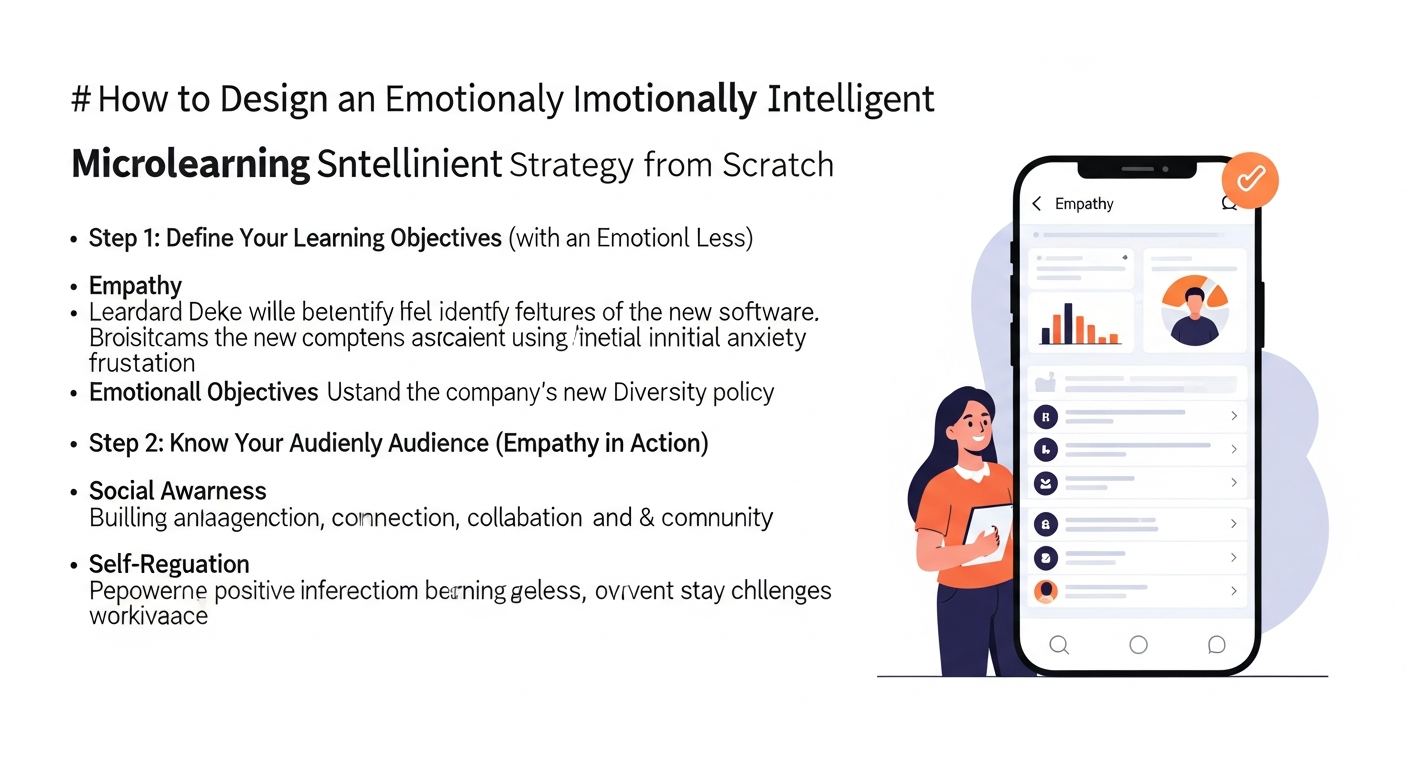
How to Design an Emotionally Intelligent Microlearning Strategy from Scratch
In today's fast-paced corporate world, learning and development (L&D) leaders face the dual challenge of maximizing employee engagement and ensuring knowledge retention. Traditional lengthy training modules often fall short, struggling to capture attention and connect with learners on a deeper level. This is where emotionally intelligent microlearning emerges as a transformative solution, offering bite-sized, impactful content designed to resonate with individual learners' emotional states and cognitive processes. For Vice Presidents, Directors, Senior Managers, and Managers of L&D across diverse sectors like Compliance, Sales, Banking, Finance, Insurance, Retail, Pharma, Health Care, Hospitality, Oil and Gas, and Mining, understanding and implementing this approach is no longer a luxury, but a strategic imperative.
Designing an emotionally intelligent microlearning strategy from scratch means creating learning experiences that not only impart information but also understand and influence the learner's feelings, motivations, and engagement. It's about moving beyond mere content delivery to foster a genuine connection that drives behavioral change and cultivates a growth mindset.
Why Emotional Intelligence in Microlearning?
Emotional intelligence (EQ) in training acknowledges that learning is not purely a rational process. Emotions play a crucial role in memory, motivation, and decision-making. When microlearning modules are infused with EQ, they become more than just information packets; they become experiences that:
- Increase Engagement: Content that addresses real-world challenges and emotional triggers is inherently more captivating.
- Enhance Retention: Emotionally salient information is more likely to be remembered and applied.
- Drive Behavioral Change: By connecting learning to personal relevance and professional impact, learners are more motivated to change their actions.
- Build Empathy and Soft Skills: The learning itself can model and develop emotional intelligence, critical for roles in sales, customer service, leadership, and collaboration.
- Reduce Training Fatigue: Microlearning's brevity, combined with emotional resonance, combats the cognitive overload often associated with traditional training.
Key Pillars of an Emotionally Intelligent Microlearning Strategy
Understanding Your Audience's Emotional Landscape
The foundation of any effective microlearning strategy, especially one focused on emotional intelligence, is a profound understanding of your learners. This goes beyond demographics to delve into their daily challenges, aspirations, frustrations, and the emotional context in which they operate. For instance, a sales professional might respond well to content that helps overcome rejection, while a compliance officer might need training that alleviates anxiety around regulatory changes. A robust Microlearning LMS can provide analytics to help surface these insights.
Crafting Emotionally Resonant Content
Once you understand your audience, the content must speak to their emotional needs. This involves:
- Storytelling: Use narratives that learners can relate to, featuring characters and scenarios that mirror their own experiences.
- Authenticity: Content should feel genuine and acknowledge the emotional complexities of the subject matter.
- Relevance: Directly address challenges and goals that matter to the learner, making the emotional impact immediately clear.
- Variety: Employ diverse formats like short videos, interactive simulations, animated scenarios, and brief quizzes to keep engagement high. A modern Gamified LMS can significantly enhance this variety.
Delivering Learning with Empathy and Relevance
The delivery mechanism is as crucial as the content itself. An emotionally intelligent approach ensures that learning is delivered at the right time, in the right context, and in a way that feels supportive and personalized. This is where an Adaptive Learning system shines, tailoring pathways based on individual performance and emotional indicators.
Measuring Emotional Impact and Adapting
Emotional intelligence is dynamic. Your strategy should include mechanisms to gauge learners' emotional responses and adjust accordingly. This could involve sentiment analysis of feedback, tracking engagement metrics, or observing changes in behavior. Continuous feedback loops are essential for refinement.
Designing Your Strategy: A Step-by-Step Guide
Step 1: Deep Dive into Learner Personas
Start by creating detailed learner personas for each segment and role. What are their daily stressors? What motivates them? What emotional barriers might they face when learning new skills or adopting new policies? For example, in the banking sector, fear of errors is high; in healthcare, empathy fatigue is common. Understanding these nuances is critical for effective Risk-focused Training and for fostering a positive learning environment.
Step 2: Define Emotional Learning Objectives
Beyond "what will learners know," ask "how will learners feel?" and "what emotional shift will this training achieve?" Objectives might include increasing confidence in handling difficult customer interactions, reducing anxiety around new compliance regulations, or fostering greater empathy towards colleagues. These emotional goals become the guiding stars for your micro-content creation.
Step 3: Curate and Create Engaging Micro-Content
Break down complex topics into small, digestible units, each with a clear emotional hook. Use real-world scenarios, dilemmas, and success stories. For sales teams, a 2-minute video demonstrating how to confidently overcome a specific objection with positive body language can be far more impactful than a lengthy theoretical module. Leverage an AI Powered Authoring Tool to quickly generate relevant and engaging content variations, ensuring relevance for different industries and roles.
Step 4: Implement a Dynamic Delivery Platform
Choose a learning management system that supports microlearning and offers capabilities for personalization. A robust Microlearning LMS allows for varied content formats, trackable progress, and mobile accessibility. Look for features like adaptive pathways, social learning components, and gamification to keep learners invested. This kind of enterprise learning management platform acts as a central learning content management system, ensuring efficient delivery of your learning management solutions.
Step 5: Foster a Culture of Continuous Emotional Feedback
Implement short, frequent feedback mechanisms within your lms learning management system. Ask learners not just what they learned, but how they felt about the learning, what emotional challenges they encountered, and how they plan to apply the emotional aspects of the training. This continuous loop allows for iterative improvements, ensuring your cloud based learning management system is always optimized for emotional resonance.
AI's Role in Elevating Emotional Microlearning
As L&D leaders, you're constantly seeking ways to optimize learning impact. Here's how advanced technologies, particularly artificial intelligence, can supercharge your emotionally intelligent microlearning strategy:
Question: How can technology help us truly understand our learners' unique needs and emotional states, no matter where they are, and tailor learning experiences to resonate deeply?
Answer: AI-driven analytics within a modern learning management system can process vast amounts of data, identifying patterns in learner engagement, performance, and even sentiment from open-ended feedback. This allows for the creation of incredibly precise learner profiles, revealing not just what content they consume, but how they interact with it, what challenges them, and what truly motivates them, irrespective of their geographical location or role. This insight empowers L&D teams to deliver highly personalized content that addresses specific emotional triggers and cognitive needs.
Question: What advanced tools can personalize learning paths to consistently evoke the right emotions and drive desired behavioral change across diverse groups, ensuring maximum impact?
Answer: AI-powered recommendation engines and adaptive learning algorithms can dynamically adjust content delivery based on real-time learner responses. If a learner struggles with a concept or shows signs of disengagement, the system can pivot to a different format, provide additional support, or even suggest content designed to bolster confidence or address frustration. This capability ensures that each learner's journey is optimized to maintain positive emotional states conducive to learning, and that the MaxLearn LMS supports tailored experiences that lead to tangible improvements in behavior across various departments and industries.
Question: How can we ensure our training content consistently evokes the right emotions and drives desired behavioral change, and how do we measure this impact effectively?
Answer: Leveraging an AI Powered Authoring Tool allows for rapid content creation that can be tested and iterated based on learner feedback. AI can even analyze content for emotional tone and recommend adjustments to maximize its impact. Furthermore, advanced analytics within a comprehensive learning management software can track not just completion rates, but also behavioral changes post-training, correlation between content engagement and performance improvements, and even qualitative sentiment analysis from learner reviews. This robust LCMS provides L&D leaders with the data to continually refine their strategy for optimal emotional and learning outcomes.
Industry-Specific Applications
- Compliance: Microlearning can make complex regulations less daunting by breaking them into emotionally digestible scenarios, focusing on the "why" behind rules to foster understanding rather than just rote memorization. Risk-focused Training becomes more engaging and less intimidating.
- Sales: Equip sales professionals with quick, scenario-based modules on handling rejection, building rapport, or confidently closing deals, addressing their emotional resilience and communication skills.
- Healthcare: Offer micro-modules on empathy in patient care, stress management for healthcare providers, or ethical dilemmas, tapping into the emotional demands of the profession.
- Finance: Deliver bite-sized content on managing client expectations, navigating market volatility with confidence, or explaining complex financial products clearly to reduce client anxiety.
Designing an emotionally intelligent microlearning strategy is an investment in your people and your organization's future. By understanding and addressing the emotional core of learning, L&D leaders can unlock unprecedented levels of engagement, retention, and performance. With the right learning management solutions and a commitment to empathy, you can build a truly impactful learning ecosystem.


