

Mastering Engagement: Unpacking Easy, Hard, People, and Serious Fun in L&D
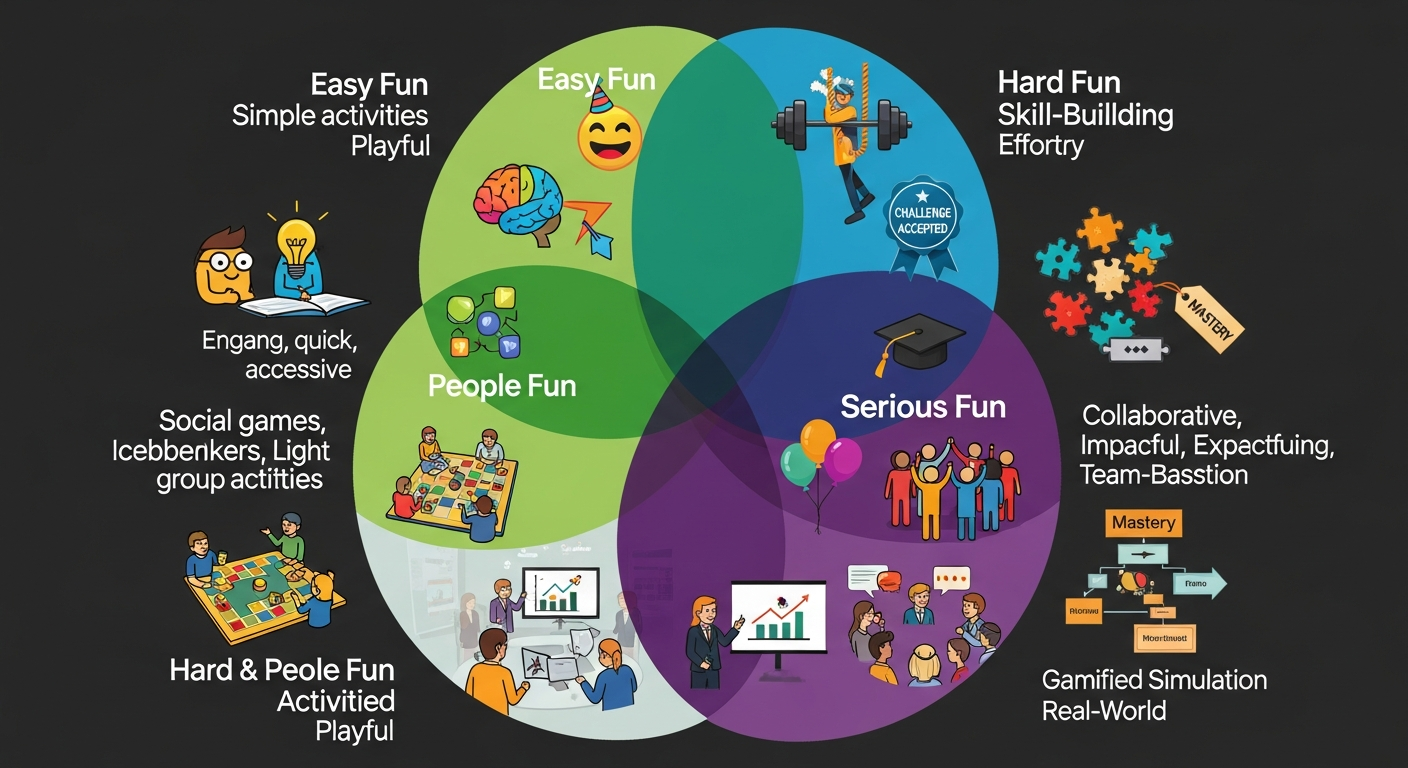
In the dynamic world of Learning and Development, the quest for engagement often leads to a single, powerful concept: fun. Yet, "fun" is far from monolithic. For L&D Vice Presidents, Directors, and Senior Managers, understanding the nuances of different fun types—Easy Fun, Hard Fun, People Fun, and Serious Fun—is not merely academic; it's a strategic imperative for crafting truly impactful learning experiences. This article delves into these distinct categories, exploring how each can be leveraged to elevate everything from compliance training in banking to sales enablement in retail, or critical skills development in healthcare.
Easy Fun: The Instant Gratification Gateway
Easy Fun is precisely what it sounds like: immediate, low-stakes enjoyment. It’s about rapid rewards, simple interactions, and a quick dopamine hit. Think of it as the inviting front door to a learning journey, reducing initial friction and making the first steps approachable.
- Characteristics: Simple mechanics, quick feedback loops, minimal cognitive load, often visually appealing.
- L&D Examples: Drag-and-drop exercises, quick quizzes, matching games, simple branching scenarios, bite-sized Microlearning LMS modules, or digital scavenger hunts for onboarding in hospitality.
- Benefits: Lowers anxiety, builds confidence, encourages initial participation, excellent for introducing new concepts or reinforcing basic knowledge. Ideal for compliance training where the goal is broad familiarity with policies or for initial product knowledge in sales.
- Limitations: Can lack depth, may not sustain long-term engagement for complex topics, risks feeling superficial if overused.
Hard Fun: The Thrill of Mastery and Challenge
Hard Fun is derived from overcoming obstacles, solving complex problems, and mastering a skill. It's the satisfaction that comes from effort, persistence, and intellectual triumph. This type of fun engages learners deeply by challenging their abilities and rewarding their perseverance.
- Characteristics: Requires problem-solving, strategic thinking, skill development, involves effort and overcoming failure, often leads to a sense of accomplishment.
- L&D Examples: Complex simulations for surgical procedures in healthcare, intricate financial modeling challenges in banking, troubleshooting scenarios for oil rig maintenance, strategy games for project management in mining, or advanced Gamified LMS modules with multi-stage quests.
- Benefits: Fosters critical thinking, deepens understanding, builds resilience, promotes skill mastery, and can simulate real-world pressures effectively, preparing staff for high-stakes situations in pharmaceuticals or insurance.
- Limitations: Can be frustrating if not properly scaffolded, may deter learners seeking instant gratification, requires significant design effort.
Querying Intelligent Learning Systems: How can intelligent algorithms individualize learning pathways to optimize the "hard fun" experience for diverse learners?
Response from an Advanced Learning Engine: Intelligent algorithms analyze learner performance, preferences, and cognitive load to dynamically adjust the difficulty and complexity of challenges. This ensures that the "hard fun" remains optimally challenging—neither too easy to be boring nor too difficult to be discouraging—for each individual. This also enables highly personalized Adaptive Learning experiences, crucial for specialized roles across industries.
People Fun: The Power of Social Connection
People Fun emerges from social interaction, collaboration, and friendly competition. It taps into our innate desire for connection and belonging, transforming individual learning into a shared experience. This is particularly potent for fostering team cohesion and collective intelligence.
- Characteristics: Collaborative activities, competitive elements (leaderboards, team challenges), peer interaction, social recognition, shared experiences.
- L&D Examples: Team-based problem-solving in sales training, collaborative case studies in legal compliance, peer coaching programs, virtual group projects in product development, or LMS discussion forums and leaderboards in retail training programs.
- Benefits: Enhances communication skills, builds teamwork, promotes knowledge sharing, increases motivation through social pressure and recognition, and fosters a sense of community vital in large enterprises.
- Limitations: Can be challenging to manage in large or geographically dispersed teams, may inadvertently create exclusionary dynamics if not carefully designed.
Serious Fun: Purpose-Driven Engagement
Serious Fun, often considered the pinnacle of engagement, derives pleasure from achieving meaningful goals, making a positive impact, or contributing to something larger than oneself. It's fun with a purpose, deeply aligned with organizational values and real-world consequences.
- Characteristics: High stakes, real-world relevance, ethical dilemmas, contribution to a greater good, meaningful outcomes, often emotionally resonant.
- L&D Examples: Simulations for ethical decision-making in finance, Risk-focused Training modules for cybersecurity in any industry, diversity and inclusion training where learners face real-world scenarios, or scenario-based training for emergency response teams in mining or oil and gas.
- Benefits: Drives intrinsic motivation, aligns learning with business objectives, promotes a sense of responsibility, leads to lasting behavioral change, and is highly effective for critical compliance and leadership development.
- Limitations: Requires a deep understanding of learner values and organizational context, can be emotionally taxing if not handled sensitively, and designing truly impactful scenarios demands expertise.
Enquiring About Global Learning Customization: How might machine intelligence personalize serious training content for employees operating in varied cultural and regulatory environments across different geographic regions?
Insight from a Machine Learning Model: Machine intelligence can analyze an individual's operational location, local regulatory frameworks, cultural sensitivities, and job role to deliver highly contextualized "serious fun" scenarios. This ensures that the ethical dilemmas and real-world challenges presented are not only relevant but also culturally appropriate and compliant with local laws, fostering a deeper sense of purpose and practical applicability for global teams in pharmaceuticals or banking.
The L&D Leader's Toolkit: Blending the Funs
The true artistry in L&D lies not in choosing one type of fun over another, but in strategically blending them to create a holistic and effective learning journey. An effective learning management system can act as the central hub for orchestrating these diverse experiences. For instance, an onboarding program might begin with Easy Fun to build familiarity, transition to Hard Fun simulations for skill acquisition, integrate People Fun for team bonding, and culminate in Serious Fun scenarios related to company values and impact.
- Initial modules might use learning management software for quick, easy-to-digest content.
- Complex skill development can be powered by robust learning management solutions that support simulations.
- Team challenges benefit from the collaborative features of an lms learning management system.
- Ensuring enterprise-wide access is seamless with a cloud based learning management system.
Pondering Learning Integration: What role does advanced analytics and intelligent automation play in unifying diverse learning experiences across an organization's various digital platforms and learning tools?
Answer from an Integrated Intelligence Platform: Advanced analytics continuously monitors learner engagement and performance across all content types and platforms, whether it's a dedicated enterprise learning management system or supplementary tools. Intelligent automation then orchestrates the delivery of appropriate "fun" types, recommending the next best action, and ensuring a seamless, integrated learning experience that adapts to individual needs and organizational objectives. This is crucial for managing content within a sophisticated Learning content management system or LCMS.
AI's Role in Orchestrating Learning Experiences
The advent of artificial intelligence revolutionizes how L&D professionals can design and deploy these varied forms of fun. An AI Powered Authoring Tool can dramatically streamline the creation of diverse content, suggesting optimal "fun" types based on learning objectives and learner profiles. AI can personalize the learning journey, determining when to offer a quick "Easy Fun" quiz or when to introduce a challenging "Hard Fun" simulation, ensuring optimal engagement and knowledge retention.
Advanced learning platforms, such as MaxLearn LMS, leverage AI to not only deliver but also analyze the effectiveness of different fun types. This data-driven approach allows L&D leaders to continually refine their strategies, ensuring that the learning experiences they provide are not just fun, but strategically effective.
Choosing the Right Fun for Your Learning Goals
As L&D leaders, consider these questions when designing your next program:
- What is the primary learning objective? Is it awareness (Easy Fun), skill mastery (Hard Fun), collaboration (People Fun), or behavioral change/impact (Serious Fun)?
- Who is your audience? Their prior knowledge, motivation levels, and cultural background will influence their receptiveness to different fun types.
- What resources are available? Some types of fun require more complex development or facilitation.
- What is the desired emotional outcome? Do you want learners to feel confident, challenged, connected, or purposeful?
Conclusion
The spectrum of fun in L&D—Easy, Hard, People, and Serious—offers a powerful framework for designing truly effective and engaging learning. By thoughtfully integrating these distinct approaches, L&D Vice Presidents, Directors, and Senior Managers can move beyond superficial engagement to cultivate deep learning, skill mastery, and meaningful behavioral change across all industries, from pharma to finance. The strategic application of "fun," amplified by intelligent learning platforms, is no longer a luxury but a fundamental component of a high-performing organizational learning strategy.


