

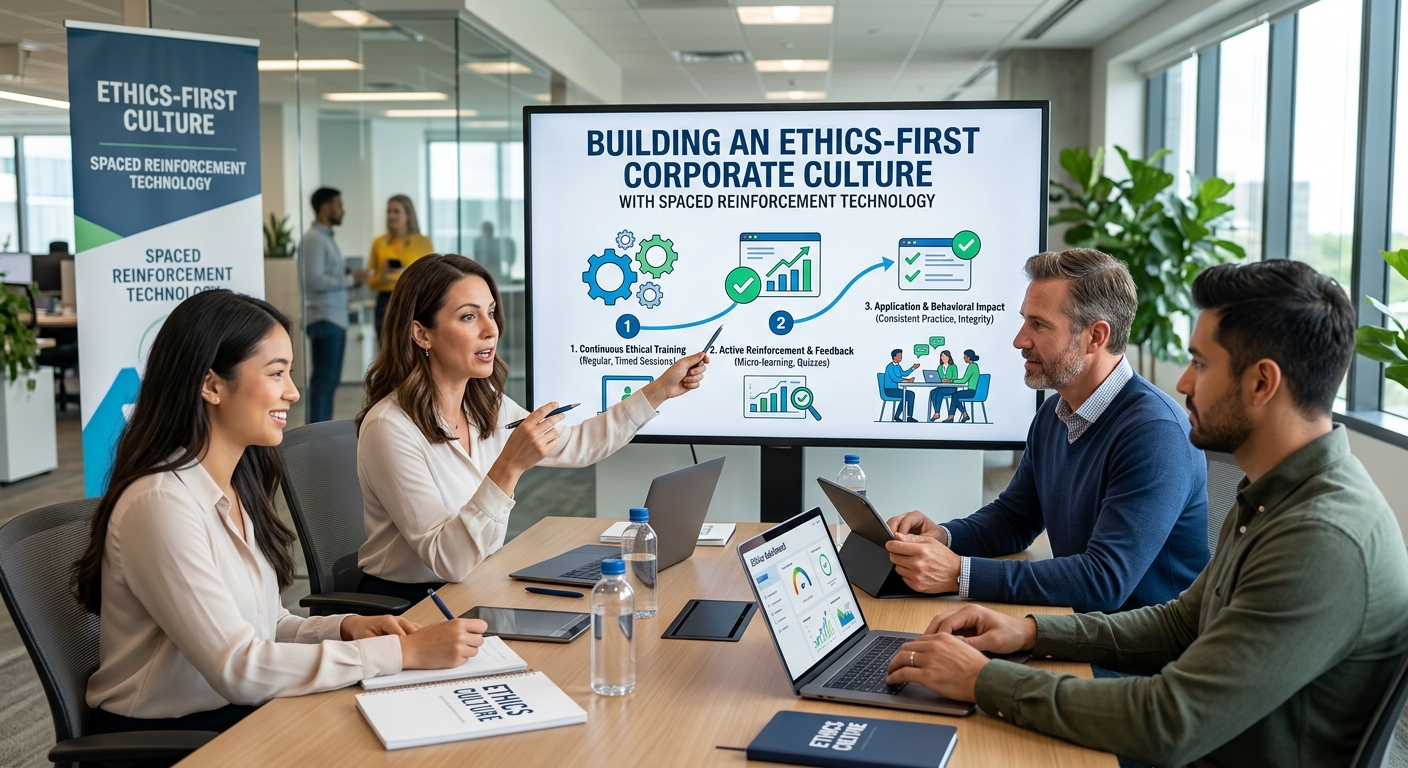
Building an Ethics-First Corporate Culture with Spaced Reinforcement Technology
In today's complex business landscape, an organization's ethical compass is more than just a moral obligation—it's a strategic imperative. From the board room to the front lines, a robust, ethics-first culture underpins trust, drives employee engagement, and safeguards reputation. Yet, cultivating and sustaining such a culture requires more than annual compliance videos or occasional workshops. It demands continuous reinforcement and innovative approaches that combat the natural decay of knowledge over time. This is where spaced reinforcement technology, powered by advanced learning management solutions, emerges as a game-changer for L&D leaders across industries like Compliance, Sales, Banking, Finance, Insurance, Retail, Pharma, Health care, Hospitality, Oil and Gas, and Mining.
The Imperative of an Ethics-First Culture
The consequences of ethical lapses can be devastating, ranging from hefty fines and legal battles to irreparable brand damage and loss of customer loyalty. Beyond external repercussions, a weak ethical framework erodes internal morale, fostering an environment of distrust and cynicism. Conversely, a strong ethical foundation:
- Enhances corporate reputation and brand equity.
- Fosters a culture of trust and transparency.
- Improves employee retention and attraction.
- Mitigates legal and financial risks.
- Drives sustainable long-term growth.
For L&D professionals, the challenge lies in moving ethics from a checkbox exercise to an ingrained organizational value. Traditional training, often characterized by lengthy modules and infrequent refreshers, frequently falls short. The "forgetting curve"—the psychological phenomenon where learned information is rapidly forgotten without reinforcement—is a particularly formidable foe in ethics education, where subtle nuances and situational judgment are key.
Transforming Ethics Training with Spaced Reinforcement Technology
Spaced reinforcement technology, rooted in cognitive science, is designed to counteract the forgetting curve. It works by presenting information in strategically timed intervals, prompting learners to recall and apply knowledge just as they begin to forget it. This active retrieval practice strengthens memory traces, leading to deeper, more lasting retention. When applied to ethics training, this approach ensures that critical principles, company policies, and best practices remain top-of-mind, translating into better decision-making in real-world scenarios.
An effective LMS (learning management system) serves as the backbone for delivering this kind of continuous, impactful training. Modern learning management software, especially a robust cloud based learning management system like MaxLearn LMS, allows organizations to deploy and manage sophisticated ethics programs that leverage spaced reinforcement.
The Role of Microlearning and Gamification
Spaced reinforcement thrives on brevity and engagement, making it a natural fit for Microlearning LMS approaches. Instead of long, cumbersome courses, ethics content is broken down into bite-sized modules—short videos, interactive quizzes, or scenario-based questions—that can be consumed quickly and easily. These micro-lessons are then reinforced through spaced recall prompts, ensuring key ethical dilemmas and resolutions are regularly revisited.
To further enhance engagement, integrating a Gamified LMS transforms compliance training from a chore into an interactive experience. Leaderboards, points, badges, and real-time feedback not only motivate learners to participate but also encourage them to master the content. When ethical dilemmas are presented as challenges to be overcome, and correct decisions are rewarded, employees become more invested in understanding and applying ethical principles.
Adaptive and AI-Powered Learning for Personalized Ethics Training
No two employees face identical ethical challenges, nor do they learn at the same pace or in the same way. This is where Adaptive Learning shines. An advanced learning content management system (LCMS) with adaptive capabilities can tailor the learning path based on an individual's performance, role, and even historical compliance record. If an employee consistently struggles with conflict-of-interest scenarios, the system can provide additional, targeted reinforcement on that specific topic, ensuring competency where it’s most needed.
Furthermore, an AI Powered Authoring Tool empowers L&D teams to create dynamic, relevant ethics content with unprecedented efficiency. AI can help generate scenario-based questions, identify emerging ethical risks based on industry trends, and even personalize case studies to resonate more deeply with specific departments or roles. This ensures that the ethics training provided through your enterprise learning management system is not generic but highly contextual and impactful.
Risk-focused Training for Critical Industries
For industries like Banking, Finance, Pharma, and Healthcare, where the stakes of ethical breaches are extraordinarily high, Risk-focused Training is paramount. By leveraging an intelligent learning management system, L&D leaders can pinpoint areas of highest risk within their organizations and design spaced reinforcement modules specifically addressing those vulnerabilities. For example, a financial institution might prioritize modules on insider trading or data privacy, while a pharmaceutical company might focus on ethical drug promotion or clinical trial integrity. This targeted approach ensures that the most critical ethical principles are reinforced most frequently and effectively.
Addressing Key L&D Concerns with Intelligent Learning Solutions
L&D leaders are constantly seeking ways to optimize their training initiatives for maximum impact and reach. Leveraging sophisticated learning management solutions can provide answers to common questions:
Question 1: How can we ensure our ethics training truly resonates with employees across all departments and fosters genuine engagement?
Answer: By adopting an adaptive, microlearning approach delivered through a MaxLearn LMS, training can be tailored to individual roles and learning styles. Scenario-based content, personalized feedback, and interactive elements, often found in a Gamified LMS, make the learning experience highly relevant and engaging. This move away from one-size-fits-all training to a personalized journey helps employees connect ethical principles to their daily responsibilities, driving deeper understanding and retention.
Question 2: In a globally distributed workforce, how can ethical standards be consistently upheld and reinforced, considering diverse regional norms and regulations?
Answer: A robust cloud based learning management system is essential for delivering consistent, yet localized, ethics training. With capabilities for multi-language content, regional compliance updates, and context-specific case studies created with an AI Powered Authoring Tool, organizations can ensure that universal ethical values are communicated effectively while respecting local nuances. Spaced reinforcement ensures these standards are regularly reinforced across all geographical locations, adapting delivery times and content as needed for optimal impact.
Question 3: What technological advancements can L&D leaders leverage to proactively identify potential ethical blind spots and continuously improve compliance education?
Answer: Modern learning management system platforms, particularly those with embedded analytics and machine learning capabilities, can continuously monitor learner performance, identify knowledge gaps, and predict areas of potential ethical risk. This data-driven approach allows for proactive adjustment of training content, the creation of new Risk-focused Training modules, and personalized interventions. This ensures that compliance education is not static but dynamically evolves to meet emerging challenges and reinforce an ethical culture.
Building Blocks for an Ethics-First Culture with an LMS Learning Management System
Implementing spaced reinforcement technology for ethics training requires a strategic approach:
- Leadership Commitment: Ethics starts at the top. Leaders must champion the initiative and visibly participate.
- Clear Policies & Code of Conduct: These are the bedrock upon which all training is built.
- Integrated Learning Management System: A powerful MaxLearn LMS is crucial for delivery, tracking, and reporting.
- Microlearning & Spaced Repetition: Break down complex ethical concepts into digestible, frequently reinforced segments.
- Gamification & Engagement: Make ethics training interactive, challenging, and rewarding.
- Adaptive Learning Paths: Personalize the learning journey to address individual needs and roles.
- Continuous Feedback Loops: Regularly solicit feedback and iterate on training content and delivery.
Conclusion
An ethics-first corporate culture is no longer a luxury but a fundamental necessity for organizational resilience and growth. By harnessing the power of spaced reinforcement technology, delivered through a sophisticated learning management system like MaxLearn LMS, L&D leaders can move beyond traditional, often ineffective, compliance training. This innovative approach, combining Microlearning LMS principles, Gamified LMS features, Adaptive Learning, and an AI Powered Authoring Tool, ensures that ethical principles are not just learned, but deeply embedded and consistently practiced. Invest in a future where ethical conduct is second nature, driving not just compliance, but true corporate excellence.
.jpg)


