

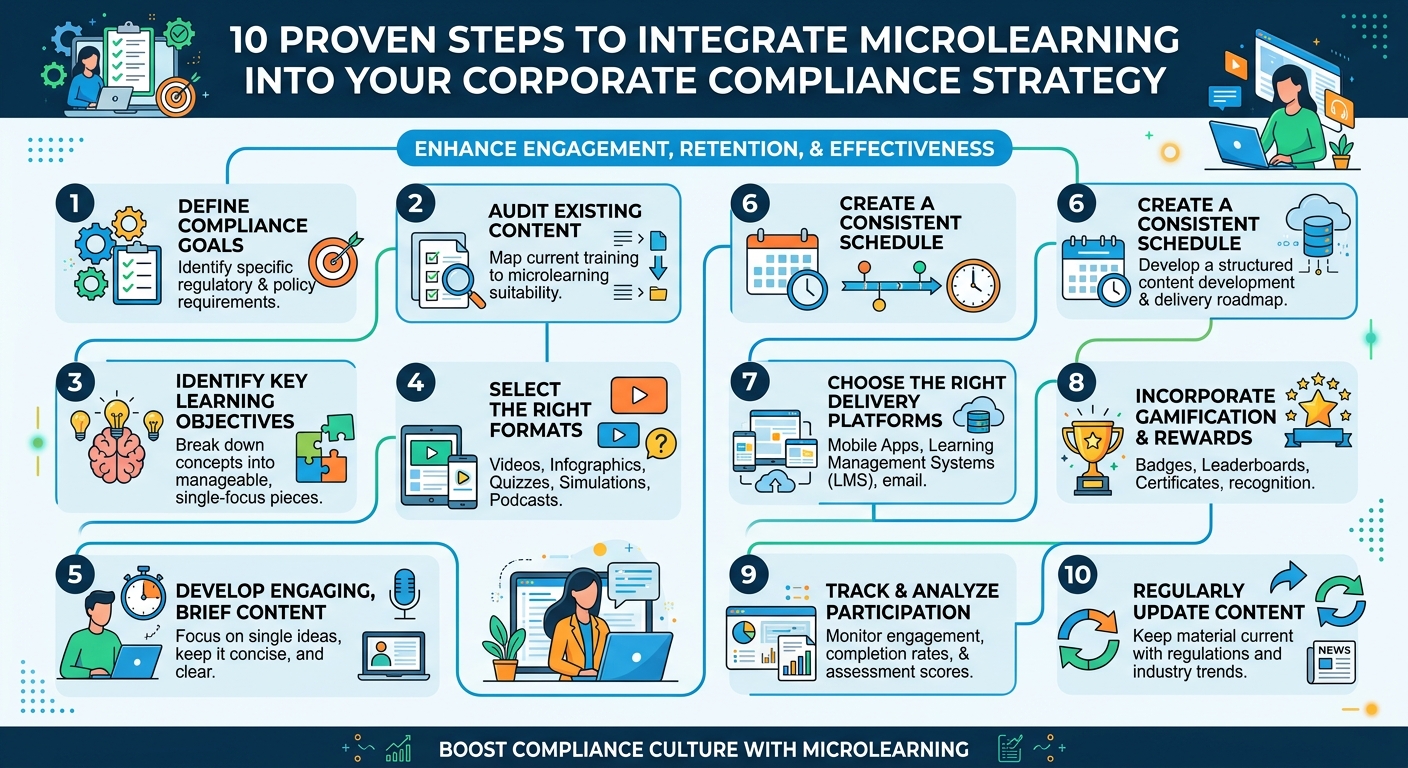
10 Proven Steps to Integrate Microlearning into Your Corporate Compliance Strategy
In today’s rapidly evolving business landscape, regulatory frameworks are becoming increasingly complex and stringent. For Vice Presidents, Directors, and Senior Managers of Learning & Development, ensuring robust and effective corporate compliance training is not just a regulatory necessity but a strategic imperative. Traditional, lengthy compliance courses often lead to information overload, poor retention, and a tick-box mentality. This is where microlearning emerges as a powerful, agile solution.
Microlearning, characterized by short, focused bursts of content designed to achieve a specific learning objective, offers a fresh perspective on compliance training. It addresses the modern learner's preference for on-demand, bite-sized information, making even the driest topics engaging and digestible. By breaking down complex regulations into manageable modules, companies across industries—from banking and finance to healthcare and retail—can achieve higher engagement, better knowledge retention, and ultimately, a more compliant workforce. Integrating microlearning effectively, however, requires a strategic, phased approach. Here are 10 proven steps to transform your compliance strategy with microlearning.
Step 1: Conduct a Comprehensive Compliance Content Audit
Before diving into microlearning creation, understand your existing compliance training landscape. Categorize all current materials by topic, target audience, format, and associated risks. Identify areas where traditional training is failing, perhaps due to low engagement or frequent non-compliance incidents. This audit provides the baseline for what needs to be converted or created anew.
Step 2: Define Clear Learning Objectives for Each Micro-Module
The essence of microlearning is its focus. For each compliance topic, break it down into granular learning objectives. Instead of "Understand GDPR," aim for "Identify personally identifiable information (PII)" or "Describe the process for data breach notification." Each objective should correspond to a single, actionable piece of knowledge or skill that a learner can acquire within minutes. A robust Microlearning LMS is instrumental in managing these granular objectives effectively.
Step 3: Chunk Content into Bite-Sized Segments
This is the core of microlearning. Take your well-defined objectives and create content segments that are typically 3-10 minutes long. These could be short videos, interactive quizzes, infographics, quick simulations, or brief scenario-based challenges. The goal is to deliver just-in-time, just-enough information to achieve one specific objective. An LMS with strong content management capabilities can help organize these segments efficiently.
Step 4: Incorporate Diverse and Engaging Formats
Varying content formats keeps learners engaged and caters to different learning styles. For compliance, consider:
- Short Animated Videos: Explaining complex regulations visually.
- Interactive Quizzes: Testing understanding immediately after a concept.
- Infographics: Summarizing key policies or procedures.
- Scenario-Based Mini-Games: Applying compliance rules to real-world situations.
- Audio Snippets: Quick policy updates for on-the-go learners.
How can an intelligent platform ensure that compliance training directly addresses the most common areas of learner confusion or critical information needs? An AI Powered Authoring Tool, for example, can analyze common search queries within an internal knowledge base or frequently asked questions to identify gaps, ensuring content is highly relevant and anticipatory of learner needs.
Step 5: Leverage Technology with a Powerful Learning Management System
A sophisticated Microlearning LMS is the backbone of your strategy. Look for a learning management system that supports a variety of content types, offers robust tracking and reporting, and provides an intuitive user experience. Features like mobile accessibility, progress tracking, and integration with other enterprise systems are crucial for seamless delivery. A modern learning management software can truly elevate your compliance program.
Step 6: Integrate Adaptive Learning Pathways
Not every employee needs the same training. An Adaptive Learning approach allows you to personalize compliance training based on an individual’s role, department, prior knowledge, or even past compliance breaches. For instance, a sales professional might focus on anti-bribery regulations, while a finance employee needs deeper insight into anti-money laundering. This ensures relevancy and efficiency. What if each employee's compliance journey could be uniquely tailored to their role, prior knowledge, and performance? A sophisticated Adaptive Learning system can achieve this, using algorithms to assess individual proficiency and recommend specific microlearning modules, thereby optimizing engagement and retention for personalized learning outcomes.
Step 7: Gamify for Engagement and Retention
Compliance doesn't have to be dull. Incorporating game-like elements can significantly boost engagement and memory retention. Badges, leaderboards, points, and friendly competitions motivate learners to complete modules and strive for mastery. A Gamified LMS can transform mandatory training into an enjoyable and rewarding experience, particularly effective for global enterprises with diverse employee demographics in sectors like retail and hospitality.
Step 8: Implement Regular Reinforcement and Spaced Repetition
The "forgetting curve" is a major challenge in compliance. Combat it with spaced repetition through microlearning. After an initial module, send out short quizzes, flashcards, or recap videos at increasing intervals (e.g., one day, one week, one month later) to reinforce key concepts. This cements knowledge and ensures long-term retention. MaxLearn LMS provides tools to manage such reinforcement schedules.
Step 9: Focus on Risk-Based Training and Real-World Scenarios
Prioritize microlearning modules based on the level of risk associated with non-compliance. Focus heavily on areas that could lead to significant legal, financial, or reputational damage. Present compliance in the context of real-world scenarios relevant to the learner's job function. This helps employees understand the practical implications of their actions and how compliance directly impacts their daily tasks and the company's success. Implementing Risk-focused Training through microlearning is critical for business growth and avoiding costly penalties. Considering global operations, how can a learning platform adapt content to specific regional regulations or cultural sensitivities? Advanced Adaptive Learning systems leverage data analytics to dynamically present modules pertinent to a learner's geographical location, ensuring local compliance without overwhelming them with irrelevant global policies.
Step 10: Measure, Analyze, and Iterate
The work doesn't stop once the microlearning modules are deployed. Continuously monitor completion rates, assessment scores, learner feedback, and most importantly, actual compliance behavior and incident reports. Use the data collected by your enterprise learning management system to identify areas for improvement. Are certain modules consistently showing low scores? Is there a particular regulation frequently misunderstood? Use these insights to refine existing content or create new micro-modules, ensuring your compliance strategy remains effective and agile. A powerful learning content management system allows for continuous optimization.
The Power of Microlearning for a Compliant Future
Integrating microlearning into your corporate compliance strategy is more than just a trend; it's a fundamental shift towards more effective, engaging, and measurable training. For organizations in highly regulated industries such as healthcare, pharmaceuticals, banking, and oil & gas, this approach ensures that critical information is not only delivered but truly understood and applied. By adopting these 10 proven steps and leveraging powerful learning management solutions, L&D leaders can build a culture of compliance that is proactive, resilient, and deeply embedded in the daily operations of their enterprise.
A cloud based learning management system like MaxLearn LMS provides the infrastructure to implement these strategies seamlessly, helping you navigate the complexities of corporate compliance with confidence and precision.
.jpg)


