

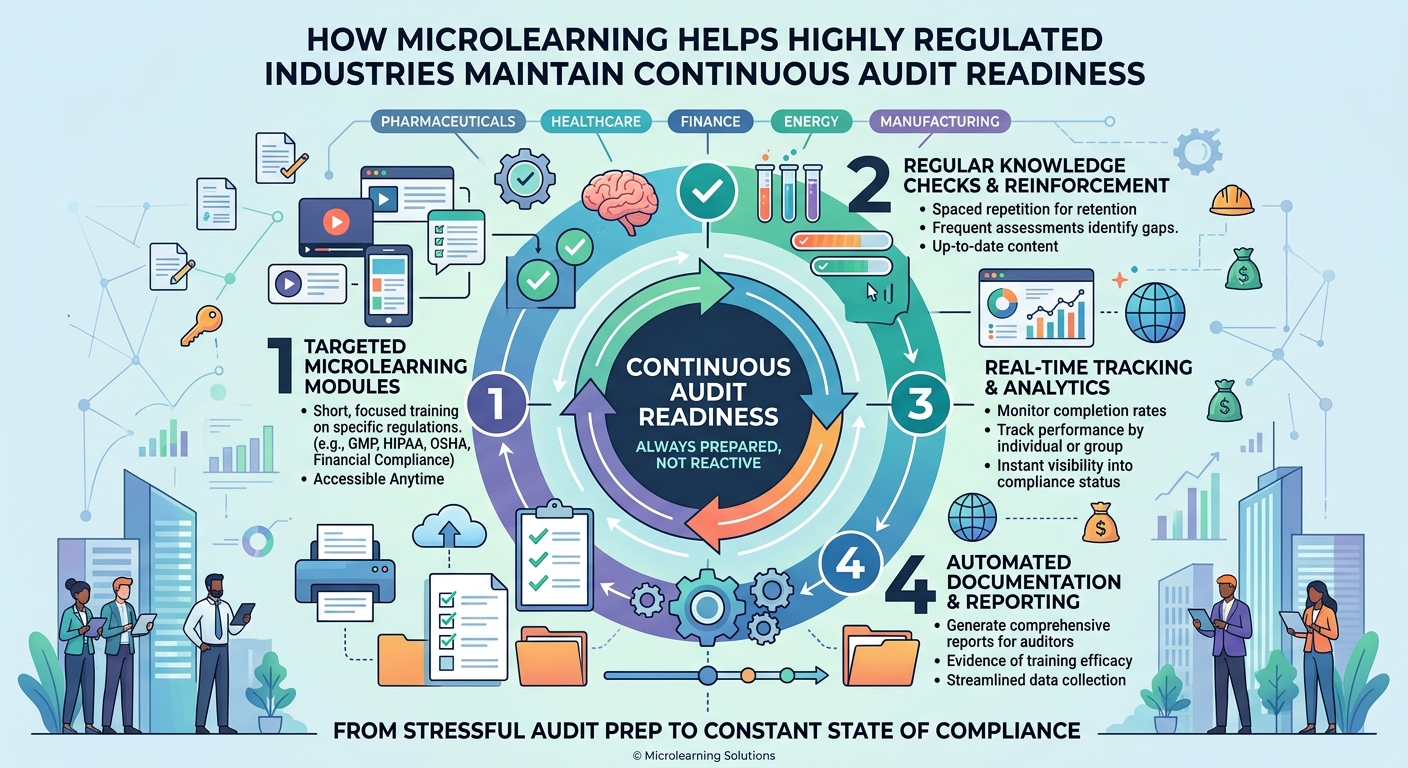
How Microlearning Helps Highly Regulated Industries Maintain Continuous Audit Readiness
In the high-stakes world of regulated industries—from banking, finance, and insurance to pharma, healthcare, and oil and gas—the pressure for continuous compliance is relentless. Organizations in these sectors navigate an ever-shifting landscape of stringent regulations, where a single oversight can lead to colossal fines, reputational damage, and even operational shutdowns. For L&D Vice Presidents, Directors, and Managers, the challenge isn't just delivering training; it's proving that every employee, at every level, possesses the precise knowledge and skills required to meet regulatory mandates at all times. This is where Microlearning LMS emerges not just as a training methodology, but as a strategic imperative for maintaining continuous audit readiness.
Traditional, lengthy training sessions often fall short in these dynamic environments. Information overload, poor retention rates, and the sheer pace of regulatory change render annual compliance courses largely ineffective for sustained readiness. What's needed is an agile, precise, and easily verifiable approach to learning. This article explores how microlearning, supported by a robust learning content management system, provides the critical solution for highly regulated industries to stay perpetually prepared for any audit.
The Regulatory Tightrope: Why Traditional Training Fails
Regulated sectors like retail, hospitality, mining, and healthcare operate under a magnifying glass. Compliance is not a 'nice-to-have' but the bedrock of their operations. However, the sheer volume and complexity of regulations pose significant challenges:
- Information Overload: Employees are swamped with extensive policies and procedures, leading to cognitive fatigue.
- Rapid Changes: Regulations evolve constantly, making it difficult to keep training materials current and employees updated.
- Proving Competence: Auditors demand concrete proof of understanding and application, not just completion certificates.
- Disruption to Operations: Long training sessions pull employees away from critical tasks, impacting productivity.
- Knowledge Decay: Information learned once quickly fades without regular reinforcement.
These challenges highlight the urgent need for a more effective, efficient, and measurable approach to compliance training. An advanced learning management system is key to addressing these issues.
Microlearning: Precision Learning for Critical Compliance
Microlearning delivers short, focused bursts of information, typically 3-10 minutes in duration, designed to achieve a specific learning objective. When integrated into an enterprise learning management system, it transforms compliance training into a manageable, continuous process. Here’s how:
1. Enhancing Knowledge Retention and Application
One of the biggest hurdles in compliance training is ensuring that critical information sticks. Microlearning combats the "forgetting curve" by delivering information in easily digestible chunks, ideal for complex topics like those found in financial regulations or pharmaceutical protocols. These bite-sized modules are perfect for just-in-time learning, allowing employees to access specific compliance information exactly when they need it—perhaps before handling a sensitive customer transaction in banking or preparing a hazardous material in oil and gas. This immediate application significantly boosts retention and reinforces the practical relevance of the training.
2. Agility in Responding to Regulatory Updates
Regulatory landscapes are fluid. A new directive in insurance, an updated data privacy law in retail, or a revised safety standard in mining can emerge with little warning. Traditional training struggles to keep pace. With microlearning, updating compliance training becomes a streamlined process. Instead of overhauling an entire course, L&D teams can quickly create or modify individual modules focusing on the new regulation, deploying them instantly across the organization via a cloud based learning management system. This agility ensures that your workforce is always operating with the most current information, a non-negotiable for continuous audit readiness.
3. Measurable Competency and Proactive Risk Mitigation
Auditors don't just want to see that training happened; they want proof of understanding and competence. A sophisticated MaxLearn LMS integrated with microlearning provides robust tracking and analytics. Every micro-module, quiz, and interaction can be recorded, allowing L&D leaders to:
- Identify specific knowledge gaps at individual, team, or departmental levels.
- Track completion rates and performance on critical compliance topics.
- Generate comprehensive reports demonstrating training effectiveness and regulatory adherence.
This granular data enables Risk-focused Training, allowing organizations to proactively address weak spots before an audit uncovers them. It shifts compliance from a reactive scramble to a proactive, data-driven strategy.
4. Efficiency, Engagement, and Cost-Effectiveness
Microlearning significantly reduces the time employees spend away from their primary duties, making it highly efficient. Its concise nature also makes it more engaging, especially when combined with elements of a Gamified LMS. Short, interactive modules prevent boredom and encourage active participation, leading to better learning outcomes. From a cost perspective, creating and updating microlearning content is often less resource-intensive than developing lengthy courses, offering a higher ROI on your compliance training investment.
Leveraging Intelligent Technologies for Superior Compliance Training
The synergy between microlearning and advanced technological platforms—especially those powered by smart algorithms—is revolutionizing compliance training. These platforms transform how learning is delivered, managed, and optimized, providing unparalleled advantages for regulated industries.
Q&A on Advanced Learning Optimization:
Q: How do intelligent learning systems ensure content is always perfectly aligned with an individual's knowledge gaps and regulatory requirements, leading to optimal performance?
A: Modern learning management software utilizes sophisticated algorithms to analyze a learner's past performance, job role, and specific compliance mandates. This allows for Adaptive Learning paths, where the system intelligently delivers personalized, bite-sized modules that directly target identified weak areas or new regulatory updates. By focusing only on what’s needed, training becomes incredibly efficient and highly relevant, ensuring employees gain and retain the exact knowledge required for their role’s compliance, making them continuously audit-ready.
Q: In a world of complex, global regulations, what role does advanced technology play in harmonizing compliance understanding and training across diverse global operations?
A: Advanced technological platforms, such as a robust learning management system, leverage intelligent automation to centralize and standardize compliance training globally. These systems can instantly disseminate critical regulatory updates, translate microlearning content into multiple languages, and track competency across different regions in real-time. This ensures that every employee, regardless of their location, receives consistent, up-to-date, and culturally relevant compliance training. Such global harmonization is critical for multinational corporations in finance, pharma, or energy sectors, simplifying multi-jurisdictional audits and demonstrating uniform adherence to global standards.
Q: Beyond just training delivery, how can smart algorithms contribute to proactively demonstrating regulatory adherence and providing insights into an organization's audit preparedness?
A: Intelligent learning content management systems go beyond simply delivering courses. They aggregate vast amounts of learning data—from module completion and quiz scores to interaction patterns and time spent on specific topics. Smart algorithms then analyze this data to identify potential compliance risks, predict areas where employees might struggle, and highlight departments or regions that require additional support. An AI Powered Authoring Tool can even assist in generating content to address these identified gaps. This predictive capability transforms audit preparation from a reactive scramble into a continuously proactive process. L&D and compliance teams can generate detailed, evidence-based reports that not only demonstrate training efficacy but also forecast potential vulnerabilities, allowing them to pre-emptively reinforce training and address issues before an auditor even asks.
Real-World Impact Across Industries
The benefits of microlearning within a sophisticated learning management system extend across numerous regulated sectors:
- Banking & Finance: Ensuring staff are updated on AML, KYC, and data privacy regulations through quick, searchable modules.
- Pharma & Healthcare: Delivering critical updates on drug protocols, patient safety, and regulatory changes (e.g., FDA, HIPAA) without disrupting patient care.
- Insurance: Keeping agents current on policy changes, claims processing, and ethical selling practices.
- Oil and Gas & Mining: Providing just-in-time safety procedures, environmental regulations, and operational compliance training.
- Retail & Hospitality: Training on food safety, hygiene, customer data protection, and anti-discrimination laws.
In each case, microlearning provides a nimble and effective solution that traditional training cannot match.
Conclusion: The Future of Compliance is Micro
For L&D leaders in highly regulated industries, the shift to microlearning is no longer an option but a necessity. It is the most effective way to ensure that employees are consistently updated, deeply knowledgeable, and fully compliant with the ever-evolving regulatory landscape. By adopting a modern learning management system that champions microlearning, organizations can:
- Significantly improve knowledge retention and application.
- Respond with unparalleled agility to regulatory changes.
- Gain granular, verifiable proof of competency for auditors.
- Boost engagement and efficiency while reducing training costs.
- Leverage intelligent systems for proactive risk identification and continuous optimization.
Investing in a comprehensive, cloud based learning management system built around microlearning is investing in your organization’s future stability, reputation, and continuous audit readiness. It empowers your workforce with the critical knowledge they need, exactly when they need it, ensuring that your organization remains resilient and compliant in the face of constant scrutiny.
.jpg)


