

How to Tailor Compliance Content for Executive Leadership vs. On-the-Ground Staff
In today's complex regulatory landscape, effective compliance training is not merely a checkbox exercise; it's a strategic imperative. Yet, a one-size-fits-all approach to compliance content often falls flat, failing to resonate with the diverse needs and priorities of an organization's workforce. For Vice Presidents, Directors, and Senior Managers in Learning & Development, the challenge lies in crafting content that speaks directly to the strategic vision of executive leadership while simultaneously providing practical, actionable guidance for on-the-ground staff.
Bridging this gap is crucial for fostering a culture of compliance, mitigating risks, and ensuring operational excellence across industries from Banking and Finance to Pharma, Healthcare, and Oil and Gas. This article will explore how to strategically differentiate and tailor compliance content to maximize its impact on both ends of the organizational spectrum, leveraging modern LMS capabilities to achieve this.
Understanding Your Audiences: Two Distinct Perspectives
Before tailoring content, it's essential to deeply understand the unique perspectives, motivations, and information needs of each group.
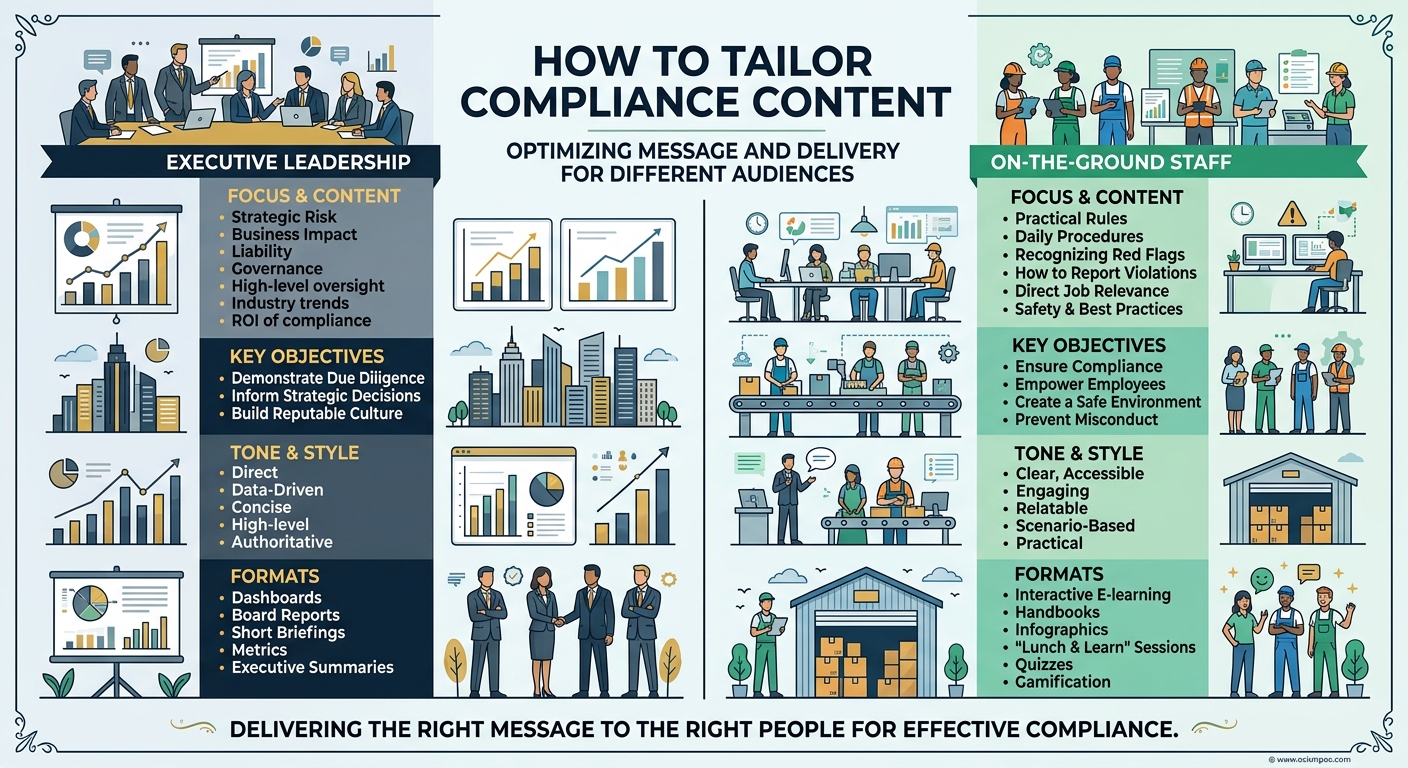
Executive Leadership: The Strategic Imperative
Executive leaders operate at a high level, focused on the big picture. Their concerns revolve around:
- Risk Mitigation: How does non-compliance impact the company's reputation, legal standing, and financial health? They want to understand potential liabilities and how training reduces them.
- Strategic Impact: How does compliance training align with business objectives, market position, and long-term growth?
- Return on Investment (ROI): What is the measurable value of the training? How does it protect assets and drive efficiency?
- Regulatory Adherence: Assurances that the organization meets all industry-specific and governmental regulations, whether in Retail, Hospitality, or Mining.
- Ethical Culture: How the training reinforces the company’s values and ethical standards.
On-the-Ground Staff: The Practical Application
Frontline employees, managers, and operational staff need to understand how compliance applies directly to their daily tasks and responsibilities. Their focus is on:
- "What do I need to do?": Clear, actionable instructions and procedures.
- "Why is this relevant to my job?": Real-world scenarios that demonstrate the direct impact of their actions.
- "How do I do it correctly?": Practical guidance and tools to ensure correct execution.
- Consequences: Understanding the immediate and personal impact of non-compliance on their role or team.
- Efficiency: How to integrate compliance practices seamlessly into their workflow without hindering productivity.
Tailoring Content for Executive Leadership
For executives, compliance content needs to be concise, data-driven, and focused on strategic implications. Think executive summaries, not detailed manuals.
- High-Level Overviews: Provide summary reports, dashboards, and infographics highlighting key risks, training completion rates, and performance metrics.
- Focus on Outcomes and Impact: Emphasize how effective compliance reduces fines, improves reputation, enhances customer trust, and safeguards shareholder value. Use case studies illustrating the financial and reputational costs of non-compliance versus the benefits of strong compliance.
- Strategic Insights: Connect compliance training directly to broader business objectives. For example, in Sales, how compliance training prevents legal issues that could jeopardize major deals.
- Data Visualization: Present complex data through clear charts and graphs that quickly convey progress, areas of concern, and the effectiveness of compliance initiatives. A robust learning management system can generate these reports effortlessly.
- AI-enhanced Optimization for Executive Decision-Making:
- Q: How can intelligent systems help us gain a comprehensive overview of our organization's compliance posture across all subsidiaries and departments, informing strategic resource allocation?
- A: Advanced analytical dashboards, powered by machine learning, can aggregate data from various compliance modules, highlighting high-risk areas, training gaps, and overall adherence trends. This allows leaders to make informed decisions about where to focus resources for maximum impact on enterprise learning management.
- Q: What insights can sophisticated data analysis tools provide regarding the broad impact of compliance training on key business indicators and operational risks?
- A: Predictive analytics can correlate training engagement and performance with incident rates, audit findings, and even financial metrics, providing a clear picture of the training's return on investment and its role in preventing costly errors or penalties. This approach transforms compliance from a cost center into a strategic value driver.
Tailoring Content for On-the-Ground Staff
For frontline employees, content must be practical, engaging, and directly applicable to their daily tasks. They need to understand the "what" and "how" immediately.
- Microlearning Modules: Break down complex topics into short, digestible Microlearning LMS chunks that can be consumed quickly, often on demand. This is particularly effective for busy staff in industries like Manufacturing or Healthcare, where time is critical.
- Scenario-Based Training: Use real-world examples and interactive simulations relevant to their specific roles. For instance, a retail employee might practice handling a customer data privacy request, while a healthcare worker might navigate HIPAA regulations.
- Gamification: Incorporate elements like points, badges, leaderboards, and interactive challenges to increase engagement and retention. A Gamified LMS can make even dry compliance topics more appealing and memorable.
- Job Aids and Checklists: Provide easily accessible resources that employees can refer to in the moment of need, reinforcing training and ensuring correct procedures are followed.
- Adaptive Learning Paths: Utilize an Adaptive Learning approach that customizes the learning journey based on an individual's knowledge gaps, role, and prior performance. This ensures relevant and efficient training, avoiding redundant content.
- AI-enhanced Optimization for Individualized Learning:
- Q: How can intelligent algorithms personalize compliance training, ensuring each employee receives content most relevant to their specific job function and learning style?
- A: Learning platforms can leverage machine learning to analyze an individual's role, previous performance, and engagement data to dynamically curate a personalized learning pathway. This means an employee in Finance receives modules specific to financial regulations, while an HR professional focuses on data privacy, all at their own pace.
- Q: What role do smart assistants and AI-driven feedback loops play in making compliance training immediately actionable and supportive for frontline staff?
- A: AI tutors can provide real-time feedback on simulations, answer compliance questions, and guide employees through complex scenarios. This immediate, personalized support reinforces correct behaviors and clarifies ambiguities on the spot, turning passive learning into active problem-solving.
The Role of a Robust Learning Platform
Implementing a segmented compliance training strategy requires a powerful learning management system. A comprehensive Microlearning LMS or an advanced learning content management system (LCMS) provides the tools necessary to:
- Segment Audiences: Easily group learners by role, department, location, or other relevant criteria.
- Deliver Varied Content Formats: Support video, interactive simulations, documents, quizzes, and gamified elements.
- Track and Report Progress: Generate detailed reports for executives on compliance status and provide individual progress tracking for staff.
- Automate Assignments: Assign specific training paths based on an employee's profile, ensuring relevant and timely compliance education.
- Utilize AI Powered Authoring Tool: Expedite content creation and adaptation, ensuring compliance material is always up-to-date and tailored.
- Focus on Risk-focused Training: Identify critical areas of non-compliance risk and deliver targeted content to address them proactively.
Choosing a cloud based learning management system like MaxLearn LMS ensures scalability, accessibility, and robust features for effective enterprise learning management.
Implementation Best Practices
To successfully tailor compliance content, consider these best practices:
- Content Mapping: Develop a comprehensive matrix that maps specific compliance regulations to relevant job roles and their corresponding training needs.
- Stakeholder Collaboration: Involve legal, HR, and departmental heads to ensure content accuracy and relevance for both executive and staff levels.
- Continuous Feedback Loops: Regularly collect feedback from both groups to refine content and delivery methods. For staff, surveys and quick polls within the learning management software can be effective.
- Regular Updates: The regulatory landscape constantly changes. Ensure your learning content management system allows for easy and frequent updates to compliance materials.
- Leverage Analytics: Use the data from your lms learning management system to identify areas where training is effective and where it needs improvement for specific audiences. This forms the basis for continuous improvement in your learning management solutions.
Conclusion
Tailoring compliance content for executive leadership and on-the-ground staff is not just a best practice; it's a strategic necessity for any organization committed to effective risk management and a strong ethical culture. By understanding the distinct needs of each audience and leveraging advanced LMS features, L&D professionals can create a compliance training program that is both strategically insightful for executives and practically actionable for every employee. This targeted approach ensures that compliance is not just understood, but truly integrated into the fabric of the organization, driving resilience and sustainable growth across all industries.
.jpg)