

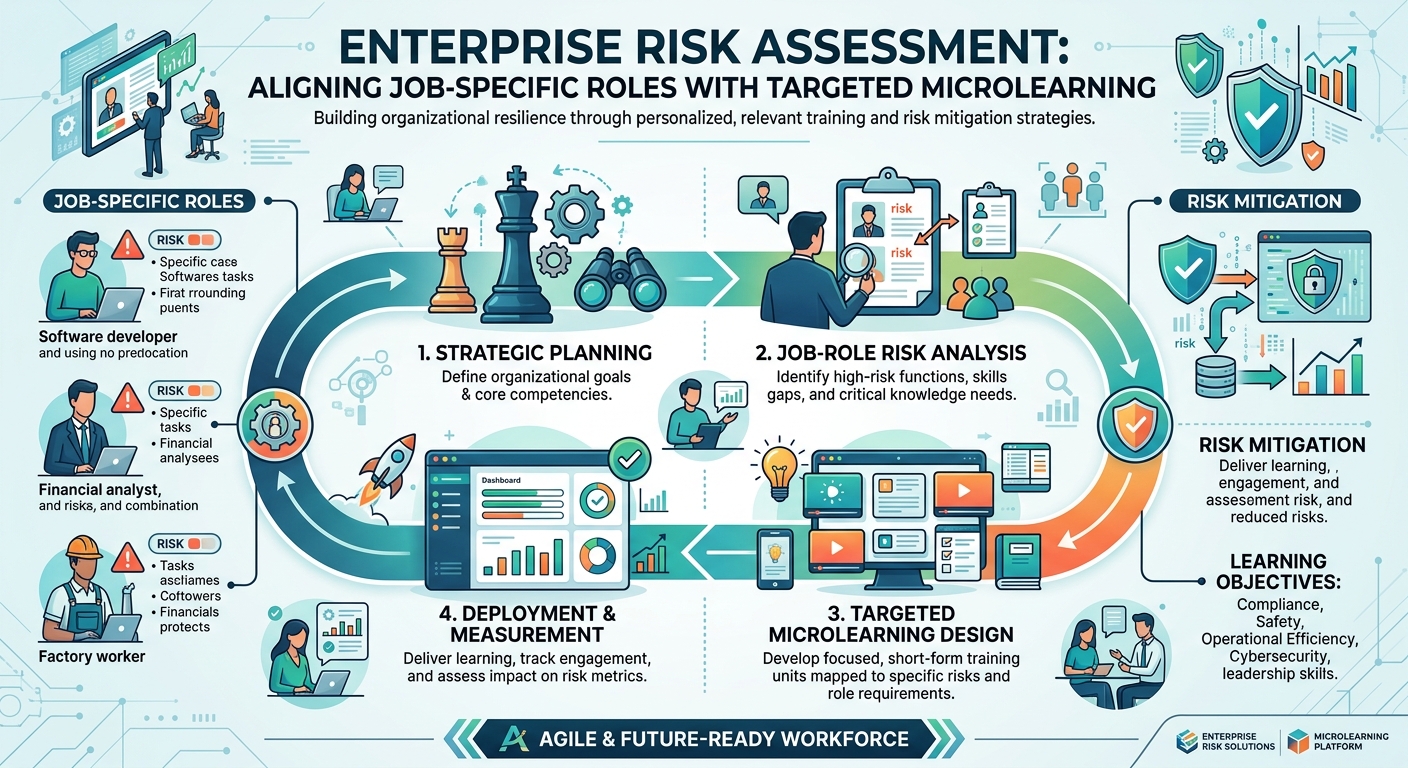
Enterprise Risk Assessment: Aligning Job-Specific Roles with Targeted Microlearning
In today’s complex business environment, navigating risks is no longer just a compliance checkbox; it's a strategic imperative. For Vice Presidents, Directors, and Senior Managers in Learning & Development (L&D), the challenge lies in transforming broad enterprise risk assessments into actionable, job-specific training that truly mitigates threats. Traditional, one-size-fits-all training often falls short, leading to disengagement and knowledge gaps. This is where the power of targeted microlearning, meticulously aligned with individual roles and risk profiles, becomes a game-changer.
The imperative for robust enterprise learning management systems capable of delivering precise, impactful training has never been clearer. Organizations across banking, finance, insurance, retail, healthcare, and beyond are grappling with an ever-evolving landscape of regulatory, operational, cybersecurity, and market risks. An effective learning management system (LMS) is the backbone for delivering this crucial education.
The Evolving Landscape of Enterprise Risk and L&D’s Crucial Role
From data privacy breaches in healthcare to supply chain disruptions in retail, and from financial fraud in banking to safety hazards in oil and gas, risks are diverse and pervasive. An enterprise risk assessment helps identify these potential pitfalls, but the real challenge for L&D leaders is translating these findings into meaningful behavioral change. Generic annual compliance training often fails to resonate with employees because it lacks direct relevance to their daily responsibilities. This is where an advanced learning management software solution shines, enabling granular content delivery.
For L&D professionals, the goal is to build a culture of risk awareness where every employee understands their specific role in maintaining organizational resilience. This requires a shift from broad-stroke education to highly focused, contextualized learning experiences – a shift perfectly facilitated by microlearning strategies delivered via a modern Microlearning LMS.
Why Traditional Training Falls Short in Risk Mitigation
Traditional training methodologies, often characterized by lengthy e-learning modules or classroom sessions, struggle to keep pace with the dynamic nature of risk. Key shortcomings include:
- Information Overload: Too much information at once leads to poor retention.
- Lack of Context: Generic content fails to connect with specific job functions.
- Disengagement: Long, mandatory sessions can be perceived as tedious.
- Slow Updates: Content becomes outdated quickly in fast-changing regulatory environments.
These issues highlight the need for a more agile, employee-centric approach, which is precisely what a powerful MaxLearn LMS offers.
Microlearning: The Precision Tool for Risk-focused Training
Microlearning, characterized by bite-sized, focused learning modules, is ideally suited for addressing the nuances of enterprise risk. By breaking down complex risk topics into easily digestible segments, it ensures higher engagement and better retention. Imagine a bank teller receiving a 3-minute module on identifying suspicious transactions, or a pharmaceutical sales representative getting a 2-minute refresher on new compliance guidelines – immediately applicable and impactful.
This approach moves beyond simply "checking the box" on training. It embeds risk awareness directly into the workflow, empowering employees with timely, relevant knowledge. A robust learning content management system is essential for organizing and deploying these granular pieces of content efficiently.
Aligning Microlearning with Job-Specific Roles
The true power of microlearning in enterprise risk assessment lies in its ability to be hyper-personalized. L&D leaders can leverage detailed risk assessments to map specific risks to specific job roles and then create bespoke microlearning paths. This requires an intelligent lms learning management system that supports this level of customization.
- Sales Teams: Focus on ethical selling practices, data privacy, and anti-bribery regulations, perhaps delivered through a Gamified LMS to boost engagement.
- Banking & Finance: Modules on AML (Anti-Money Laundering), KYC (Know Your Customer), fraud detection, and regulatory compliance.
- Healthcare: HIPAA compliance, patient data security, medical device safety protocols.
- Oil and Gas: Safety procedures, environmental regulations, emergency response.
- Retail: Inventory shrinkage prevention, data security for customer transactions, workplace safety.
This level of precision is achievable through Adaptive Learning platforms, which tailor content delivery based on an individual's role, performance, and learning needs.
Leveraging Technology for Next-Generation Risk Education
To effectively implement a job-specific microlearning strategy for risk, L&D departments need powerful technological allies. A modern learning management system (LMS) is not just a repository; it's an ecosystem for continuous learning and risk mitigation.
How can L&D departments precisely identify and address specific risk training gaps across diverse job roles?
Advanced analytical tools within a comprehensive learning management system can pinpoint skill deficiencies and knowledge gaps by correlating job roles with risk assessment data. By tracking engagement and completion rates for targeted microlearning modules, L&D teams gain granular insights into where specific roles require more attention. This data-driven approach allows for the dynamic assignment of relevant micro-courses, ensuring that training directly addresses identified vulnerabilities rather than applying a generic curriculum. Furthermore, integrating performance metrics with training data provides a clear picture of training effectiveness at an individual and departmental level, enabling continuous refinement of the risk education strategy.
What comprehensive approach ensures that risk education remains current and impactful in a rapidly changing regulatory and threat landscape?
Maintaining the currency and impact of risk education in a volatile environment demands a continuous, agile approach. This involves leveraging an AI Powered Authoring Tool to rapidly create and update microlearning content as new risks emerge or regulations change. Implementing feedback loops from incident reports and internal audits directly into the content development process ensures that training remains relevant to real-world scenarios. Regular, automated content reviews, coupled with user performance data from the cloud based learning management system, allow L&D to proactively refresh modules. This dynamic system ensures that employees always have access to the most up-to-date information, fostering a culture of perpetual learning and adaptation to evolving risks.
In what ways can advanced technological platforms optimize the delivery and effectiveness of job-specific risk learning?
Cutting-edge technological platforms, such as a robust learning management solutions offering an enterprise learning management suite, optimize risk learning through personalization, accessibility, and sophisticated analytics. Such a platform can automatically assign specific microlearning paths based on an employee's role, department, and prior assessment results. Mobile accessibility ensures that essential risk information is available on-demand, whenever and wherever it’s needed. The use of AI-driven recommendation engines can suggest relevant modules, while interactive elements like quizzes and simulations within a Gamified LMS enhance engagement and knowledge retention. Moreover, detailed reporting capabilities provide L&D leaders with actionable insights into individual and organizational risk readiness, allowing for precise adjustments to training strategies and demonstrating clear ROI on Risk-focused Training initiatives.
Key Components of a Successful Risk-focused Microlearning Program
Implementing a comprehensive Risk-focused Training strategy involves several critical elements:
- Granular Content Design: Break down complex topics into short, focused modules (e.g., 2-5 minutes). An AI Powered Authoring Tool can significantly expedite this process.
- Contextual Relevance: Each module must directly relate to specific job duties and risk exposure. This is where Adaptive Learning shines.
- On-Demand Accessibility: Employees should be able to access training when they need it most, often directly from their workflow. A Microlearning LMS excels here.
- Interactive and Engaging Formats: Use video, quizzes, simulations, and scenarios to keep learners engaged. A Gamified LMS can significantly enhance this aspect.
- Continuous Updates: Risk landscapes change rapidly. The learning management software must allow for quick content revisions and deployment.
- Performance Measurement: Track completion rates, comprehension scores, and ultimately, real-world impact on risk incidents.
An integrated learning management system (LMS) that functions as a sophisticated LCMS (Learning Content Management System) is vital for managing, updating, and distributing this targeted content at scale across the organization.
Conclusion: Building Resilience with Strategic Microlearning
For L&D leaders, the alignment of enterprise risk assessment with job-specific, targeted microlearning represents a powerful strategy for building a more resilient, compliant, and ultimately, more successful organization. By embracing a modern MaxLearn LMS that supports microlearning, adaptive paths, and AI-driven content creation, you can transform risk training from a daunting obligation into an engaging, impactful, and continuously evolving asset. This strategic investment in learning management solutions not only mitigates potential threats but also fosters a proactive culture of awareness and responsibility, ensuring that every employee understands and contributes to the organization's overarching risk management goals. Embrace the future of Risk-focused Training and empower your workforce with the precise knowledge they need, when they need it.
.jpg)


